Get Full Government Meeting Transcripts, Videos, & Alerts Forever!
Get email alerts on the Budget Fy26 topic
No spam. Unsubscribe anytime.
School board approves FY26 budget adjustments including vacancy contingency, PTR increases and two Best homeschool satellites
Summary
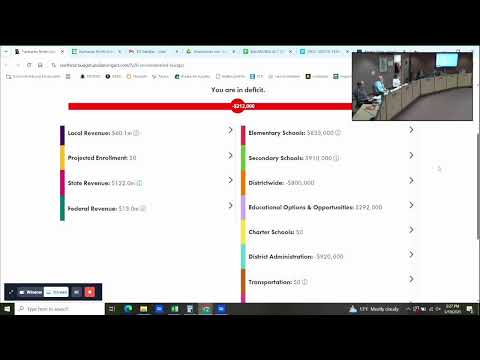
The Fairbanks North Star Borough School District board on March 19 moved a series of FY26 budget choices intended to close a shortfall while keeping core services, approving a 0.65% vacancy contingency, modest PTR increases, a $500,000 reduction in central administration and two Best homeschool satellites.
The Fairbanks North Star Borough School District board on March 19 moved a series of FY26 budget choices intended to close a shortfall while keeping core services. After extended discussion the board approved increasing the district budgeted vacancy contingency to 0.65% (about $1,040,000), raised elementary pupil‑teacher ratio (PTR) targets and secondary PTRs, accepted a $500,000 reduction to district administration staffing, restored the annual teacher laptop replacement repayment of $650,000, and approved opening Best homeschool satellite sites at 2 Rivers and Midnight Sun with a teacher at each site.
The actions were taken during a reconvened meeting that resumed the FY26 proposed budget conversation the board began the prior day. In opening the discussion, President Burnett reminded members they would proceed line‑by‑line through districtwide categories before making votes.
Why it matters: The board balanced competing priorities — keeping classroom supports, preserving administrative capacity, restoring capital replacement funding and expanding homeschool services — while acknowledging the district will draw on fund balance if state funding does not materialize. Several board members described the vacancy contingency as an accounting tool to smooth year‑to‑year volatility; others warned that treating the contingency as an operating source is effectively spending fund balance.
Vacancies and fund balance
Board member Maria Julian (board member) argued for a 1% vacancy contingency, noting it is a conservative accounting practice used by other large districts and would represent a projected $1,600,000 saving if implemented. Julian said the practice “minimizes the unnecessary cuts to programs and services on the front end during the budgeting process.” Finance director Mister DeGraw (business manager) told the board that actual vacancy levels “are constantly fluctuating on a daily basis” and that deriving a precise savings figure is difficult because of varying substitute, contracted service and utility costs. The board initially moved to budget a 0.5% vacancy (about $800,000) by motion, then later increased that to 0.65% (about $1,040,000) after further balancing work to reach a small positive variance in the tool the administration uses to model the budget.
Pupil‑teacher ratios and projected enrollment
As part of the budget package the board adjusted PTR targets across grades: elementary PTR was approved at 26, grades 6–8 at 29, and grades 9–12 at 32. Board members framed the three votes as a package intended to protect secondary elective and advanced offerings while accepting modest increases at the elementary level. Several members opposed raising elementary PTRs, saying the district is already stretching elementary capacity in some neighborhoods; others argued that spreading impacts is preferable to larger increases at the secondary level.
The administration’s projected enrollment for FY26 — 11,626 students, a 1.5% decline from FY25 — remained unchanged. Business manager DeGraw told the board the enrollment projection had been prepared with multiple factors in mind and that changing it now would be premature.
Administration staffing, curriculum and technology
The board accepted the administration’s self‑proposed $500,000 reduction in district administration staffing. Several members said further cuts would risk critical central services; others argued that additional reductions were needed to preserve classroom staffing. The board also restored the teacher‑laptop replacement annual contribution ($650,000), which DeGraw said had a zero balance in the replacement fund and would be required to meet the normal replacement cycle. The regular instruction supplies line (an increase of roughly $70,000 for K–12) remained in the budget by consensus.
Best homeschool satellites
The board voted to establish Best homeschool satellite offices at 2 Rivers and Midnight Sun (North Pole) and to provide a teacher at each location. The administration described the two satellite investments — $165,000 for 2 Rivers and $127,000 for Midnight Sun (about $292,000 combined) — as intended to grow the program and reduce long bus rides for families. Superintendent Doctor Minor confirmed the plan includes two additional education specialist positions to staff the satellites; board members discussed caseload comparisons and asked that caseload triggers be used to justify further staffing if enrollment grew.
Transportation subsidy and other items
The board debated reducing the transportation subsidy from the proposed $2,000,000 to $1,500,000 but the motion to lower the subsidy failed; the proposed $2,000,000 subsidy remained. Members noted the governor had proposed a statewide transportation increase in his budget but said relying on that funding posed a risk. Other line items discussed and retained in the proposed budget included charter‑related assumptions (handled separately), equipment replacement and minimal charter administration charges.
Votes at a glance
- Budget for vacancies moved to 0.5% (motion by Maple; initial roll call: Hardy — yes; Maple — yes; Burgess — yes; Julian — yes; Carol Hubbard — yes; Doran — no; Burnett — yes) — motion carried. - Later amendment to increase vacancy contingency to 0.65% (~$1,040,000) — motion carried (roll call recorded in minutes). - Move elementary PTR to 26 — motion carried (roll call recorded: several yes/no votes as recorded in minutes). - Move grades 6–8 PTR to 29 and grades 9–12 PTR to 32 — motion carried. - Accept $500,000 district administration staffing reduction (proposed by administration) — motion carried. - Restore teacher laptop replacement annual repayment ($650,000) — restored by unanimous consensus (no formal roll call). - Approve Best homeschool satellites at 2 Rivers and Midnight Sun and add one teacher at each site (includes two additional ed‑specialist positions) — motion carried (roll call recorded). - Transportation subsidy: motion to reduce to $1,500,000 failed; $2,000,000 subsidy retained.
What’s next
The board recessed and scheduled a brief reconvene the following day to finalize the recommended FY26 budget after administration updated the district’s balancing tool to reflectapproved changes. Board members acknowledged continued risk from state funding uncertainty and that the final approved budget may change if the Legislature or governor alter school funding assumptions.
Attributed speakers in this article are those who appear in the meeting record: President Deborah Burnett (board president), Missus Richardson (board clerk), Doctor Minor (Superintendent), Mister DeGraw (business manager), Maria Julian (board member), Miss Maple (board member), Mister Dorn (board member), Mister Burgess (board member), Miss Carol Hubbard (board member), Mister Doran (board member), Missus Hardy (board member).
Ending: The board closed the evening after scheduling a 5:00 p.m. reconvened meeting the next day to take a final vote on the recommended FY26 budget.