McGill study lays out seven options, wide cost gap for Appomattox County solid-waste plan
Loading...
Summary
A consultant presented seven disposal and processing options — from continued hauling to a $102 million waste-to-energy plant — and ranked them primarily by total 20‑year cost. The board later approved a $47,300 payment to McGill & Associates to complete the county's solid‑waste study.
Mark Cathy, vice president and regional manager at McGill & Associates, presented a 20‑year comparison of seven solid‑waste management options to the Appomattox County Board of Supervisors, outlining capital, operating and revenue assumptions and projecting costs and tons managed for each scenario.
The study, commissioned last year, examined continuing direct haul from convenience centers; building a county transfer station; partnering with a private transfer station; reactivating previously permitted cells at the county landfill; building a new county landfill on county‑owned property; selling the site to a private landfill developer; and developing a waste‑to‑energy facility. The Region 2000 landfill, which currently accepts much of the county’s waste, is estimated in the presentation to run out of permitted airspace around 2029.
McGill’s cost comparisons used a 20‑year planning horizon and a set of escalation assumptions for salaries, hauling, disposal and equipment. Cathy told the board the analysis focused on “total cost” to the county over that period, and highlighted wide differences between alternatives.
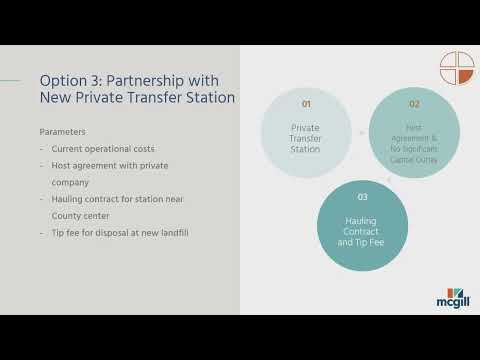
Major findings and illustrative 20‑year totals presented by McGill: - Direct haul to the nearest municipal solid‑waste (MSW) landfills: roughly $40 million total; about 132,460 tons managed; average cost per ton about $303. - County‑owned transfer station (county builds and operates): roughly $57 million; 132,460 tons; average cost per ton about $431 (higher capital outlay for construction and equipment replacement drives costs). Option 2b (adding commercial waste) increased tons but produced a lower average per‑ton cost because of scale. - Partnership with a private transfer station (county host agreement, private capital): roughly $31.5 million; 132,460 tons; average about $238 per ton — the lowest county out‑of‑pocket cost in McGill’s models because the private partner bears capital expense. - Reactivate previously permitted landfill cells (sales J and K): roughly $69 million; about 1.3 million cubic yards of airspace estimated; average cost per ton presented at higher levels in McGill’s model but with substantial county engagement and permitting responsibilities. - New county landfill on county property (desktop estimate): roughly $69 million; about 41 acres and 2.7 million cubic yards estimated from preliminary topographic review; average cost per ton similar to the reactivated cells scenario. - Private landfill developed on county property (sell to private developer, negotiate host agreement): McGill estimated the county’s 20‑year net cost at roughly $27.6 million assuming a private developer bears major capital costs. - New waste‑to‑energy facility: McGill estimated capital and operating costs near $102 million in the model used; the firm emphasized the large tonnage required for economic scale, lengthy air‑quality permitting and the need to secure residual disposal for ash. McGill noted existing U.S. facilities serving large metropolitan areas and several Virginia facilities that have closed, and said permitting for a waste‑to‑energy project could take many years.
Cathy told supervisors the private landfill or a private transfer‑station partnership appeared most favorable on total county cost, while a county landfill would give the county “control” of disposal but would raise capital exposure. He warned that bringing in outside waste can shorten landfill life even as it helps pay capital costs — a classic tradeoff county leaders would have to weigh. Cathy also said McGill used conservative assumptions for revenues (for example, tipping fees and recycling) and escalators for salaries, hauling and capital replacement.
Supervisors pressed McGill on schedule and permitting. McGill said permitting timelines vary by option; a transfer station or reopening a previously permitted cell should not take a decade under normal permitting processes but political and site‑specific issues can extend schedules. McGill reiterated the Region 2000 landfill expiration (presented as about 2029) as a driver for near‑term decisions.
Board action tied to the study: later in the meeting the supervisors approved a transfer of $47,300 from the general fund to professional services to pay McGill & Associates for the solid‑waste study. That transfer motion was moved and seconded during the consent and finance items; the board voted to approve the payment.
Why it matters: Appomattox County currently handles roughly 5,700 tons per year in the county waste stream; the Region 2000 authority’s capacity outlook, rising disposal and construction costs, and several policy and local‑control considerations mean the next steps the board chooses could alter capital needs, operating costs and the county’s long‑term fiscal exposure.
Looking ahead: McGill recommended the county investigate potential private partners and host agreements, refine market capture assumptions (how much out‑of‑county tonnage can realistically be attracted), and complete due diligence on county property for a possible new cell. Supervisors asked staff to continue vetting options and to return with more detailed financials and permitting timelines as needed.
Ending: The presentation gave supervisors quantitative comparisons but did not produce an immediate policy choice; the board approved McGill’s invoice and directed staff to continue work and to report back so the board can consider next steps before Region 2000’s projected capacity constraints.