Get Full Government Meeting Transcripts, Videos, & Alerts Forever!
Get email alerts on the Labor Restaurants Tipped Workers topic
No spam. Unsubscribe anytime.
House advances bill letting local governments address restaurant tip offsets
Summary
Lawmakers debated House Bill 1208, the "restaurant relief" bill that would give local governments limited authority over tip offsets for tipped employees. Sponsors said the measure preserves local control to stem restaurant closures; opponents said it risks reducing pay for low-paid, tipped workers and may raise constitutional issues.
House members on Tuesday debated House Bill 1208, known in session as the Restaurant Relief Act, which would give local governments authority to address the tip offset that employers may use when calculating compliance with a local minimum wage.
Sponsors said the measure responds to restaurant closures and job losses in Denver and other cities, and that it preserves local control; opponents warned the change could reduce some tipped workers’ pay and questioned whether the legislature has authority to alter the state’s $3.02-per-hour tip-offset limit in the constitution.
Representative Woodrow, prime sponsor and member of the Finance Committee, told colleagues, “It is an honor to stand before you and present HB 25 12 08, the restaurant relief act,” and framed the bill as a compromise arrived at after stakeholder discussions. Woodrow said the bill would allow local governments to “address their tip offsets” and said Denver has seen the bulk of closures, arguments he said justify local flexibility.
Co-prime sponsor Representative Valdez, who represents downtown Denver, described visible restaurant vacancies and cited job losses, saying, “If you have been out to eat in Denver, you have noticed there are no more back waiters. ... Our goal is to stop that.” Valdez urged members to support the amendment that grants partial local control.
Opponents including Representative Zokai and Representative Garcia said the proposal still risks cutting pay for low-income tipped workers. Representative Zokai argued the bill “takes money out of the pockets of workers” and warned it could make wage theft easier by increasing confusion over tip-offset calculations; Garcia, a former server, said wage cuts are not the right solution and urged a no vote.
Representative Zokai also raised a constitutional concern, pointing to language in current law that limits tip offsets to no more than $3.02 per hour and saying that changing that limit without a vote of the people risks a legal challenge.
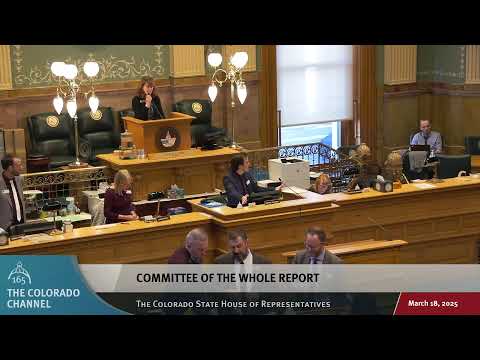
The Finance Committee report on HB 1208 was adopted on the floor; a voice vote was recorded with the speaker noting “the ayes have it and the committee report passes.” The Committee of the Whole later reported HB 1208 as passed on second reading and placed it on the calendar for third-reading final passage. A floor tally for final passage was not specified in the transcript.
Clarifying details repeated on the floor included the current Denver minimum wage cited by sponsors ($18.81 an hour) and a $3.02-per-hour tip-offset figure referenced by multiple members as the existing statutory cap that they said limits the legislature’s options. Sponsor remarks also included anecdotal numbers (Representative Valdez cited up to 22,000 jobs lost in Denver), presented as the sponsor’s account of local impacts.
Because the transcript records committee and second-reading actions but not a final third-reading vote for HB 1208 during this session, the bill remains on the calendar for a later final passage vote.
Ending: The bill’s sponsors framed the measure as a local-control compromise intended to preserve restaurants and jobs; opponents said it risks reducing wages for the state’s lowest-paid tipped workers and could face constitutional challenge. Floor action moved the bill forward to third reading.