Get Full Government Meeting Transcripts, Videos, & Alerts Forever!
Get email alerts on the Comprehensive Plan Update topic
No spam. Unsubscribe anytime.
Ashland County planning committee adopts citizen member, sets timeline and outreach steps for comprehensive plan update
Summary
The Ashland County Planning Committee voted to include citizen Charlie Ortman as a leader for one element of the county comprehensive plan and agreed on a roughly 12‑ to 18‑month timetable for gathering department, township and public input as it prepares to bring Northwest Regional Planning on as a consultant.
The Ashland County Planning Committee voted to include citizen Charlie Ortman as a leader for one element of the county comprehensive plan and agreed on a roughly 12‑ to 18‑month timetable for gathering department, township and public input as it prepares to bring Northwest Regional Planning on as a consultant.
The committee’s action to add Ortman came during its March 19 meeting in Ashland County. The motion to include Charlie Ortman as a citizen member to lead one plan element was made by Pat Kenny and seconded by Bradley Ray; the committee approved the motion by recorded verbal “ayes” (vote counts not specified in the meeting transcript). Ortman, newly approved by the county board as a citizen member, told the committee, “I’m free to participate however the committee sees fit. What I’m not free to do is commit the city to any kind of activity without talking to them first and getting the approval of the council or the department.”
Why this matters: the committee is beginning work to update the county comprehensive plan and is aligning three workstreams — departmental input, municipal/township input and public outreach — so a consultant can assemble a draft. Committee members emphasized the need to gather usable background data, accommodate low‑and‑moderate income and senior residents, and design outreach that does not rely solely on online surveys.
Most important decisions and next steps
- The committee agreed on a rough schedule: invite and seek input from county departments and committees by June, reach out to townships and other governmental units by about September, hold public input meetings (and any legally required hearings) later in the year, and expect a consultant‑drafted plan by the following March for subsequent revisions and public review.
- Dan Grady, county planning staff, told the committee that the Ashland County board is scheduled to vote next Wednesday on hiring Northwest Regional Planning; representatives from that firm will present their approach and timeline to the board if hired.
- Committee members discussed the Community Development Block Grant (CDBG) funding timeline and the option of pre‑accepting CDBG funds at next week’s board meeting to shorten the grant acceptance window. Erica (staff) said the board could pre‑accept CDBG funding so work could begin more quickly if the grant is awarded, but she cautioned there may be no operational benefit to forcing the acceptance at the next meeting and suggested timing the acceptance to match consultant needs.
Outreach, workspace and survey plans
Committee members agreed to centralize incoming documents in a shared Outlook folder. Rachel (staff) said she set up the folder and a generic outreach email address for public responses (countyoutreach@ashlandcounty.wa) so inquiries would funnel to staff rather than individual committee members. She asked that committee members forward any topic‑specific files to staff for upload.
Members also prioritized designing a suite of short, targeted surveys for different audiences — departments, committees, municipalities and general public — and discussed multiple distribution methods. Pat cautioned that online surveys will undersample residents without reliable broadband, and committee members proposed supplementing electronic outreach with paper surveys and in‑person visits to senior centers and town meetings.
Substantive discussion highlights
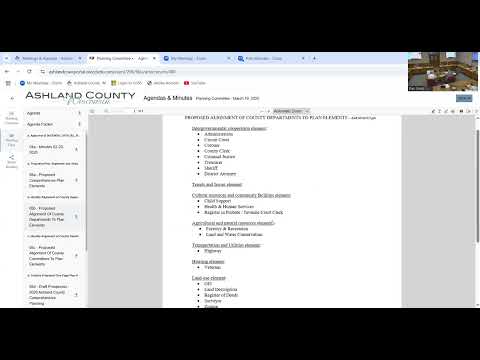
- Grouping of plan elements: Alyssa and others recommended keeping community facilities together with utilities (as a single element) because they said those topics tend to involve large, county‑level service providers and shared subject‑matter experts. Several members said the exact groupings can be adjusted later once work groups begin meeting.
- Use of existing plans: Multiple members urged staff and the consultant to pull in existing department plans (forestry, land and water conservation, pre‑disaster mitigation, etc.) so the comprehensive plan aligns with ongoing department work and does not duplicate or conflict with those documents.
- Public engagement approach: Members recommended holding informal public input meetings rather than relying solely on formal hearings for initial public comment. The committee acknowledged it must meet any statutory hearing requirements but favored flexible outreach (in‑town meetings, senior lunch visits, surveys) to gather substantive input.
Votes and formal motions
- Agenda approval: motion passed (verbal ayes recorded; vote counts not specified in the transcript).
- Minutes approval (prior meeting): motion passed (mover: Charlie Ortman; second: Liz Branick; verbal ayes recorded; vote counts not specified in the transcript).
- Inclusion of citizen member Charlie Ortman as a leader on one plan element: motion passed (mover: Pat Kenny; second: Bradley Ray; outcome: approved; verbal ayes recorded; vote counts not specified in the transcript).
What the committee did not decide
The committee did not finalize the detailed membership of every element work group, the exact survey text, or the formal public hearing dates; members agreed to return with drafts at the next meeting and to synchronize scheduling with Northwest Regional Planning once that firm’s availability is known.
Ending: next meeting and follow up
The committee set a tentative placeholder for a meeting at 1 p.m. on April 23, to be finalized to accommodate Northwest Regional Planning’s schedule. Committee members asked staff to circulate a draft agenda and proposed surveys in advance so the group can act quickly after the county board’s decision on consultant selection.