Get AI Briefings, Transcripts & Alerts on Local & National Government Meetings — Forever.
Committee splits on $3.5 million appropriation for Yuma Center of Excellence for Desert Agriculture; SB 1083 fails
Loading...
Summary
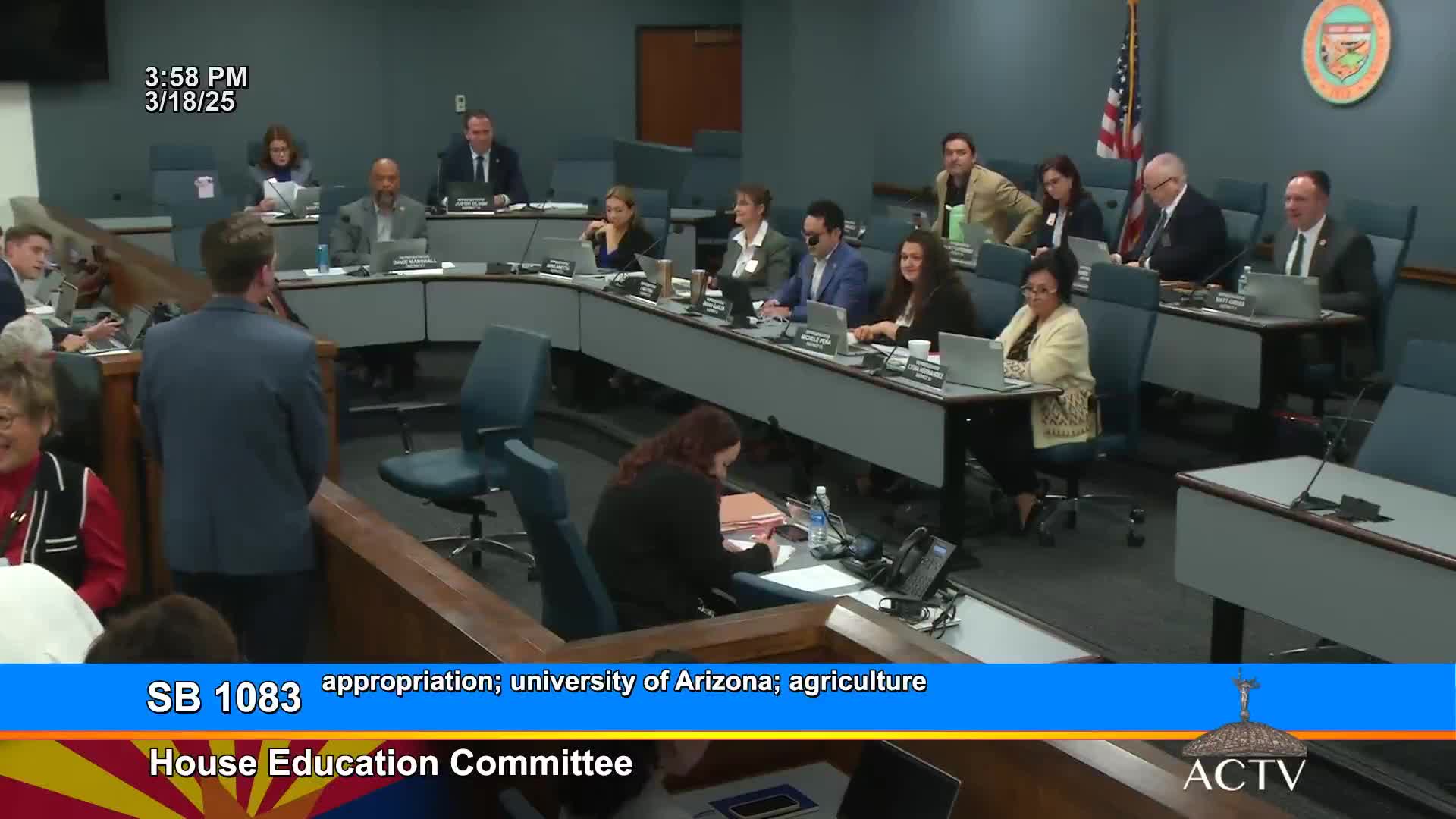
The House Education Committee voted to defeat Senate Bill 10‑83 after hearing testimony on a $3.5 million ongoing appropriation to the University of Arizona for the Yuma Center of Excellence for Desert Agriculture.
The Arizona House Education Committee considered Senate Bill 10‑83, a proposal to appropriate $3,500,000 from the state general fund in fiscal year 2026 to the University of Arizona for the Yuma Center of Excellence for Desert Agriculture (YCEDA). The committee heard detailed testimony from the bill sponsor and YCEDA leadership and then declined to advance the bill.
Senator Tim Dunn, the sponsor, said the center is a public‑private partnership formed about 10 years ago to address water, soil health and production challenges unique to Yuma’s winter vegetable industry. He described YCEDA as a “special operations” research unit that partners with University of Arizona faculty, industry and federal agencies to pilot region‑specific solutions for arid agriculture.
Dr. Tanya Hodges, identified in testimony as executive director of WICIDA / the Yuma Center of Excellence for Desert Agriculture and a University of Arizona employee, said the requested $3.5 million would scale a suite of roughly 10 priority initiatives — for example, a Desert Soil Health Initiative (DASHI), water‑use efficiency projects and field‑scale trials — and provide “engine” funding to hire researchers, pay overhead and enable rapid response to urgent problems. Hodges said the center’s operating overhead is roughly $500,000 and that project grants and collaborative funding have totaled millions; she said the center had received about $7 million in grant awards and participated in $31 million in collaborative efforts.
Committee members focused on two questions: how the $3.5 million would be spent in year one, and whether the appropriation should be made while state universities experienced budget cuts. Representative Fink asked for a detailed short‑term expenditure plan; Hodges and Senator Dunn said the YCEDA board has an internal expenditure plan and that the appropriation is designed to grow research capacity and leverage additional grant funding. Lawmakers pressed whether the funds would go to overhead, direct research, salaries, or to leverage other grants. Hodges said the funding would be used for a mix of hiring, startup research and to build initiatives that attract outside grants.
Several members expressed concerns about state priorities. Representative Gutierrez and others noted recent cuts to university budgets and questioned whether special program funding should take priority over core university funding or school nutrition programs; some members asked whether the University of Arizona itself should provide more base funding. Representative Olsen and Representative Marshall said they supported the program goals but were uncomfortable approving a $3.5 million ongoing appropriation without a detailed line‑item plan or measures of success.
After public comment and questioning, the committee voted 5 ayes and 7 nos; the chair announced the bill failed to pass the committee. Members and the sponsor agreed to continue dialogue and to provide additional information to the committee for future consideration.