
Adams 12 leaders warn of significant budget shortfall as teachers plan Capitol action
Get AI-powered insights, summaries, and transcripts
Sign Up Free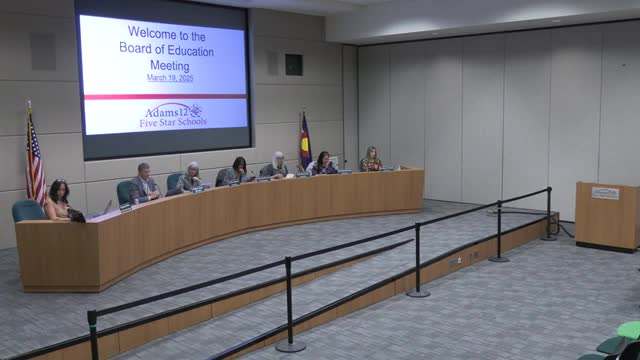
Summary
District leaders told the board and the public that changes in state school finance calculations and falling Medicaid direct-certifications will cut revenue next year, prompting modeling of painful reductions; teachers and parents urged legislators to restore funding during public comment and ahead of a planned walkout.
Superintendent Chris Gadowski told the Adams 12 Five Star Schools Board of Education that state changes to the School Finance Act and lower direct-certification through Medicaid will reduce the district's funded pupil count next year and create a substantial budget gap.
Gina Lanier, the district's chief financial officer, said the statewide inflation factor for the School Finance Act is 2.3 percent, but the district expects a year-over-year funded pupil decrease of about 905.4 students under four-year averaging and a modified implementation of HB 1448. That shift, Lanier said, explains most of the projected drop in revenue and contributes to what the district models as a very tight 2025-26 budget.
The projection also reflects a roughly 6 percent decline in the district's free-and-reduced-lunch direct certifications after federal COVID-era Medicaid verification changes were rescinded, Lanier said. "Those were lifted, I think last year. And so this was the first year since COVID that people had to prove their eligibility to remain Medicaid eligible," she said.
Why it matters: board members, staff and public commenters framed the shortfall as a driver of planned demonstrations at the state Capitol and potential local cuts that could affect staffing, services and programs. Board members and administrators said they are modeling options that include the use of one-time reserves but warned that long-term reductions would require ongoing revenue or deeper cuts.
In explaining modeling choices, Gadowski said the district expects about $15.6 million in one-time resources (largely available fund balance) and is weighing whether to use one-time funds for staff compensation increases or to preserve them for ongoing obligations. He and other administrators said they have prioritized preserving step and lane increases for certificated and classified staff where possible, but acknowledged that sustaining those commitments without added revenue will be difficult.
Lanier said the district would not move forward with an elementary math curriculum adoption next year, noting the district recently implemented combined benchmark reading and writing work and prefers to let that change settle instead of layering another major adoption.
Public comment at the meeting focused heavily on funding and the walkout planned for the Capitol. Several teachers and district staff described long classroom hours, shrinking support services and program cuts since 2011. Jonathan Rethinger, a long-time teacher, said, "We are too invested in their becoming to see them abandoned by a line item veto," and described collective action as a last resort to secure resources for students. Tricia LaRue told the board the state remains underfunded by about $4 billion and said the district faces cuts larger than any since 2011.
Board discussion and next steps: administrators said they will update the board after the final School Finance Act language is adopted (Lanier said they hope for clarity by May 7), continue scenario modeling, brief principals and stakeholder groups, and prepare an amended budget once October pupil counts are finalized. The board asked staff to emphasize transparent timelines and humane staffing notices for employees if reductions become necessary.
The meeting recorded no formal budget vote; administrators presented information and directed district teams to continue modeling and to brief principals and staff ahead of final decisions.
The board and staff repeatedly framed the problem as partly structural: Colorado's statewide funding formula, differences in local mill-levy overrides, and demographic trends such as declining birth rates and out-migration are all factors the district cited in explaining why local options alone will not bridge the gap.