Get Full Government Meeting Transcripts, Videos, & Alerts Forever!
Get email alerts on the Education Curriculum Aapi topic
No spam. Unsubscribe anytime.
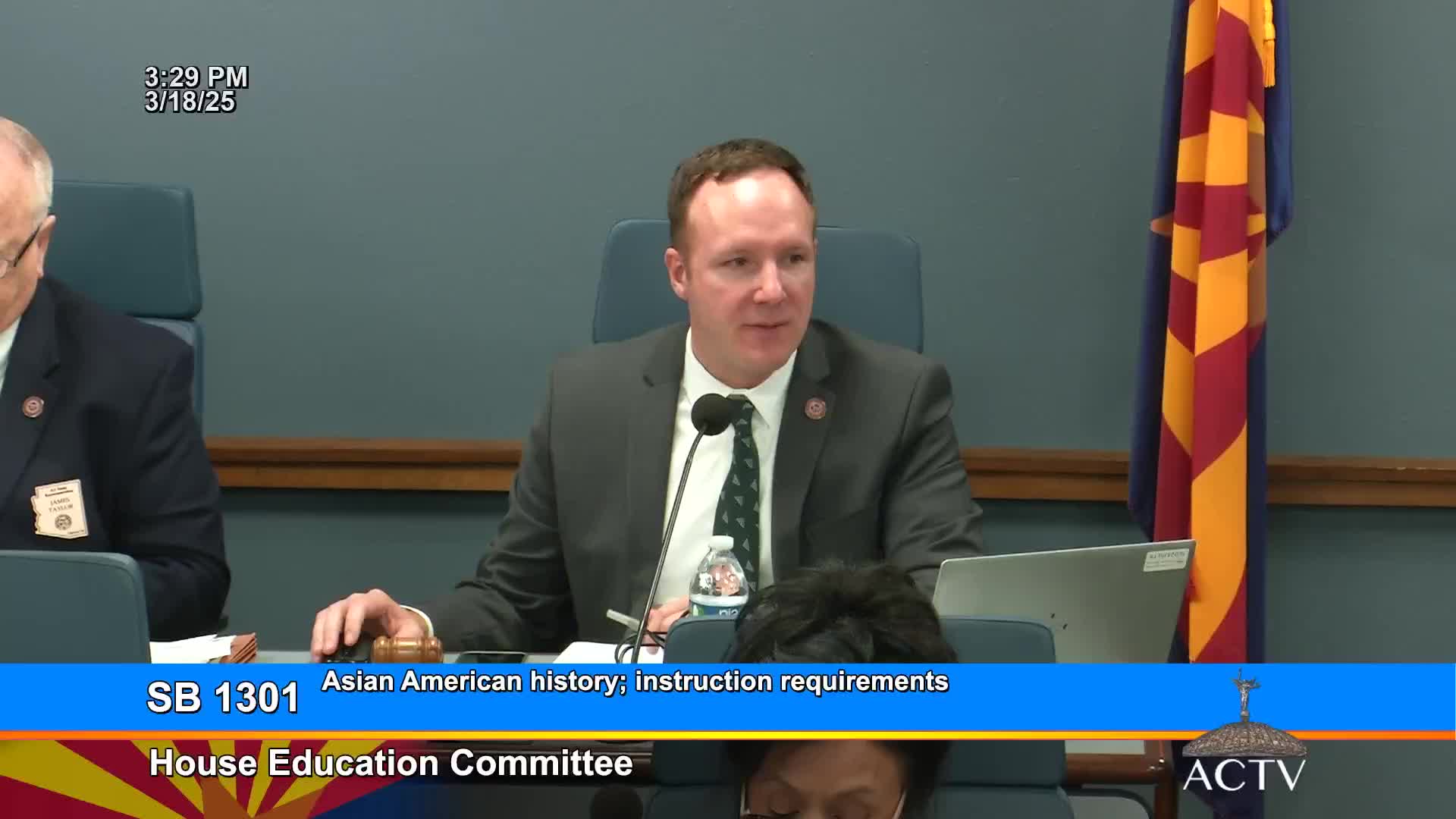
House education committee gives SB 1301 due pass to require instruction on Asian American, Native Hawaiian and Pacific Islander history
Summary
The Arizona House Education Committee voted to return Senate Bill 13‑01 with a due‑pass recommendation after testimony for and against a measure that would require instruction on Asian Americans, Native Hawaiians and Pacific Islanders in public school curricula.
The Arizona House Education Committee voted to return Senate Bill 13‑01 with a due‑pass recommendation after public testimony both for and against the measure and comments from the bill sponsor.
SB 13‑01 would require instruction on the history of Asian Americans, Native Hawaiians and Pacific Islanders in Arizona public school curricula. The bill directs the Arizona Department of Education and the State Board of Education to require, by June 14, 2029, and annually thereafter, that school districts and charter schools attest that the instruction is planned, ongoing and systematic. The measure does not prescribe a specific number of hours or require a particular grade level; it says the State Board will set standards and that local educators and communities will participate in developing content.
Senator John Kavanagh, the bill sponsor, told the committee the measure fills a gap in current standards, which he said mention Asian Americans minimally and omit Native Hawaiians and Pacific Islanders. “There is currently no requirement anywhere in the curriculum to teach anything about Native Hawaiians and Pacific Islanders,” Kavanagh said. He described the proposal as limited in scope — not a full semester course — and said it leaves curricular decisions to educators and community stakeholders.
Supporters said the measure would increase representation and help reduce prejudice. Andy Lim, who identified himself as president of a community organization, called SB 13‑01 “a critical piece of legislation” that would help combat anti‑Asian hate by teaching students historical contributions and context. Dalton Walker, a 10‑year‑old public school student, and family members also spoke in favor, saying instruction would help students understand classmates’ backgrounds.
Opponents urged caution about process and local control. Noah James Markham, speaking as a Native Hawaiian, asked the committee to ensure the State Board of Education and educators follow “the right procedures” and consult affected communities. Several representatives who explained their votes told the committee they favored State Board involvement in standards and were concerned about unfunded mandates and teacher training. Representative Abathia and others said curriculum adoption should follow established State Board and local school board review processes; Representative Gutierrez, a classroom teacher, said the bill does not include funding or training to prepare teachers and called it an “unfunded mandate.”
After questions and discussion, the committee voted to return the bill with a due‑pass recommendation. The roll call result recorded by the secretary was 7 ayes, 4 nos, 1 present, 0 absent.
The bill will now proceed through the legislative process with the committee’s recommendation; the statute would require the State Board of Education and ADE to phase in attestations beginning in 2029, aligning with the next social studies standards update, according to testimony.
Votes at this hearing reflected the split between members who wanted the State Board to act to fill a perceived curriculum gap and members who urged guaranteeing local‑level review, added resources and teacher training before imposing a statewide requirement.