Get Full Government Meeting Transcripts, Videos, & Alerts Forever!
Get email alerts on the Digital Assets Policy topic
No spam. Unsubscribe anytime.
Senate commerce committee advances package of cryptocurrency measures, including legal-tender definition and state reserve provisions
Summary
The Arizona Senate Commerce Committee on March 19 advanced three related cryptocurrency measures, voting 6-4 on each to send them forward with due-pass recommendations.
The Arizona Senate Commerce Committee on March 19 advanced three related cryptocurrency measures, voting 6-4 on each to send them forward with due-pass recommendations.
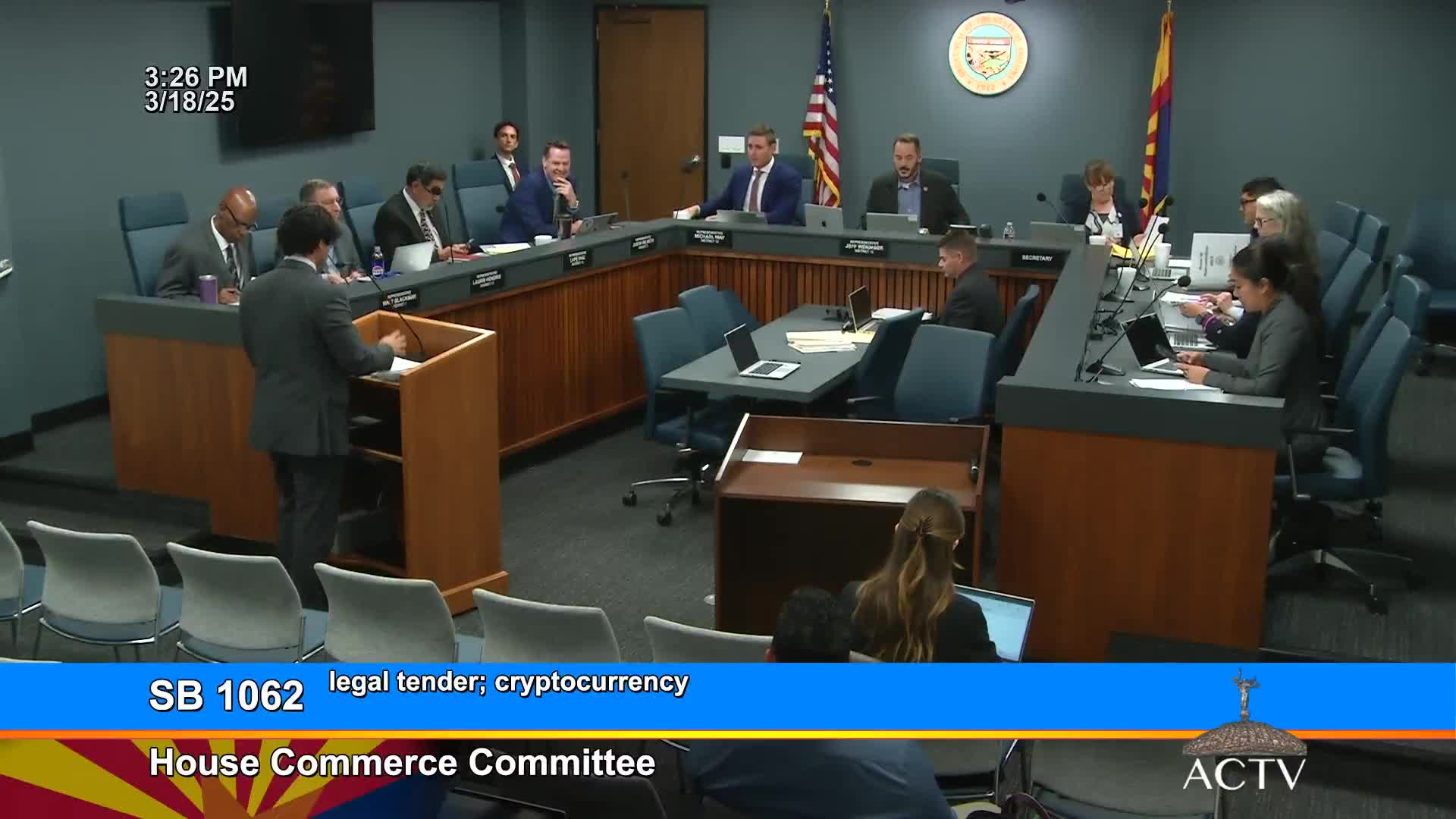
The trio includes: Senate Bill 1062, which would add cryptocurrency to a statutory definition of legal tender; Senate Bill 1373, which would create a "digital assets strategic reserve fund" and allow the State Treasurer to loan or invest digital assets from that fund (with an investment cap of 10% of the fund); and Senate Bill 1025, which would permit the State Treasurer or a public retirement system to invest up to 10% of public monies under its control in virtual currency holdings and to store holdings in a segregated account tied to a strategic Bitcoin reserve if established by the U.S. Treasury.
Supporters framed the measures as permissive and preparatory rather than mandatory. Senator Finchem (sponsor of the legal-tender language) argued that cryptocurrency can function as a medium of exchange and likened it to previously recognized specie such as gold and silver, saying in committee discussion that "you now have a situation where... some cryptocurrencies... you can use [them] to purchase direct from consumer to seller for both goods and services." Senator Cook, speaking for SB1373, described that bill as "permissive, not prescriptive," and noted other states are establishing similar reserve mechanisms. Senator Wendy Rogers, sponsor of SB1025, said the bill would allow certain public funds to set aside up to 10% for virtual currency holdings and highlighted retirement-system applicability.
Opponents raised operational and fiscal concerns. Megan Kintner of the Arizona Association of Counties testified in opposition to SB1062 on behalf of county treasurers, telling the committee the counties "do not really have a mechanism to accept cryptocurrency as a payment" for property taxes and that volatility in cryptocurrency value could create reconciliation challenges. County treasurer staff also said current county systems lack the infrastructure to receive and secure cryptocurrency payments and that gateways exist but are not widely implemented in county offices.
Committee members questioned readiness and the role of the State Treasurer. Several members said they supported exploring the topic but were uncomfortable advancing statutory authority before local offices and the treasurer's office had systems and safeguards in place. Sponsors repeatedly described the bills as enabling options the treasurer or retirement systems could decline to use: a permissive authorization rather than a mandate.
Votes at committee: SB1062 (legal tender) — 6 ayes, 4 nays, due-pass recommendation; SB1373 (digital assets strategic reserve fund) — 6 ayes, 4 nays, due-pass recommendation; SB1025 (allow investments up to 10% in virtual currency for treasurer/retirement systems) — 6 ayes, 4 nays, due-pass recommendation.
The measures include technical provisions that sponsors said they will coordinate across the different bills to align language if multiple bills advance. Sponsors and several members said they plan further discussions with the State Treasurer's office and the attorney general's office as the bills move forward.
If enacted, the bills would change statutory permissions for the treasurer and other public fiduciaries; none of the three bills compel immediate purchases or transfers of public funds into cryptocurrency — sponsors emphasized that any investment would remain at the discretion of the treasurer or governing body and subject to fiduciary duties.
Committee consideration now moves the measures to the next stage of the Legislature, where further amendments, fiscal analyses and stakeholder conversations are likely.