Get Full Government Meeting Transcripts, Videos, & Alerts Forever!
Get email alerts on the Entertainment Commission Restructure topic
No spam. Unsubscribe anytime.
Council committee adopts substitute for Music, Entertainment and Film Commission after heated debate over hiring authority
Summary
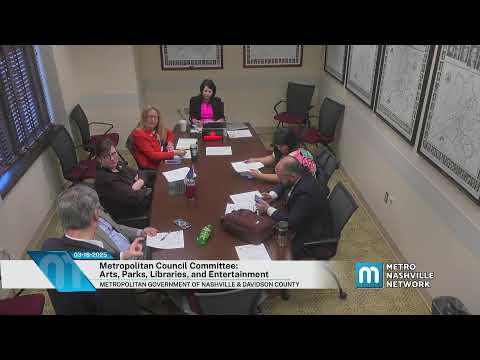
The Arts, Parks, Libraries & Entertainment Committee on March 18 approved a substitute and then passed an ordinance changing the Music, Entertainment and Film Commission’s structure and hiring process after a contentious debate over whether hiring authority should rest with the mayor or the commission.
The Arts, Parks, Libraries & Entertainment Committee on March 18 approved a substitute to an ordinance that changes the Nashville Music, Entertainment and Film Commission’s structure and hiring process and then passed the bill as substituted.
"I love the sponsor," Council Member Stiles said in presenting her substitute, "I do not support her bill at all, hence the substitute." Stiles argued the commission and local creative-industry members should retain the hiring authority for the executive director and that removing that authority would protect continuity across mayoral administrations.
Commission members of the commission and cultural stakeholders attended the meeting to urge the committee not to shift hiring authority to the mayor. Max Butler, chair of the commission, told the committee he and other commissioners were frustrated by repeated procedural changes and described the process as disrespectful. "I'm so sick of this and talking about this. I've been doing this for years, and my time has been wasted," Butler said.
Council and administration officials described a different view. Dave Rosenberg of the mayor's office said the version filed by Council Member Sepulveda would allow "the immediate swift hiring of an executive director," while the substitute, he said, would make the hiring process slower because it would be managed by a commission through publicly noticed meetings.
Human resources and Metro staff raised practical concerns about a stand-alone "department of one." Shannon Hall, identified at the meeting as a director in the administration, said that historically an office of one has spent much of its time on administrative support rather than programmatic work and recommended using existing HR and finance structures to allow the executive director to focus on programmatic duties.
Council Member Stiles said the commission already has a large applicant pool for the executive director role; she said the commission had received about 117 applications.
After a floor vote on the substitute, the committee recorded 4 in favor, 2 against and 1 present not voting; the committee then voted the bill as substituted by the same margin, adopting the ordinance as substituted.
Discussion: Commissioners said the 2019–2023 effort to create an independent office responded to industry concerns about changing mayoral priorities; commissioners argued the commission members, who come from the music and film industry, are best placed to assess candidates. Sponsors and administration staff said placing the office within the mayor's structure would enable faster hiring and cross-department coordination.
The committee did not enact any immediate administrative appointments at the meeting; the substitute preserves the commission’s hiring role as presented in the substitute and will govern the hiring process as the commission proceeds to screen candidates.
Ending: The ordinance as substituted now moves forward with committee approval; staff and commissioners said they will continue candidate screening and will return materials or requests to the committee or council as required.