
MPO advances 2025 public transit safety plan targets for fixed‑route and demand‑response services
Get AI-powered insights, summaries, and transcripts
Sign Up Free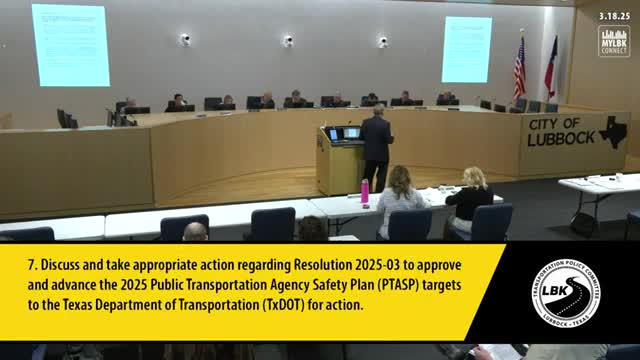
Summary
The policy committee approved Resolution 2025-03 to adopt 2025 Public Transportation Agency Safety Plan targets for fixed‑route and demand‑response modes, keeping fatalities at zero and setting injury and safety‑event rates based on five‑year rolling averages.
The Lubbock MPO Transportation Policy Committee approved Resolution 2025‑03 on March 18, 2025, advancing the 2025 Public Transportation Agency Safety Plan targets to TxDOT.
LMPO speakers explained the targets mirror the safety‑metrics approach used for highways: five‑year rolling averages on fatalities, injuries and other reportable safety events, scaled per million revenue miles. For fixed‑route service the plan retains a target of zero fatalities, sets injuries at 2.4 (per million revenue miles) and total reportable safety events at 2.8; for demand‑response services the targets are zero fatalities, injuries at 2.0 and safety events at 1.7. The plan also reports a mean distance between major mechanical failures for fixed‑route vehicles (reported to increase to 123,000 miles) and for demand‑response vehicles.
Committee members asked about the underlying data and what counts as an injury. Staff explained injuries counted here are incidents requiring transport to further medical care (beyond first aid), including boarding slips, trips and falls, mobility device securement failures and other events that meet National Transit Database reporting thresholds. A council member asked whether the mean distance between major mechanical failures rose from about 90,000 miles; staff said the calculation uses a standardized TxDOT form and a five‑year rolling average, and recent new vehicle deliveries have raised the average.
A motion by Council Member McDonald, seconded by Mayor McBrayer, carried with no recorded opposition.
The targets will be forwarded to TxDOT as the MPO’s adopted public transit safety measures and will inform project and service planning for the fixed‑route and demand‑response systems operated in the Lubbock metropolitan area.