Get Full Government Meeting Transcripts, Videos, & Alerts Forever!
Get email alerts on the Property Tax Appeals Homeowner Exemption topic
No spam. Unsubscribe anytime.
Committee advances House Bill 354 to shift burden in some property-tax appeals, clarify homeowner-exemption proration
Summary
The Senate Local Government and Taxation Committee voted to send House Bill 354 to the Senate floor with a do-pass recommendation. The bill would shift the burden of proof in certain property-tax appeals when values jump more than 10% and would codify proration rules for the homeowner exemption.
The Senate Local Government and Taxation Committee voted to send House Bill 354 to the Senate floor with a do-pass recommendation after hearing testimony that the measure would shift burdens of proof in some property-tax appeals and clarify how the homeowner exemption is prorated.
"There's 2 primary things that this House Bill deals with. It's a burden of proof on property tax appeals, and it shifts that burden of proof, when 2 things happen," Representative Dustin Manwaring, R-29 of Pocatello, told the committee as he introduced the bill.
The bill does two main things. First, it shifts the burden of proof to a county assessor in appeals when a property's assessed value increases by more than 10% in a single year and the assessor did not follow the equalization methods used to measure median assessment ratios. Those equalization methods have been applied through a State Tax Commission administrative rule; HB 354 moves the standard into statute and ties the burden shift to counties being outside the acceptable median-assessed-to-market ratio range (clarified in committee discussion as roughly 90%–110% of market value). Representative Manwaring said the change is intended to prevent sudden, large reassessments that trigger mass appeals.
"In Bannock County... the new assessor came in and raised countywide thousands of properties in 1 fell swoop and there was at least 3,500 if not more tax appeals," Manwaring said. "The county commissioners were in board of equalization hearings every day all summer long. It was a... it was a mess and so I committed at that time to trying to do something to stop this from happening."
Second, HB 354 spells out how to prorate the homeowner (homestead) exemption when a property gains or loses eligibility partway through the year. The bill sets a daily tax-rate approach: multiply the levy rate by the market value, divide by the number of days in the year (365 or 366 in a leap year) to get a daily tax rate, then multiply by the number of days eligible to compute the prorated exemption amount. "You take the levy rate and you multiply that times the market rate. You divide that by the number of days in the year... That's your daily tax rate," Manwaring explained to the committee.
Supporters who testified said the bill is practical for counties and homeowners. "The Idaho Association of Counties supports House Bill 354," Sarah Westbrook told the committee, adding that stakeholders including county assessors and realtors helped shape the measure. Max Pond, government affairs director for the Idaho Realtors, echoed those remarks: "We appreciate the counties coming to the table and and working to a solution here."
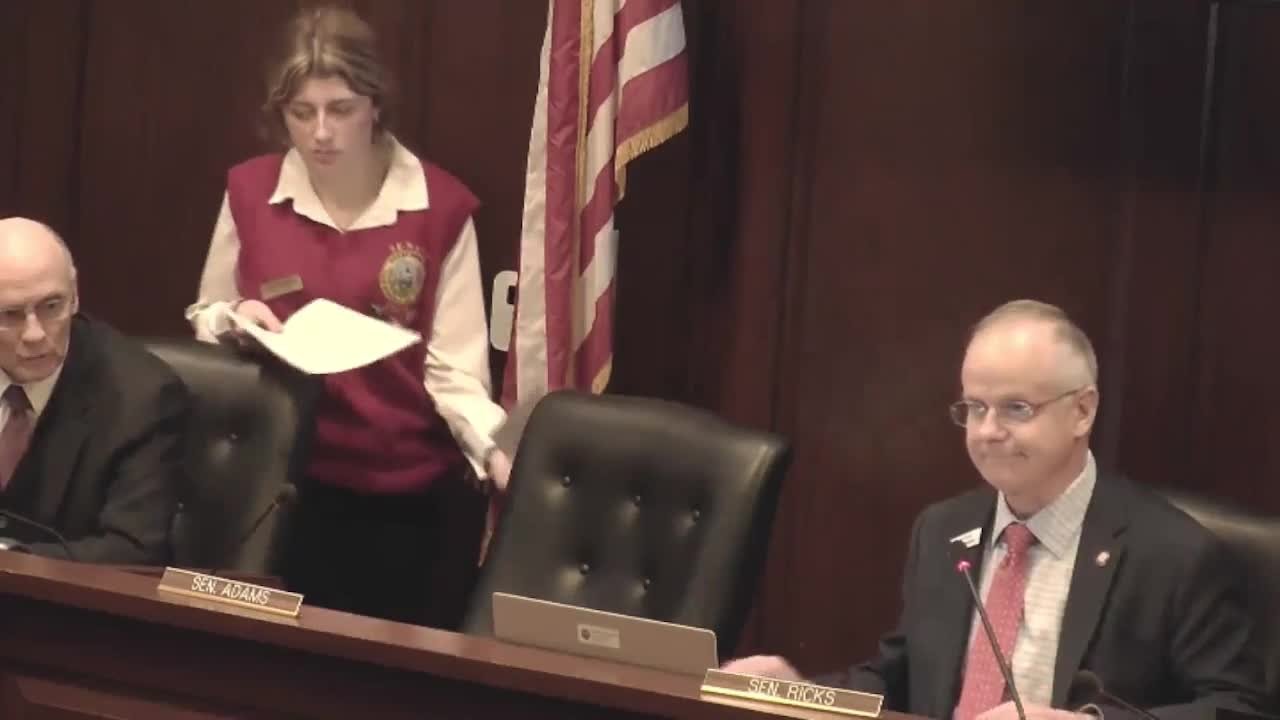
Committee members noted HB 354 had unanimous support in the House Revenue and Taxation Committee and passed the Idaho House floor unanimously. After brief discussion in committee, Senator Toews moved to send HB 354 to the floor with a do-pass recommendation; Senator Taylor seconded. Chairman Ricks called the voice vote and said, "That motion carries." Representative Manwaring said Senator Burt agreed to carry the bill on the Senate floor.
No opponents spoke during the committee hearing. Committee chair and members asked clarifying questions about both the proration calculation and the codification of the State Tax Commission’s equalization ranges.
HB 354 now moves to the full Senate for further consideration.