Get Full Government Meeting Transcripts, Videos, & Alerts Forever!
Get email alerts on the Workforce Development topic
No spam. Unsubscribe anytime.
Ohio senator proposes letting 14- and 15-year-olds work until 9 p.m. year‑round with parental and school consent
Summary
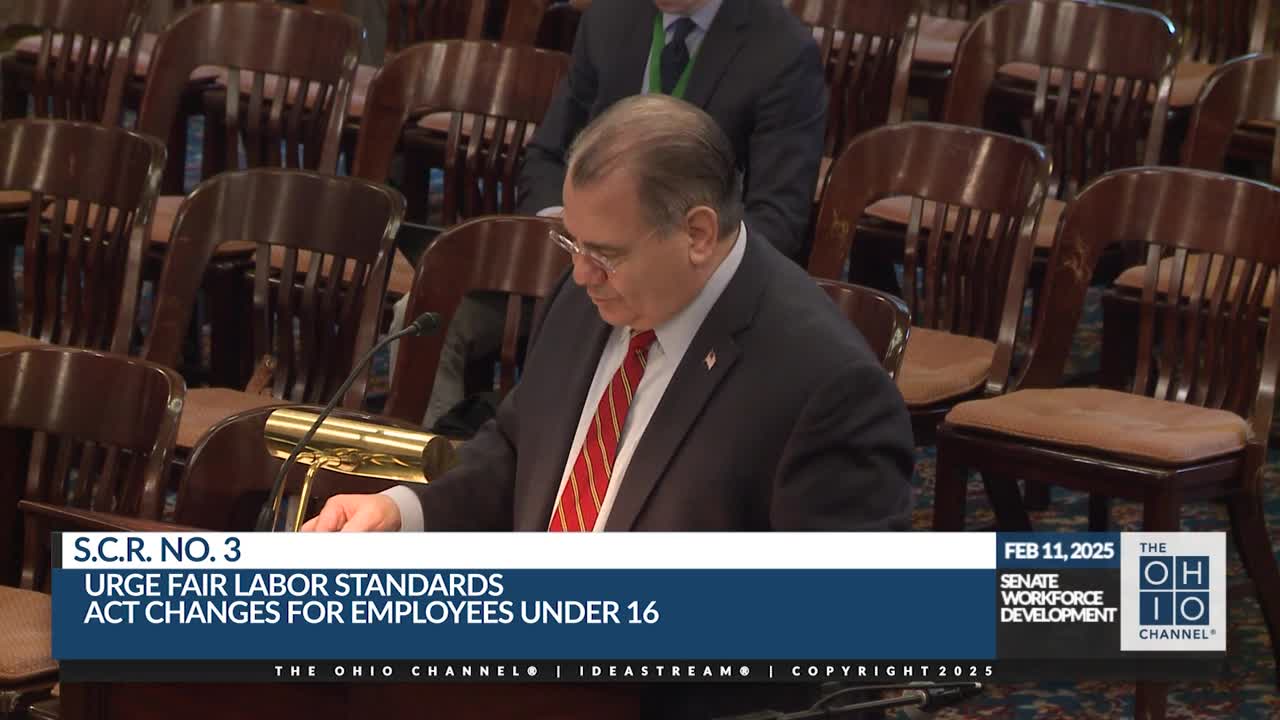
Sponsor testimony for Senate Bill 50 and Senate Concurrent Resolution 3 would allow 14- and 15-year-olds to work until 9 p.m. year‑round if a parent or guardian and a school administrator sign the work permit; sponsors and committee members debated oversight, transportation and academic impacts during a first hearing.
Senator Schaffer told the Senate Workforce Development Committee that Senate Concurrent Resolution 3 and Senate Bill 50 would let 14‑ and 15‑year‑olds work until 9 p.m. year‑round provided a parent or guardian and a school administrator sign the student’s work permit.
The sponsor said the change would “encourage kids to further develop good working skills and help employers across Ohio with their staffing challenges.” He told the panel the bills do not increase total allowable working hours for 14‑ and 15‑year‑olds and that the permitted hours would be listed on the work permit.
According to the sponsor, federal and state rules currently limit evening work for 14‑ and 15‑year‑olds; he cited the U.S. Department of Labor as saying 13 states allow youth under 16 to work until at least 9 p.m. year‑round for most nonfarm jobs. The sponsor also told the committee that the bills preserve existing guardrails, including maximum weekly and daily hours and the requirement that a parent or guardian and the school sign the permit.
Ranking Member Ingram expressed caution, calling the proposal a “slippery slope” and raising enforcement concerns. Ingram asked whether the bill would create additional oversight of the jobs, machinery or tasks minors could perform; she warned some parents might feel pressured to have children work. Senator Schaffer replied the bill does not create new oversight, and that any administrative or budgetary changes would be handled outside the bill, saying, “The laws that are in place to protect children in this state ... I think should be protected and sacrosanct.”
Senator Blackshear said he worried about transportation and academic effects for students who would return home late. He noted that some students depend on buses and may not get home until 10 p.m. or later after a 9 p.m. shift, and asked whether the change could harm school performance. The sponsor described those scenarios as hypotheticals the bill does not envision and reiterated that the measure is intended to offer scheduling flexibility without increasing total weekly hours.
Committee members pressed the sponsor on enforcement and the potential for employers to exploit younger workers amid staffing shortages. The sponsor said the bill intensifies parental and school oversight on the work permit compared with a prior version and said he was open to further conversations with state agencies about enforcement.
The committee held this as a first hearing; no committee vote or formal action on either Senate Bill 50 or Senate Concurrent Resolution 3 was recorded at the hearing.