Get Full Government Meeting Transcripts, Videos, & Alerts Forever!
Get email alerts on the Health Policy topic
No spam. Unsubscribe anytime.
Senator Kaler proposes refundable tax credit to offset employer costs from health-insurance mandates
Summary
Senate Bill 129 would create a refundable tax credit equal to 1.3% of employers' health-care premiums to offset costs imposed by legislative health-insurance mandates; sponsor said the measure fulfills a promise in prior legislation that enacted mandated autism coverage and a moratorium on new mandates.
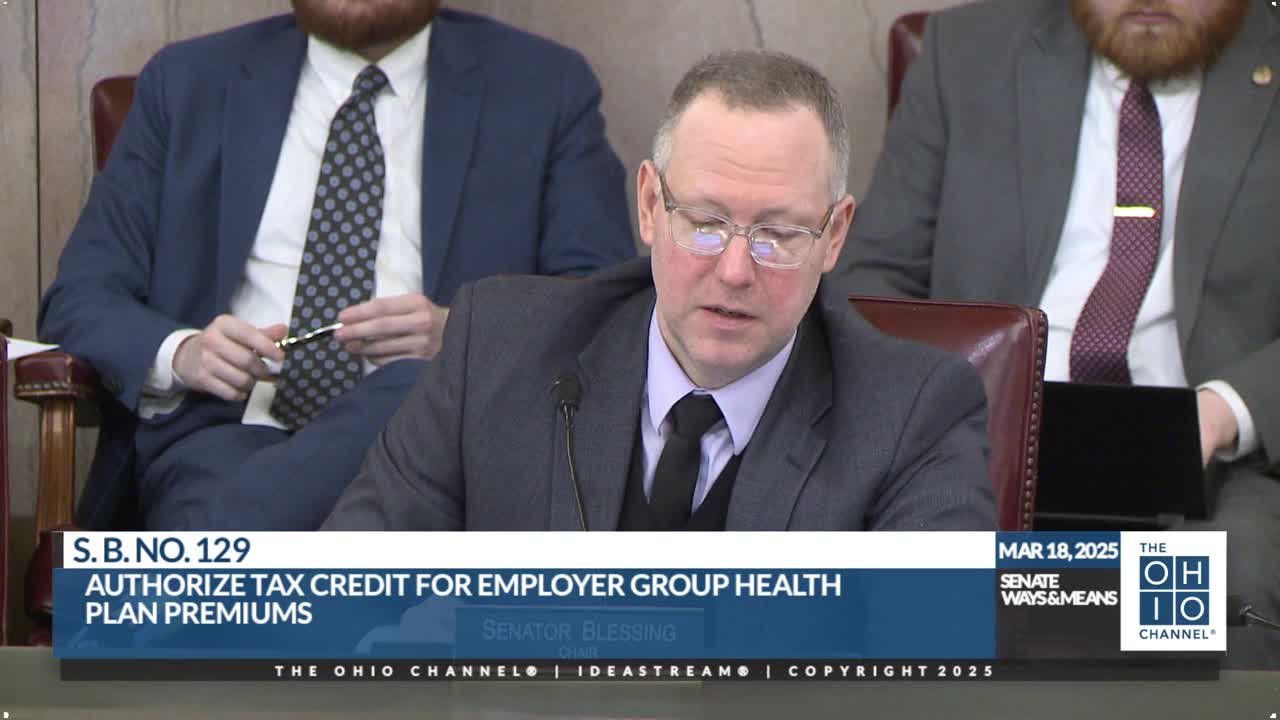
Sen. Kaler presented Senate Bill 129 to the Ohio Senate Ways and Means Committee, proposing a refundable tax credit equal to 1.3% of an employer’s cost for health-insurance premiums to offset the cost of legislative health-insurance mandates.
Kaler said the bill fulfills language included in prior enactments (House Bill 463 as amended during a prior General Assembly) that implemented a two-year moratorium on new health mandates and directed study of a potential tax credit to offset employer costs. He said HB 463 included mandated insurance coverage for autism spectrum disorders and a promise to study and, if appropriate, create a tax credit to offset future employer costs associated with legislative mandates.
Under the bill as described in testimony, the refundable 1.3% credit could be claimed against one of several taxes: the commercial activity tax (CAT), income tax, financial institutions tax, insurance company premiums tax, public utilities tax or the petroleum activity tax. The sponsor said the credit is limited to employers with employees residing in Ohio, is not available to self-insured employers and is not available to companies that register for CAT without a physical presence solely to take the credit.
Kaler said the 1.3% figure derives from a Department of Insurance study of the cost of Ohio’s health mandates; committee members asked for the fiscal analysis and LSC numbers, which Kaler said would be provided by proponent testimony. Kaler framed the bill as honoring a legislative commitment to businesses that were told a study and potential credit would follow enactment of mandated coverage.
Committee members did not take action on SB 129 during the hearing; the fiscal impact and detailed LSC analysis were not presented in the live testimony and were described as forthcoming in proponent testimony.