Get Full Government Meeting Transcripts, Videos, & Alerts Forever!
Get email alerts on the Insurance For Affordable Homeownership topic
No spam. Unsubscribe anytime.
Committee hears bill directing Insurance Commissioner study on insurance options for permanently affordable homeownership
Summary
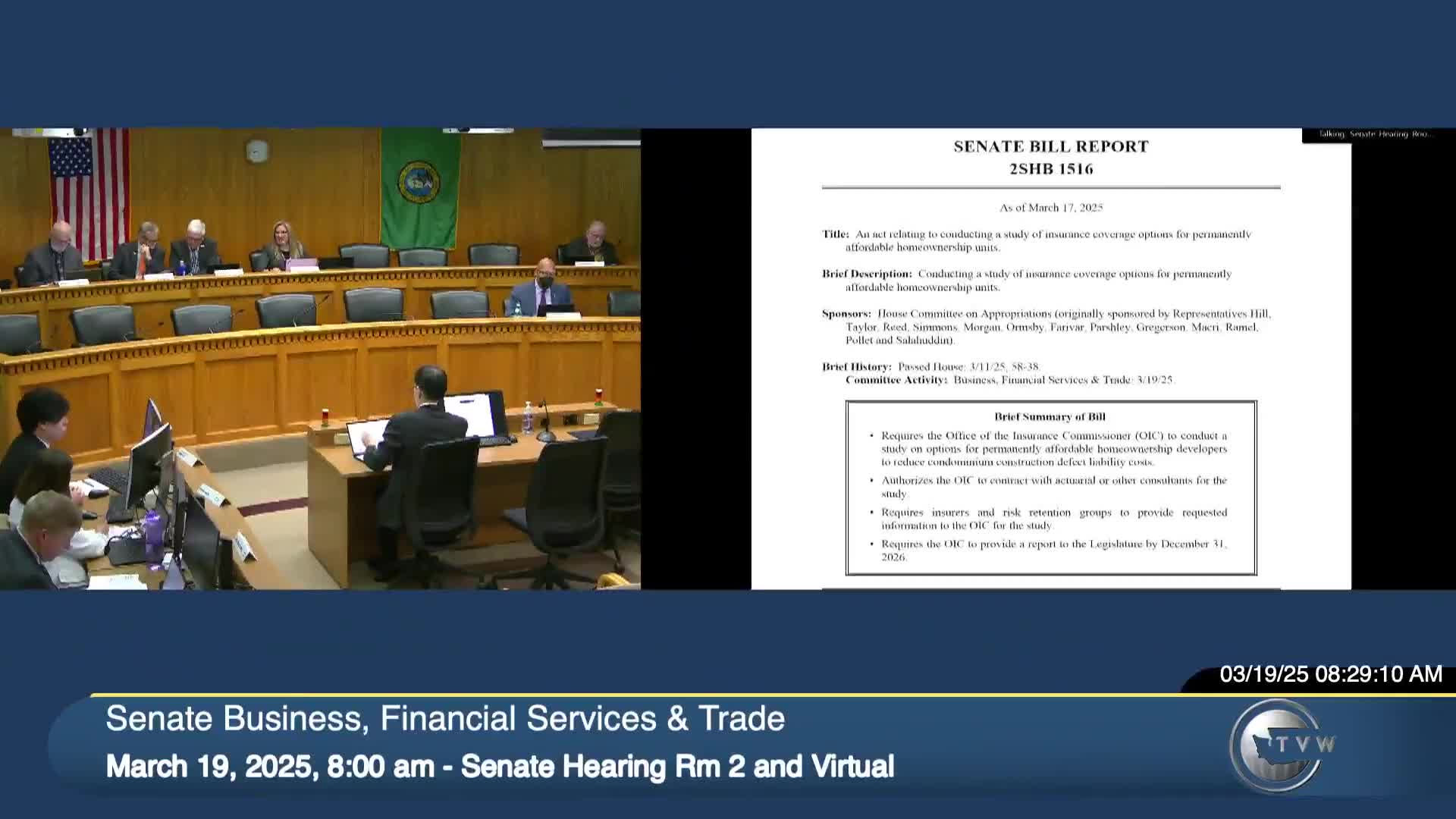
Second Substitute House Bill 1516 would direct the Office of the Insurance Commissioner to study insurance options for permanently affordable homeownership units and submit a report with recommendations to the legislature by December 2026.
Second Substitute House Bill 1516, which would require the Office of the Insurance Commissioner (OIC) to study insurance coverage options for permanently affordable homeownership units, received bipartisan testimony Wednesday before the Senate Business, Financial Services, Gaming & Trade Committee.
John Kim, committee staff, summarized the bill and its background, saying the measure responds to insurer market conditions that stakeholders have said limit condominium production and add cost for permanently affordable homeownership models. "The bill before you requires the Office of the Insurance Commissioner to conduct a study regarding how projects that develop new, permanently affordable homeownership units may use different insurance coverage options and approaches to reduce costs relating to condo construction defect liability while maintaining commensurate access to insurance coverage," Kim said. The OIC may contract with actuaries or other consultants and must report to the legislature by December 2026; the OIC estimated $368,000 in expenditures from its regulatory account for the current biennium.
Sponsor Representative Natasha Hill (Third Legislative District, Spokane) said the study is intended to identify options to reduce insurance-related barriers that nonprofit and government developers face when producing permanently affordable ownership units — including deed-restricted condominiums, community land trusts, and limited-equity cooperatives — and that increasing condo production can expand pathways to affordable homeownership. "If we can help our builders reduce the cost and find other options that will make insurance more affordable, they're going to be more willing to build," Hill said.
Representatives of the Office of the Insurance Commissioner, Habitat for Humanity Seattle-King and Kittitas Counties, the Housing Development Consortium, and the Northwest Cooperative Development Center testified in support. Rory Payne Donovan of the OIC said the office is prepared to conduct the study and appreciated authorization to contract for consultants and request insurer data. Ryan Donahue of Habitat for Humanity said nonprofit developers face upfront premium costs approaching or exceeding project budgets in some cases and that the study could identify solutions while preserving consumer protections and building standards.
Committee members asked clarifying questions about scope — whether the study would examine homeowners association (HOA) fee impacts and whether the study's scope includes townhouses or is limited to condominium-permitted products — and whether insurance is indeed a main driver of stalled condo construction. OIC and witnesses said the study should clarify these points; staff said the bill uses the statutory definition of permanently affordable homeownership (sponsored by nonprofits or government entities, subject to resale/refinancing restrictions and a ground lease or deed restriction).
The bill passed the House 58–38 and the OIC fiscal note was discussed. No committee vote occurred during the hearing.
Ending note: witnesses and sponsors said the study is an early, necessary step to identify insurance-market changes that could unlock more permanently affordable ownership units without removing consumer protections.