Get Full Government Meeting Transcripts, Videos, & Alerts Forever!
Get email alerts on the Climate Commitment Act topic
No spam. Unsubscribe anytime.
Committee weighs bill to adjust Climate Commitment Act auction controls, add market analysis and short‑term liquidity
Summary
House Bill 1975 would change auction price containment rules, cap near‑term price ceilings, shift allowances into the allowance price containment reserve (APCR) for the 2027–2030 compliance period, and require additional Ecology economic modeling. Ecology staff warned of trade‑offs including possible delayed transitions for some industries.
Isaac Caswell of Clean and Prosperous Washington told the Senate Environment, Energy and Technology Committee that House Bill 1975 seeks to improve price stability and liquidity in Washington’s Cap and Invest program while the state pursues linkage with larger markets.
"We would like to see some time for linkage conversations to go well," Isaac Caswell said. "This bill allows us within the tools that we have as a state, to introduce more liquidity, particularly to take off the table some scenarios that are inconsistent with our goal to link."
The bill would require the Department of Ecology to provide market analysis and periodic economic modeling of the program’s compliance instrument markets, cap the price ceiling at $80 in 2026 and 2027 unless linkage requires a different ceiling, adjust APCR tier 2 pricing to reflect that ceiling, and place 25% of the allowances from the 2027 through 2040 allowance budgets into the APCR to be available in the second compliance period beginning in 2027. A fiscal note reports operating expenses of $4.5 million from the Climate Investment Account over a four‑year outlook.
Why it matters: Sponsors said the changes would add liquidity in a tight market and reduce the chance of sudden high prices during the early years of program implementation, smoothing the path to linkage with other jurisdictions. Joel Creswell of the Department of Ecology cautioned that shifting allowances from later decades into earlier ones could make future allocations for emissions‑intensive, trade‑exposed industries more difficult and might delay some clean‑technology transitions.
Support and concerns
- Supporters, including business groups and some environmental advocates, argued modest, targeted adjustments will stabilize the market during a potential choke point in the second compliance period (2027–2030) and provide more predictable outcomes for regulated entities. - Critics warned that pulling allowances forward could delay long‑term pollution reductions and complicate future allocation. Several witnesses urged deeper economic modeling to understand consumer price effects and distributional impacts.
Program mechanics and implementation notes
- Market analysis: Ecology must expand modeling scenarios, including linkage scenarios, and report market and price information. - Price ceiling: The bill caps the auction price ceiling at $80 for 2026–2027 unless linkage justifies a different ceiling; related APCR tier pricing is adjusted accordingly. - Allowance timing: The bill directs that 25% of allowances from 2027–2040 budgets be placed in the APCR for release in the second compliance period (2027–2030).
What did not happen today
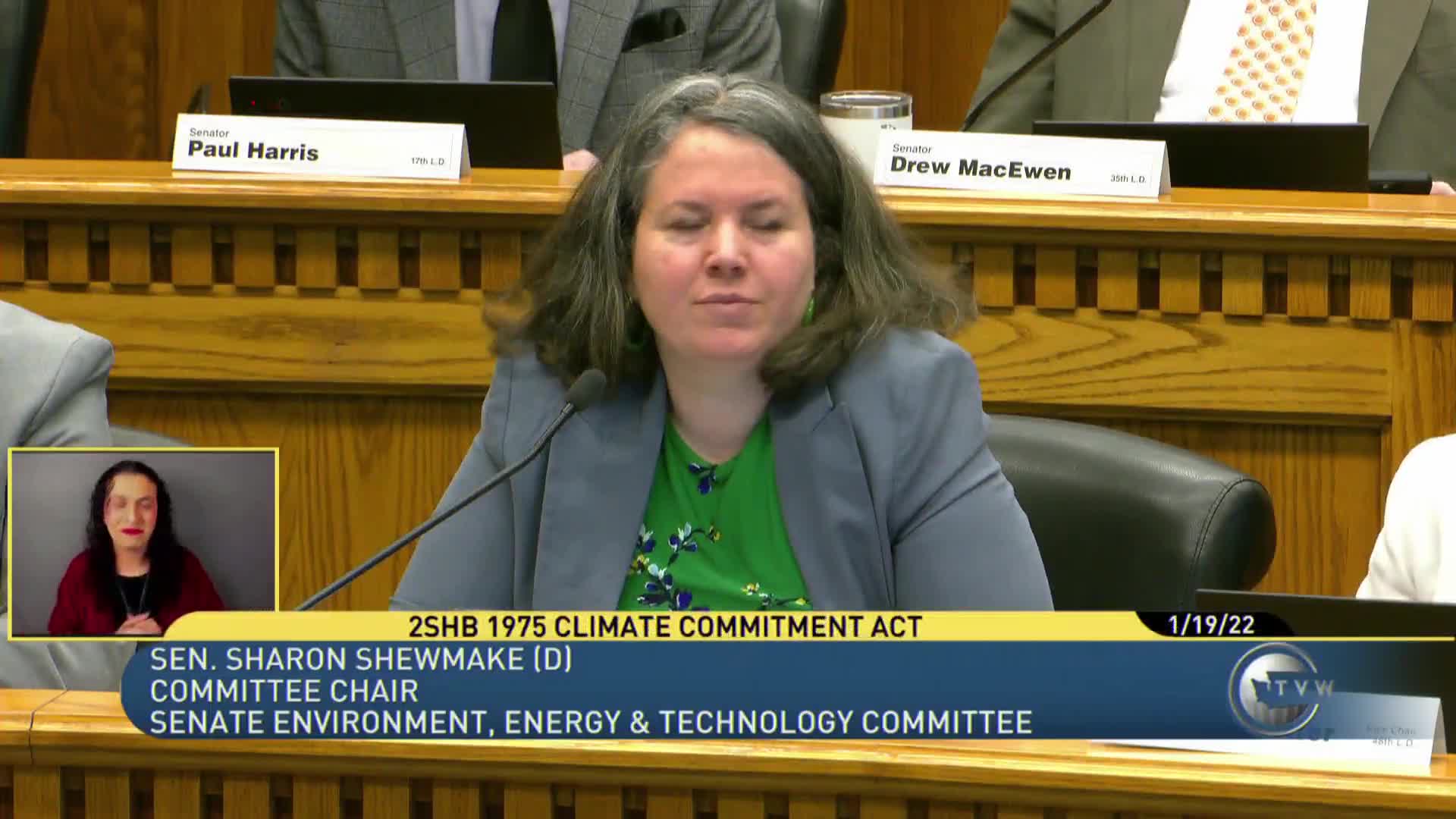
The meeting held a public hearing and took testimony; the committee did not take a formal vote on HB 1975 at this session.
Provenance
Topic introduced in staff briefing on HB 1975 (block_605, evidence excerpt). Topic finish: committee closed the hearing on HB 1975 and adjourned (block_6347, evidence excerpt).