Get Full Government Meeting Transcripts, Videos, & Alerts Forever!
Get email alerts on the Pregnancy Accommodations And Jury Duty topic
No spam. Unsubscribe anytime.
Bill would expand pregnancy accommodations, require paid lactation breaks and add parental jury excusal; AG warns of enforcement change
Summary
Engrossed second substitute SB 5217 would extend pregnancy-related accommodation protections to all employers, require paid lactation break and travel time, shift enforcement from the Attorney General's Office to L&I, and create a jury excusal/delay for parents of young infants; the Attorney General's Office urged retaining its enforcement role
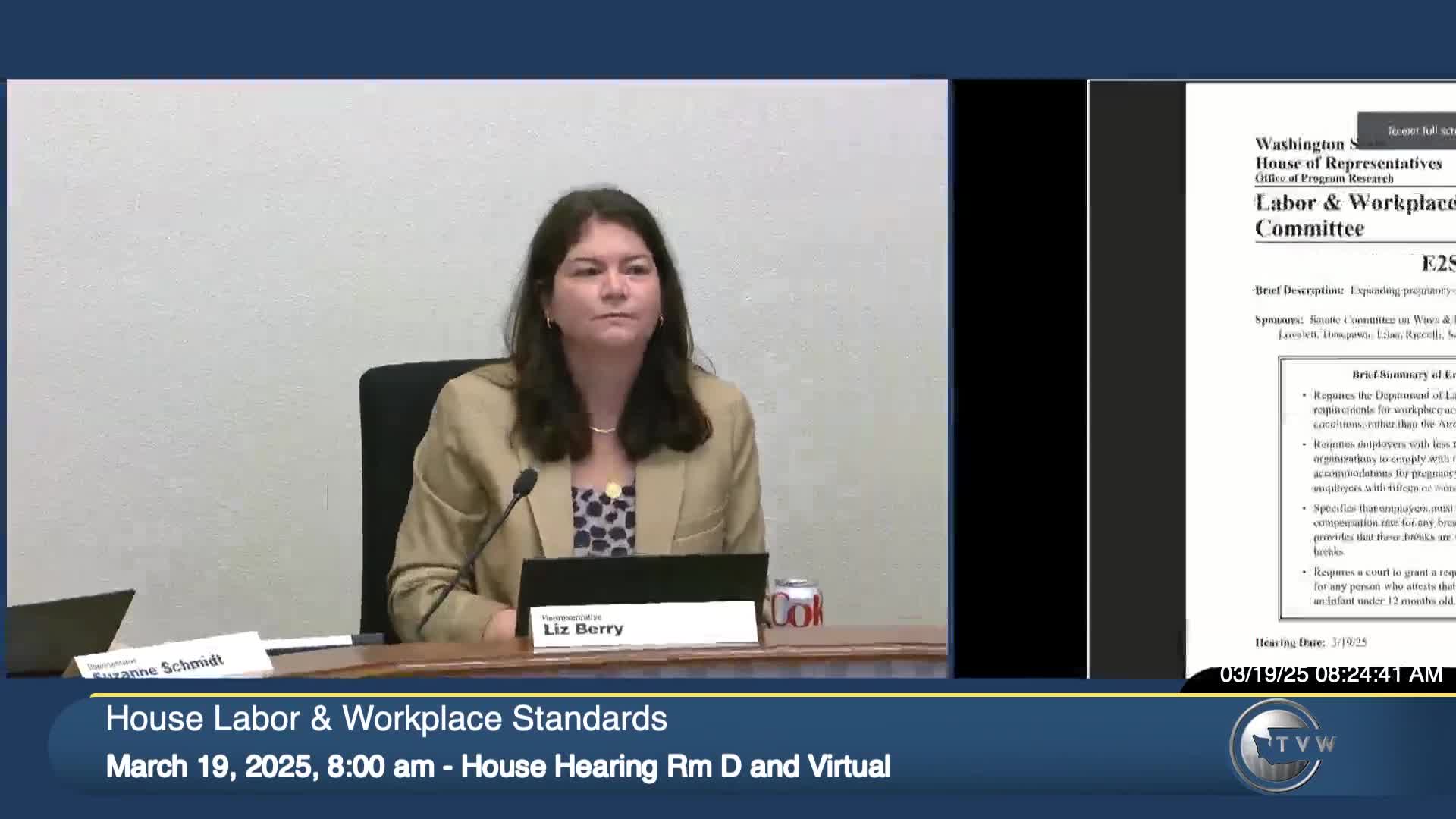
The Labor & Workplace Standards Committee heard testimony March 19 on Engrossed Second Substitute Senate Bill 5217, which would expand workplace accommodations for pregnancy-related conditions, require paid lactation break and travel time, transfer enforcement authority from the Attorney General's Office to the Department of Labor and Industries (L&I), and create a process for delay or excusal from jury service for parents of young infants.
Kelly Leonard, committee staff, summarized current law and the bill. Under current law an employer with 15 or more employees must make reasonable accommodations for pregnancy-related conditions unless doing so creates an undue hardship; the bill would extend the accommodations requirement to any employer with one or more employees and to nonprofit religious organizations. The bill would require break times and any travel to a private location for lactation to be paid at the employee's regular rate; those breaks cannot be required to be taken as paid leave and are in addition to Industrial Welfare Act meal and rest periods. The bill moves enforcement authority for these provisions from the Attorney General's Office to L&I and directs L&I to attempt in good faith to reach agreements on reasonable accommodations before issuing any orders. L&I orders restraining conditions are capped at 90 calendar days unless a court order extends them; L&I may assess civil penalties for violations.
Supporters testified SB 5217 would protect pregnant and postpartum workers. Nancy Sapero, representing a coalition including the Washington Employment Lawyers Association, the Washington State Labor Council and MomsRising, said the bill "ensures every pregnant and postpartum worker, regardless of their employer size, is entitled to reasonable accommodations on the job." Nancy Sapero also said the bill "takes model language" to require paid pumping breaks.
Multiple parents described practical burdens with jury duty while breastfeeding. Ellie Klein of PuPs described being summoned six weeks after returning to work and detailed unsanitary and inadequate lactation facilities during jury service, saying the experience showed "the profound lack of awareness, support, and respect for breastfeeding jurors." Brooke Iverson described having to pump in dirty restrooms or in a delivery truck when workplace accommodations were not provided.
Shalia Stallings and Ala e Lima of the Attorney General's Office said the AGO supports the underlying policy but strongly objects to the bill's repeal of AGO enforcement authority. Stallings told the committee AGO civil-rights staff have specialized experience enforcing pregnancy-accommodation law, prioritize these cases with urgency and have secured remedies and training for workers. "We're concerned that repealing our enforcement will put the safety at risk for the millions of workers who are currently covered by the Healthy Starts Act," she said, and urged changes that preserve AGO enforcement while stabilizing funding.
The committee heard no final action at the hearing. Supporters asked the House committee to pass the bill and AGO requested changes to preserve its enforcement role.