Get Full Government Meeting Transcripts, Videos, & Alerts Forever!
Get email alerts on the Supply Chain Infrastructure topic
No spam. Unsubscribe anytime.
Committee hears bill to create state supply‑chain competitiveness program for public and tribal ports
Summary
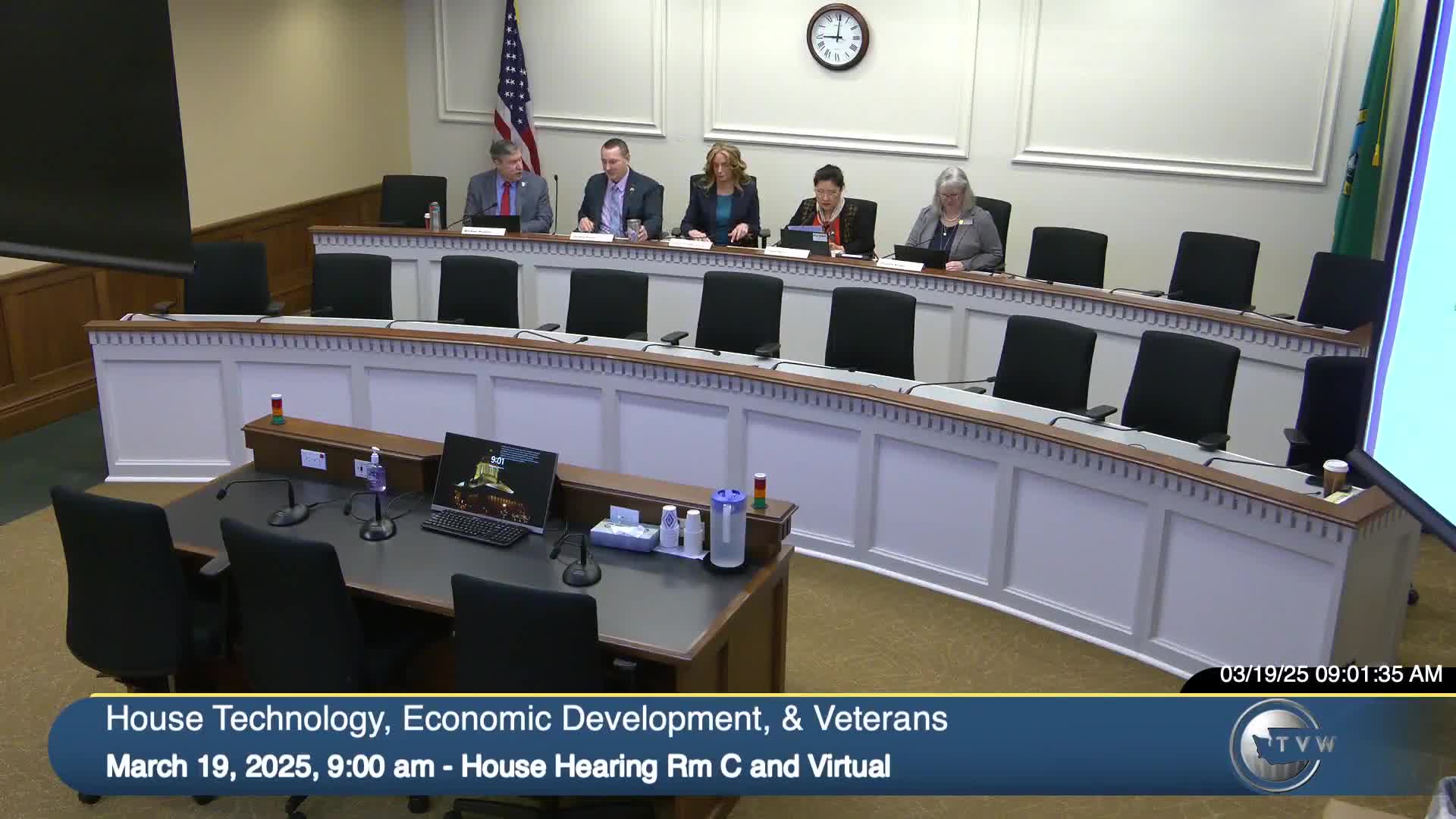
The Technology, Economic Development and Veterans Committee heard testimony on March 19 for Senate Bill 5,649, which would create a Washington State Supply Chain Competitiveness Infrastructure Program to provide grants and loans to public and tribal ports and require Department of Transportation oversight of priorities and eligibility.
The Technology, Economic Development and Veterans Committee on March 19 heard Senate Bill 5,649, which would establish a Washington State Supply Chain Competitiveness Infrastructure Program to provide grants and loans to public ports and tribal ports for freight and supply‑chain projects, staff and sponsors said.
The bill would require the Washington State Department of Transportation to set program priorities, collaborate with supply‑chain stakeholders to develop performance metrics and publish a list of eligible project types. Projects must be included in a port’s freight development plan and align with six programmatic guideline goals, including operations, efficiency, market access and mitigation for impacted communities, staff told the committee.
Martha Whaling, staff to the committee, summarized the measure for members: “Senate Bill 5,649 creates a state supply chain competitiveness infrastructure program.” She told the committee the bill creates an account in the state treasury for the program and that the companion bill is House Bill 1860.
Sen. Marco Lias, the bill’s sponsor, said the program is intended to shore up gaps in the state’s supply chain beyond rail investments. “The bill in front of us, is relevant to you if you wear clothes, eat food, or take medicine in Washington State because our supply chain touches each and every single one of us in this state,” Lias said, arguing the policy would help make the system more resilient and support jobs.
Port and tribal representatives who testified described local examples they say the program could support. Chris Herman of the Washington Public Ports Association said the measure gives ports flexibility to pursue projects that benefit local economies and partner governments, and he expressed strong support for the bill. Adam Lemieux of the Port of Everett said the program would help ports pay for projects that remove barriers for oversized and heavy cargo moving to interstate highways and reduce costs for manufacturers and consumers.
“Tthis bill creates competitive option for investment in our local community’s infrastructure to make our supply chain more resilient,” Lemieux said, describing an example of oversized components that require corridor improvements outside the port district’s boundaries.
Sean Egan of the Northwest Seaport Alliance asked the committee to note the bill’s explicit inclusion of tribal investments and pointed to a recent partnership between the alliance and a Puyallup entity to expand a marine cargo terminal as an example of projects that could benefit from the program. TJ Green, chairman of the Macaw Tribal Council, said the tribe recently completed about $15,000,000 in harbor improvements at Port Angeles and that the program would support planned multipurpose barging facilities and related work that employ local contractors.
Committee members asked about funding. Witnesses and the sponsor cautioned the bill establishes a policy framework and that funding would depend on future budget decisions. One witness characterized the current proposal as establishing an “empty bucket” for funding and said the Department of Transportation could be tasked with standing up the program and developing eligibility details if lawmakers later appropriate money.
There was no formal vote at the hearing. Chair Ryu said the committee did not need amendments and indicated the bill could be “executed out” of committee on Friday, closing the hearing on Senate Bill 5,649.