Get Full Government Meeting Transcripts, Videos, & Alerts Forever!
Get email alerts on the Worker Retraining topic
No spam. Unsubscribe anytime.
State worker retraining program serves dislocated and vulnerable workers; colleges report strong employment outcomes
Summary
The State Board for Community and Technical Colleges told the committee that the Worker Retraining Program supports dislocated and vulnerable workers through financial aid, training and advising across the state’s 34 community and technical colleges.
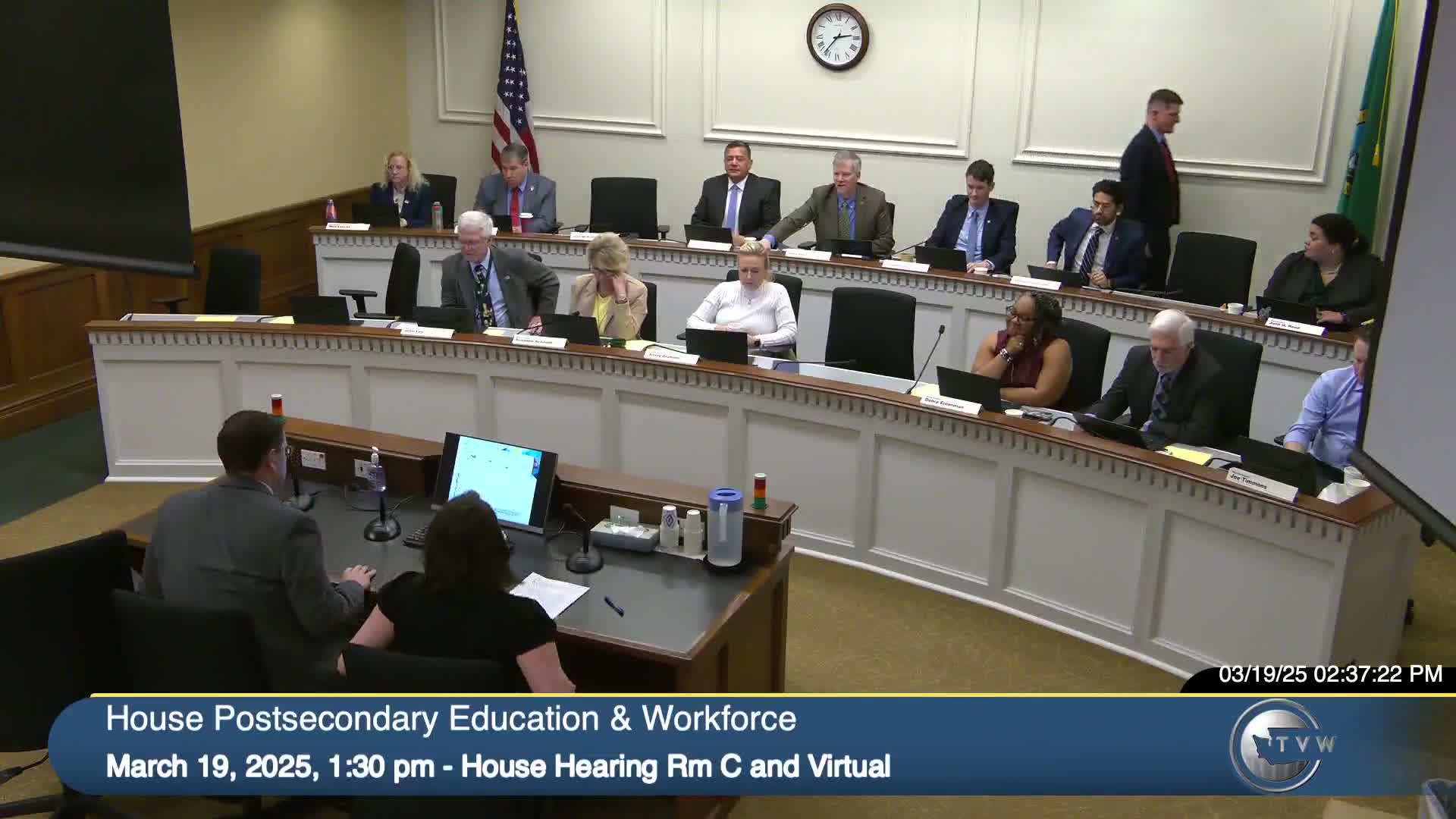
Anna Olson, policy associate at the State Board for Community and Technical Colleges, described the Worker Retraining Program to the committee as a 30‑year program that provides financial aid, advising and training aligned with local industry needs through all 34 community and technical colleges. "The funding for the Worker Retraining Program... supports students directly with financial aid and direct support services, and it also supports workforce training programs that are aligned with local industry needs," Olson said.
Olson said the program supports both instructional programs at colleges and direct student services at private career schools (through competitive contracting), and that eligibility categories include dislocated workers, vulnerable employees, veterans separating from military service and a few other groups. She said dislocated workers have policy preference and that service distribution shifts when unemployment rises.
Travis Delaney, associate director for policy research at the State Board, reviewed demographics and outcomes. He said about two‑thirds of worker retraining participants are over age 30, with a median age of 35, and that the majority of the program’s participants are female. Delaney said the largest group of credentials are in health professions, and that roughly two‑thirds of an exiting cohort left with a credential. "About 73 percent of students who exit the program were in a job two quarters after their exit, and 91 percent of those students who got that job kept that job for another two quarters," Delaney said.
Olson and Delaney showed that program enrollment spikes tracked state unemployment trends (peaking near 20,000 students during the Great Recession and falling to just under 8,400 students in 2023), and that current enrollments are up roughly 16 percent year‑over‑year in the most recent academic year. They also said local colleges reexamine eligible program mixes annually with employer and labor advisory committees.
Committee members asked about how worker retraining coordinates with other workforce actors. Olson said coordination is handled largely at the college level and through the legislatively mandated advisory committees (which include business, labor and local workforce development councils) and that the program is closely coordinated with ESD’s Training Benefits program and other funding streams.
Why it matters: Worker retraining provides an established, state‑administered route for dislocated and at‑risk incumbent workers to regain employment or upgrade skills, and the State Board’s outcome figures show substantial short‑term job placement and retention for participants.
Ending: Presenters encouraged committee members to contact the State Board for additional data; they noted the program’s role in responding to rising unemployment and the workforce needs of local employers.