Get Full Government Meeting Transcripts, Videos, & Alerts Forever!
Get email alerts on the School Improvement topic
No spam. Unsubscribe anytime.
ISBE trainer briefs East St. Louis SD 189 board on school-improvement process; Lincoln Middle in implementation year
Summary
An Illinois State Board of Education supervisor walked the East St. Louis SD 189 board through the state's school-improvement cycle on March 18, outlining needs assessments, required plans and available Title I, Part A, Section 1003 funds for districts with schools in intensive status; Lincoln Middle School is in its first year of implementation.
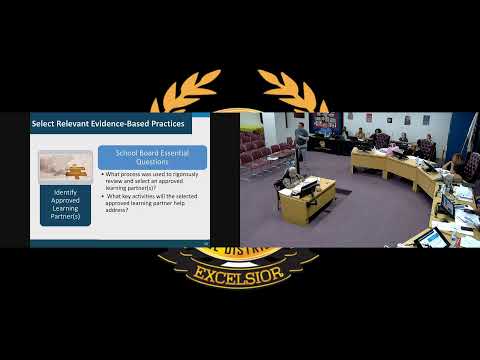
East St. Louis SD 189 welcomed Nicholas Heckel, supervisor in the Illinois State Board of Education's school-district improvement department, who delivered a detailed training on the state's school-improvement process during the board's March 18 meeting.
Heckel said the process is meant to change "adult practices to improve student outcomes," not to "change what kids do," and described a multi-year cycle of needs assessment, root-cause analysis, plan writing and multi-year implementation. "Good school improvement, good solid school improvement is 3 to 5 years," he told the board.
The presentation concentrated on designations that appear on the Illinois Report Card (exemplary, commendable, targeted, comprehensive, intensive) and the additional steps and supports that follow when a school moves into intensive status. Heckel identified Lincoln Middle School as the district building currently in intensive status that completed a planning year in 2024 and is now in the first year of implementation; report-card results in October 2027 will determine whether it exits intensive status.
Heckel described two school-level needs assessments used during the planning year: an internally conducted Illinois Quality Framework review and an external, more rigorous needs assessment performed by the American Institutes for Research (AIR). That AIR review, he said, typically includes anonymous staff surveys, classroom observations, staff and student focus groups, and a 45-minute administrator interview. Heckel said AIR reports are often 50 to 75 pages and provide an outside perspective meant to identify both "what's working" and "opportunities for growth." "A root cause analysis tries to get to the bottom of what are the problems that are causing" symptoms such as chronic absenteeism, he said.
Heckel explained state funding tied to intensive-designation status: in the designation year a school received $70,000 in Title I, Part A, Section 1003 funds; in the first year of implementation the grant rises to $100,000 and then decreases in later years to $65,000 and $35,000, respectively. He stressed districts should combine these funds with other federal and local sources as needed and plan monthly, measurable activities rather than producing a single, year-long action list.
He outlined required components of school improvement plans, including at least one ELA and one math SMART goal, monthly monitoring and a clear monitoring plan so principals and instructional coaches can verify implementation. He warned against over-reliance on interventions: "If you're giving interventions to 80% of your kids inside of your school, we need to go all the way back to the classroom," he said, urging a stronger focus on core instruction when tiered interventions become ubiquitous.
Heckel also described supports available from ISBE: an on-demand learning series, a school-improvement helpline, an assigned school-improvement coordinator (currently Christina Kelly for East St. Louis), and a roster of 48 approved learning partners districts can contract with to provide targeted assistance. He said boards for districts with intensive schools must receive this kind of training; new state legislation will require school-improvement training for new board members as part of their initial credentialing.
Superintendent Culver introduced the presentation and provided meeting materials to board members; Heckel walked the board through a packet of templates and monthly checklists intended to guide school leadership teams and stakeholder advisory groups through planning and implementation.
Board members asked clarifying questions during the presentation and Heckel invited the district to decide how it wants intensive-school progress presented to the board three times per year (required under ISBE for intensive schools). He said the state will not mandate a single presentation format and that local districts should choose a format that works for them.
Heckel concluded by reiterating that school improvement requires sustained, monitored adult practice changes and that Lincoln Middle School has three implementation years remaining to demonstrate progress ahead of the 2027 report-card review.