Get Full Government Meeting Transcripts, Videos, & Alerts Forever!
Get email alerts on the Insurance Consumer Protection topic
No spam. Unsubscribe anytime.
Committee hears bill to let insurance commissioner order restitution, expand per-violation fines
Summary
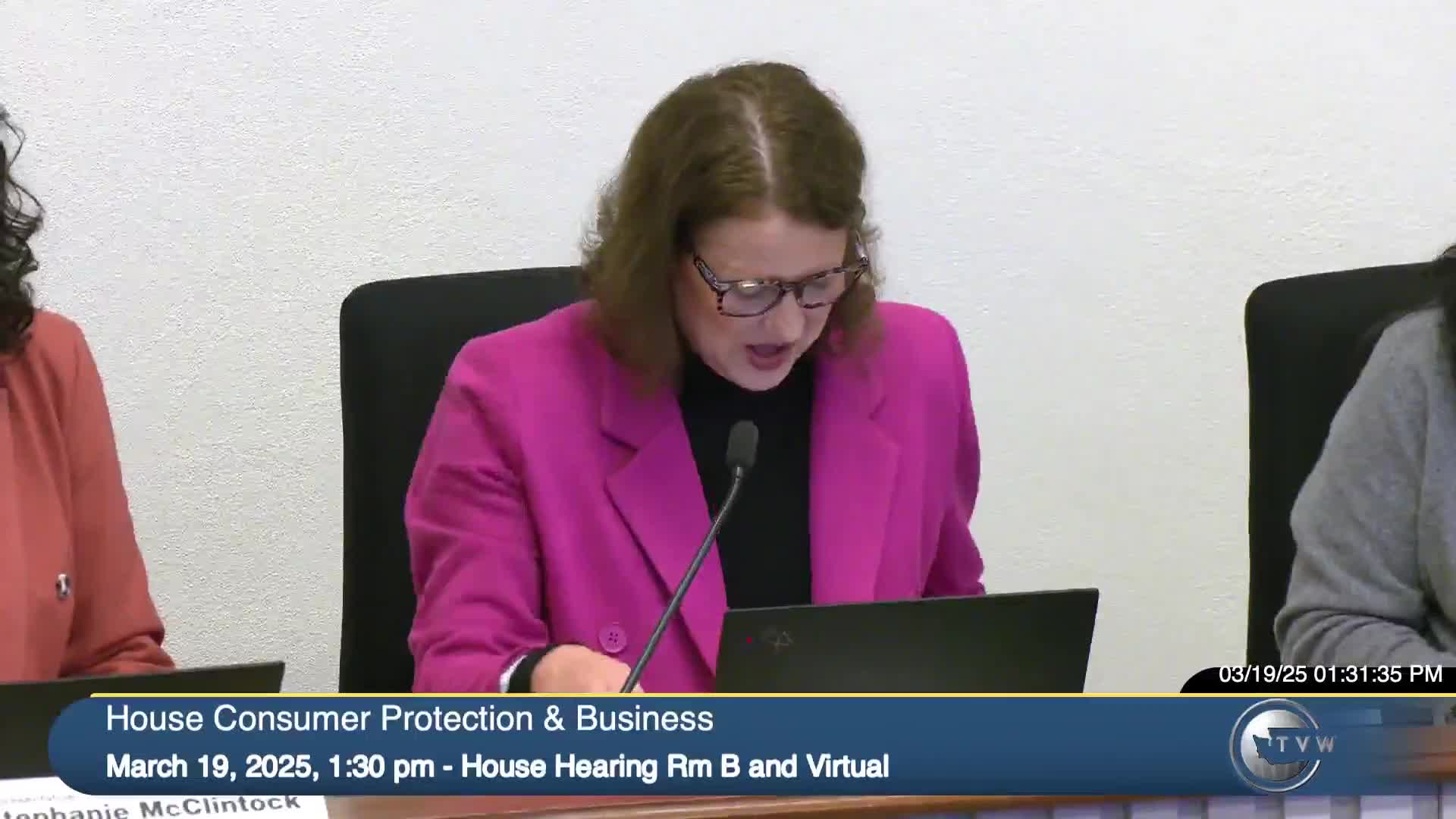
Substitute Senate Bill 5331, which would let the Office of the Insurance Commissioner order restitution to harmed policyholders and change fines to a per-violation basis, drew extended testimony at the Consumer Protection & Business Committee public hearing on March 19.
Substitute Senate Bill 5331, which would give the Office of the Insurance Commissioner (OIC) authority to order restitution to harmed consumers and change how civil fines are assessed against insurers, was the subject of an extended public hearing before the Consumer Protection & Business Committee on March 19.
The bill’s sponsor, State Senator Adrian Cortez, introduced the measure as a consumer-protection tool. "Bottom line, this is a consumer protection bill," Senator Cortez told the committee, asking members to move the bill forward.
Staff described the bill in detail. Peter Clodfelter, staff to the committee, summarized that the measure "adds authorization for the office of the insurance commissioner to order the payment of restitution after a hearing or with a person's consent if the insurance commissioner has cause to believe that a person[ is] violating or about to violate the insurance code or a regulation or order of the commissioner." The bill also narrows restitution to "only demonstrated economic damages due to another person, excluding a provider," and defines several timing rules for when an obligation "arises" for interest calculations.
Insurance Commissioner Patty Kuderer, the lead OIC witness, said the change is needed because the agency can now levy fines but cannot order repayment to consumers. "When an insurer, agent, or broker violates the law, we can take action against them, including fines, but we cannot do what the consumers and businesses want most, give them back their money," Kuderer said. She added the measure would also make the bureau’s fine schedule uniform across regulated entities.
The bill would require any restitution ordered to include 8% simple interest from the date the obligation arose and to be paid to the person entitled to restitution within 30 days of the order. Staff explained the bill includes specific timing rules: for claim payments the obligation generally "arises" 30 days after the insurer received all information necessary to determine liability and payment unless investigation cannot reasonably be completed in that period; premium obligations are dated to when the premium was charged; and other obligations are dated to when the obligation was required by statute, rule, contract, or written notice of noncompliance.
Supporters including AARP Washington State and the Consumer Federation of America urged passage. Kathleen McCall, Advocacy Director for AARP Washington State, said consumers — particularly older adults on fixed incomes — can be harmed when they are unable to recover money. Michael DeLong of the Consumer Federation argued that "fines paid to the state are good, but they're no substitute for the return of the money that consumers are rightfully owed."
Industry witnesses praised the restitution language but asked for changes to the penalty structure. Kenton Bridal, president of the Northwest Insurance Council, told the committee his group will submit written comments and corrected a prior statement the trade group had made in an earlier hearing. Chris Tefft of the American Property Casualty Insurance Association recommended distinguishing willful from non-willful violations and adding aggregate caps, saying the bill as drafted could expose insurers — including good actors — to very large aggregate fines. Bill Stoffacher of the Independent Insurance Agents and Brokers of Washington said there are "bad actors" and urged tools to hold them accountable but emphasized concern about unintended consequences.
Committee members pressed the commissioner and witnesses on frequency and mechanics. Commissioner Kuderer described examples the agency is pursuing, including a producer who collected premiums but did not transfer coverage to insurers; she said some matters also lead to criminal referrals. Several legislators asked whether aggregate caps would be factored into insurers’ rate filings; Kuderer said fines are not supposed to be passed through to consumers in rate setting.
No formal action or vote on SB 5331 was recorded in the hearing. The committee closed public testimony on the bill after in-person and remote witnesses finished their remarks.
The hearing record includes discussion of judicial review and administrative appeals: the OIC enforcement process typically proceeds to an administrative law judge and can be appealed through Superior Court, Court of Appeals and up to the state Supreme Court, which witnesses cited as checks on excessive fines.
The committee did not take a final vote during the hearing; testimony concluded and the public hearing was closed.