Get Full Government Meeting Transcripts, Videos, & Alerts Forever!
Get email alerts on the H2p Collaborative topic
No spam. Unsubscribe anytime.
Regional H2P collaborations use student voice, data and partners to smooth high school-to-postsecondary transitions
Summary
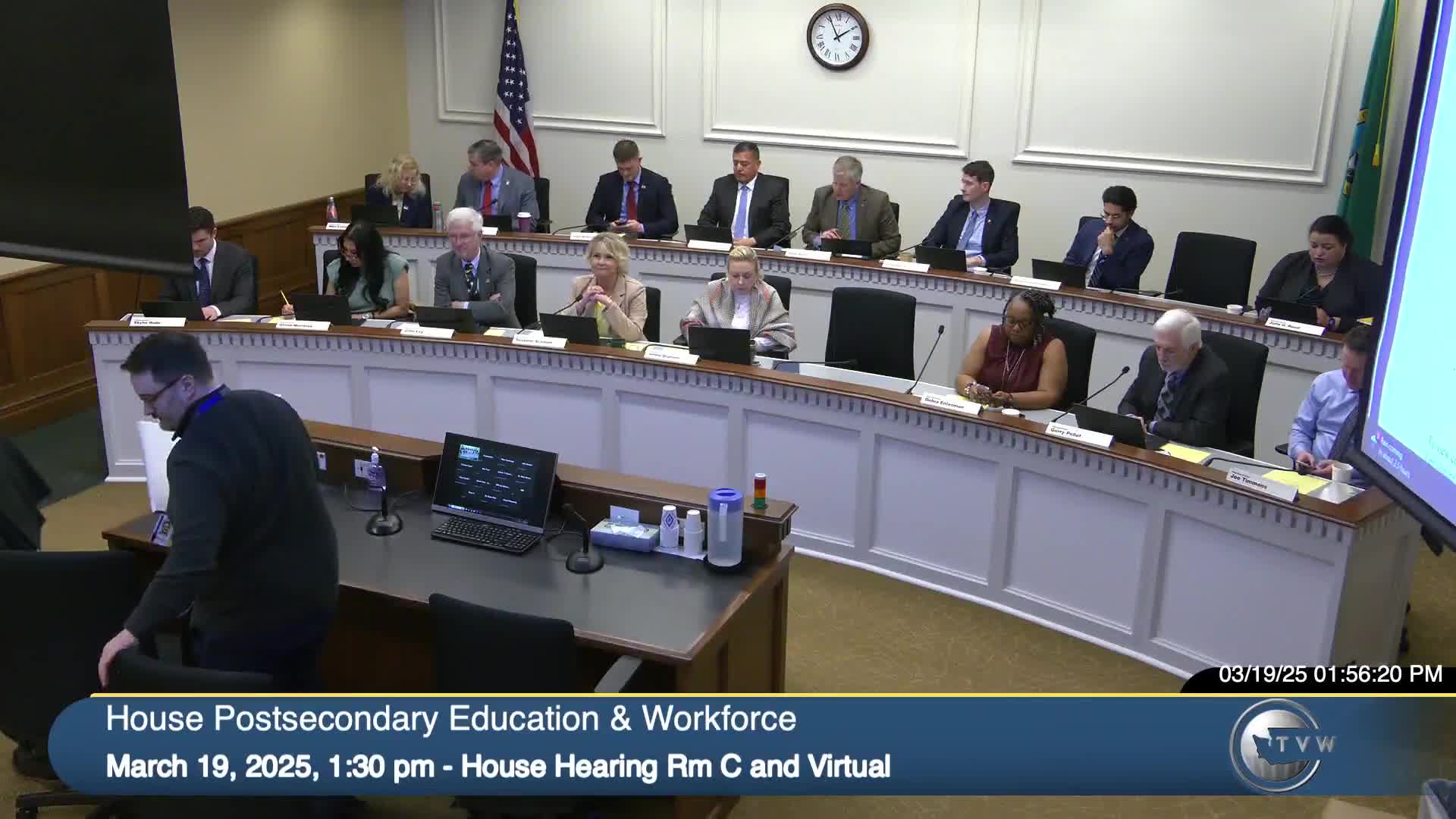
Washington STEM and regional educational service districts described a High School to Postsecondary (H2P) collaborative that supports 40 schools in 33 districts, facilitates student listening, data sharing and local interventions (for example expanding a bus route in Yakima) to improve enrollment, retention and completion.
Tana Peterman, senior program officer at Washington STEM, told the committee that nearly 90 percent of Washington students aspire to postsecondary education but only about 40 percent are projected to complete a program by age 26. Peterman said Washington STEM’s High School to Postsecondary (H2P) collaborative helps districts use student‑centered data to align K‑12, postsecondary and workforce supports.
Peterman said H2P has worked with about 40 schools in 33 districts to survey students about aspirations, supports and barriers, then to convene regional teams that include K‑12, colleges and community partners. "We hold each other accountable for different parts of this data driven process," she said.
Alma Castillo, career readiness coordinator at Educational Service District 105, described a regional H2P variant she called H2P2 that serves 25 districts across south central Washington. Castillo said regional partners convene regularly, integrate state and local data sources and center student voice through listening sessions and panels. She gave a concrete local action that followed student input: when Yakima students reported insufficient transit options to reach central campus classes, the convening funded an additional bus route with the city.
Susan Rose, assistant principal at Quincy High School, described how her school uses student qualitative data (personal statements and focus groups) and a compact “Student Story AI” tool to do large‑scale thematic analysis of student voice. Rose said Quincy has used H2P data sharing to reduce pre‑college course taking and expand dual credit and career programming aligned to local labor markets. In response to a committee question about demographics, Rose said Quincy is “about 86, 87 percent” Hispanic and that a large majority of students qualify for free or reduced price meals.
Sinead Fitzpatrick Palagi of Northwest ESD 189 discussed mapping K‑12 courses, dual‑credit articulations and postsecondary pathways in computer science and IT to identify gaps in cybersecurity and data science offerings. She said ESD 189 is building communities of practice and working with community colleges to improve transferability and equitable access.
Why it matters: The collaborative model anchors planning in student‑reported barriers and regional data, producing targeted local interventions (transportation, dual credit, advisory curriculum) and connecting school‑level practice to postsecondary partners and employers.
Ending: Presenters said the H2P model is designed to be replicable and that regions can convene similar cross‑sector teams to reduce equity gaps and create clearer postsecondary pathways.