Get Full Government Meeting Transcripts, Videos, & Alerts Forever!
Get email alerts on the Careerconnect Washington topic
No spam. Unsubscribe anytime.
CareerConnect Washington grants support business-education partnerships; Fred Hutch’s Lab Launch cited as model
Summary
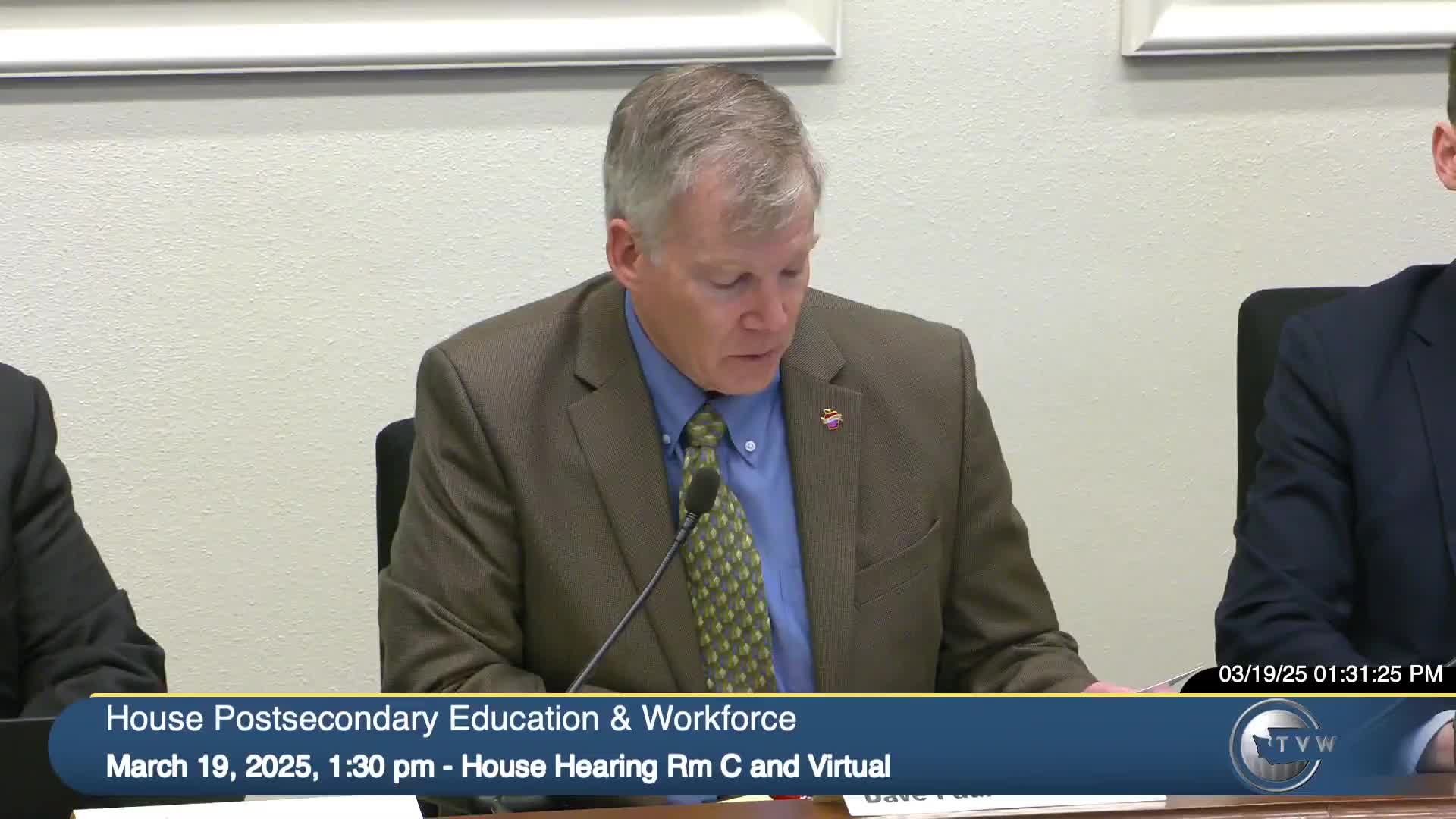
Andrew Clemens, CareerConnect Washington manager at the Washington Employment Security Department, told the committee that CareerConnect Washington grants fund regional networks, industry sector leads and competitive program builder grants to expand work‑based learning and close a postsecondary attainment gap.
Andrew Clemens, CareerConnect Washington manager at the Washington Employment Security Department, told the Postsecondary Education & Workforce Committee on March 19 that the state’s CareerConnect Washington (CCW) competitive grant program aims to expand work‑based learning and align education with employer needs. "Eighty‑six percent of high school students in Washington aspire to pursue education and training after they graduate, and... only 40 percent of our high school students complete a post secondary degree by the time they're 26," Clemens said, adding that the legislature created the Career Connected Learning Grant Program in 2019 to close that gap.
The Employment Security Department has used CCW funding to create nine competitively selected regional networks, 10 industry sector leaders and to issue 174 program builder grants that have grown or expanded about 205 programs across the state. Clemens estimated those investments served about 26,665 students over the last five years and said the department currently has about 40 percent of the resources needed to fund approved high‑priority programs in the next biennium. He described CCW’s approach as a public‑private shared leadership model that pairs state agencies with intermediaries such as the Washington Roundtable and Washington STEM.
Mary Grace Katasime of Fred Hutchinson Cancer Center described how a 2022 CCW program builder grant enabled a partnership with the Washington Alliance for Better Schools, Shoreline Community College and Shoreline School District to create Lab Launch, an accelerated lab technician pathway. "Lab Launch is now career launch endorsed by the Washington State Board and is designed to help students integrate their academic learning in biotechnology and biomanufacturing with a paid internship experience at Fred Hutch over the period of two years," Katasime said. The program combines running start dual‑credit, a six‑week paid summer internship at Fred Hutch, a year of college coursework, an accelerated lab tech certificate, a digital badge and a guaranteed job interview at Fred Hutch.
Fadouma Yousef, a Lab Launch participant, told the committee the program provided hands‑on technical courses and mentorship that influenced her postsecondary plans. "Without the Lab Launch program, I wouldn't have had the exposure to these labs, the work they do, or the mentorship that has helped shape my career path," she said.
John Bonner of the Washington Alliance for Better Schools and Mark Cummings, president and CEO of Life Science Washington, credited CCW funding with convening partners, aligning curriculum and helping employers and colleges overcome administrative barriers to scale programs. Cummings said the sector‑lead role helped replicate Shoreline’s biomanufacturing curriculum in Spokane to meet major employer demand.
Committee members asked how CCW coordinates with other agencies and how grantees are evaluated. Clemens said CCW operates with a statutory cross‑agency work group and that each CCW program has an assigned ESD grant manager for technical assistance and on‑site monitoring. He characterized CCW funds as startup or program‑builder dollars intended to create capacity; programs that become career‑launch endorsed can then pursue additional, longer‑term funding from agencies such as the State Board for Community and Technical Colleges (SBCTC), OSPI and the Student Achievement Council.
Why it matters: The CCW competitive model channels state startup funds to locally designed, employer‑informed pathways and, in the Fred Hutch example, produced a short credential plus employer interview that program leaders say increases students’ immediate employment prospects and connects local employers to trained entry‑level staff.
Ending: Committee members asked for follow‑up on performance metrics and long‑term funding paths for endorsed programs. ESD representatives said they would provide additional details about evaluation metrics and interagency funding options after the hearing.