Get Full Government Meeting Transcripts, Videos, & Alerts Forever!
Sedro-Woolley planners review land-capacity analysis and package of housing-policy options
Summary
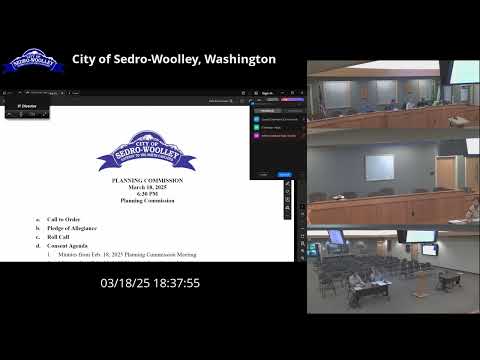
Sedro-Woolley Planning Commission members received a detailed review March 18 of the cityland-capacity analysis and a suite of housing-policy options that staff and consultants say the city could use to meet state-required housing and employment allocations.
Sedro-WoolleyPlanning Commission members received a detailed review March 18 of the cityland-capacity analysis and a suite of housing-policy options that staff and consultants say the city could use to meet state-required housing and employment allocations.
The presentation was led by Tom Glover, Sedro-Woolley planning director, and Matt Covert, a senior planner with the cityconsulting team. Covert told commissioners the analysis translates available assessor and permit data, critical-area deductions and infrastructure assumptions into a zone-level estimate of how many housing units and jobs the citycan accommodate under current regulations. "You have to show that in your plan that you have the capacity to accommodate the population, housing, and employment growth for a 20-year period," Covert said.
Why it matters: Washington state guidance and recent legislation require cities to demonstrate housing capacity across income bands (including units affordable to households below 80% of area median income). That changes how cities count housing need and can produce shortfalls in lower-income bands even where total population capacity appears sufficient.
Key findings and numbers - Baseline population used in the analysis: 12,596 (2022). The technical allocation Covert presented shows an additional roughly 4,000 people assigned to Sedro-Woolley under the county process (the packet lists 16,596 as the relevant growth allocation figure when the baseline and target are compared). - The county-derived housing allocation that the city must plan to meet totals about 2,360 housing units when income bands are combined; much of that required capacity falls below 80% AMI, the statedefinition of lower-income. - The…
Already have an account? Log in
Subscribe to keep reading
Unlock the rest of this article — and every article on Citizen Portal.
- Unlimited articles
- AI-powered breakdowns of topics, speakers, decisions, and budgets
- Instant alerts when your location has a new meeting
- Follow topics and more locations
- 1,000 AI Insights / month, plus AI Chat