Get Full Government Meeting Transcripts, Videos, & Alerts Forever!
Get email alerts on the Fleet Management Telematics topic
No spam. Unsubscribe anytime.
Committee adopts amendment, pauses final action on bill to centralize fleet telematics under TSS pending fiscal analysis
Summary
Committee adopted an amendment narrowing an exemption for telematics, discussed privacy and cost concerns, and paused final action after a request for a fiscal impact statement; the bill would require telematics (GPS) on cabinet-level state vehicles and consolidate fleet management under the Department of Transformation and Shared Services (TSS).
Representative Clowney introduced an amendment to the bill that would change the law’s enumerated exemptions for telematics to a categorical exemption for vehicles “owned by a cabinet level department of the executive branch of state government and used for law enforcement,” saying the change would capture agencies the drafters previously missed. The committee adopted that amendment by voice vote.
Clowney and TSS staff described the bill as part of a larger fleet‑management effort to centralize vehicle oversight under the Department of Transformation and Shared Services and to require telematics (GPS or global navigation devices) on cabinet‑level state vehicles by a future date. Courtney Traylor, chief of staff at TSS, told the committee that all 15 cabinet departments own vehicles and that some departments assign vehicles to individuals who travel frequently.
TSS representatives and committee members discussed the bill’s goals and tradeoffs. TSS said existing data on utilization are poor; McKinsey’s consultant report and TSS analysis identified hundreds of underutilized vehicles (for example, many vehicles showed fewer than 100 miles recorded), an average vehicle age near nine years, and roughly $8 million per year in mileage‑reimbursement spending that the state seeks to reduce. TSS estimated the telematics rollout could help identify excess vehicles, reassign vehicles to high‑mileage employees, and reduce reimbursements; a consultant estimate mentioned during the hearing put potential savings in the $3–5 million range, though TSS staff said they could not guarantee that figure because current data are incomplete.
Committee members pressed on privacy, FOIA, program cost and procurement. Witnesses said telematics data become public under FOIA after 30 days; subpoenas and other legal processes would also apply. Committee members asked whether dash cameras would be covered, whether telematics vendors would record speed and hard‑braking events, and what protections or disciplinary uses would follow. TSS staff said telematics could include safety alerts and that existing fleet policy already requires a driver authorization form and periodic driving‑record checks; they said the bill aims to automate data the state already collects manually.
Members also discussed costs. TSS told members that the state fleet includes about 4,000 vehicles in total (not all would be telematics‑equipped because law‑enforcement vehicles are intended to be exempt), and that vendor conversations suggested a per‑vehicle monthly telematics service fee in the order of $20 per month in vendor quotes discussed during the hearing. Committee members observed that a $20 monthly fee for a large pool of vehicles could translate into roughly $1 million per year in recurring fees, and asked for procurement details. TSS said some vehicles already have telematics, vendors are under consideration, and any contract would follow state procurement and RFP processes; TSS agreed that committee members deserve detailed fiscal estimates.
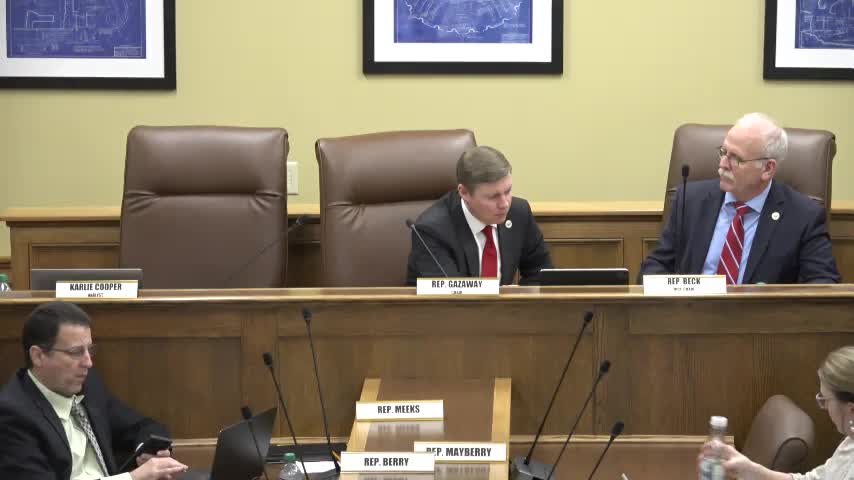
Representative Mayberry asked for and the committee recorded a formal request for a fiscal impact statement; the chair said that until the fiscal impact is prepared and presented, the committee could not take further action on the bill. No final committee vote on the amended bill was recorded at the hearing.
Representative Clowney’s amendment, the department discussion, and the fiscal‑impact request together leave the substantive policy change — mandatory telematics and centralized fleet management under TSS — pending a cost estimate and further committee action.