Get Full Government Meeting Transcripts, Videos, & Alerts Forever!
Get email alerts on the Rezoning Myers Hill topic
No spam. Unsubscribe anytime.
Glynn County denies rezoning for 369-home Myers Hill development after resident concerns
Summary
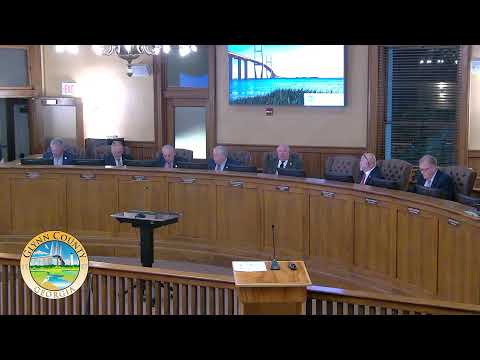
After hours of public comment and debate about flooding, traffic and emergency-services capacity, the Glynn County Board of Commissioners voted 4-2 to deny a developerrequest to rezone two parcels on Myers Hill Road to a planned development district that would have allowed up to 369 single-family homes.
The Glynn County Board of Commissioners on Jan. 16 voted 4-2 to deny a request to rezone two parcels off Myers Hill Road that the applicant had proposed to combine into a planned development district allowing up to 369 single-family lots.
The rezoning request, brought forward by owners Laura Ebert and Anna Wheeler and represented at the meeting by Jake Lemmings of Robert Veil Engineering and developer Stephen (Steve) Everett, would have added an 82-acre forest-agricultural parcel into an existing 189-acre planned development. The applicant reduced an earlier proposal that had sought 450 units to a later proposal of 375, and then to 369 units after community and Planning Commission feedback.
Why it matters: Residents and farmers told the commissioners the scale of the proposal would worsen known drainage problems, increase traffic on narrow county roads and strain already-limited emergency services and school capacity. Commissioners cited wetlands, drainage pinch points and infrastructure readiness in discussion before the vote.
The applicantengineer described the projectand the changes made after community input. "We started with 450 units. . . . because they didn't want town homes . . . we threw that out, put single family," Jake Lemmings said, describing the redesign that followed the first Planning Commission hearing. Planning staff had noted the original proposal triggered a state development-of-regional-impact review; the revised plan reduced the unit count below that threshold.
Opponents stressed local character and environmental risks. "The central concern . . . remains the proposed number of homes, 369," resident Brooke Roberts told commissioners, citing generational homesteads, farm operations and the local water table. Farmer Paul Oglesby and others said large retention ponds proposed for the development could lower nearby irrigation ponds and harm farm operations.
Commissioner Clark expressed concern about the site's natural constraints: "That FA lot is almost 50% wetlands," he said, arguing the scale of fill, crossings and new causeways would pose practical and ecological problems. Commissioner Neal framed the choice in the context of county growth: "Within five years, we're gonna be at a hundred thousand people," he said, arguing for planning but acknowledging difficult tradeoffs.
The mainland Planning Commission had recommended a cap that retained the previously approved 250-unit maximum for the original 189-acre PD and limited new units to the FA tract; commissioners asked the developer to consider further reductions. Project representatives said the owner planned to extend Joint Water and Sewer infrastructure to serve the development, at the developers cost, and proposed oversized storm ponds intended to address local drainage complaints.
After more than an hour of public testimony and questions from commissioners and county staff, the motion to deny passed 4-2. No subsequent action on the proposal was recorded at the meeting; the applicant may revise the plan or seek other approvals outside this hearing record.
The Planning and Zoning Department and county engineering staff will continue to handle technical reviews for any future filings related to the property.
Sources: Planning and zoning staff presentation; testimony from engineer Jake Lemmings and developer Stephen Everett; public comments from residents and farmers.