Get Full Government Meeting Transcripts, Videos, & Alerts Forever!
Get email alerts on the Public Health Budget topic
No spam. Unsubscribe anytime.
Public health requests added nurse, cites rising caseloads and TB costs
Summary
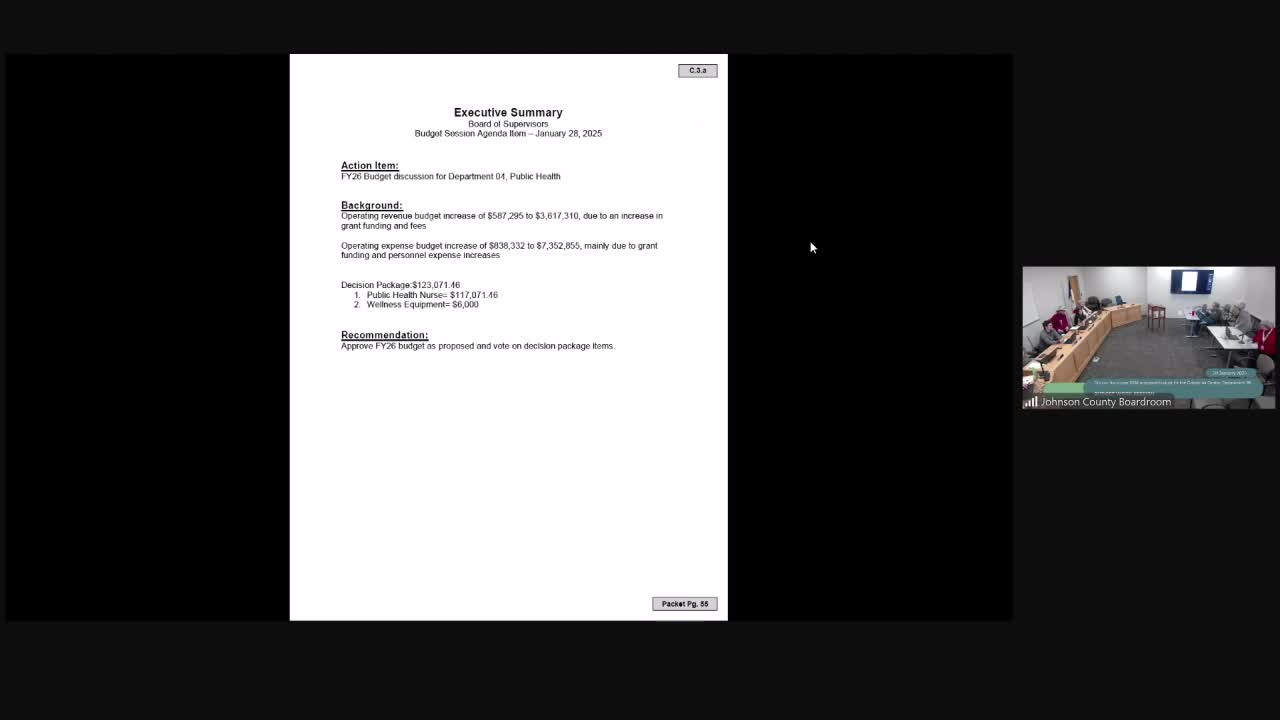
Johnson County Public Health presented its proposed FY2026 budget asking for an additional public-health nurse and continued ARPA-funded positions, citing increased WIC caseloads, rising tuberculosis costs and new grant opportunities that expand service demand.
Johnson County Public Health presented a proposed fiscal 2026 budget on Jan. 28 that requests one additional public-health nurse and seeks to sustain ARPA-funded positions while noting rising caseloads and increasing costs for communicable-disease work.
Public Health Director Daniel said the department is targeting a modest reduction in levy reliance (from about 53.45% this fiscal year to 50.8% next year) while seeking additional staff to maintain service capacity. The department reported an almost 15% increase in active WIC participants and a roughly 27% increase in lead tests over the last year.
Daniel told supervisors that tuberculosis-related costs have risen sharply: the department’s TB spending increased from roughly $27,000 to about $47,500 in one year. He said active TB cases require intensive follow-up — direct observed therapy often lasts six months — and state reimbursement of $900 per case does not fully cover local costs.
The department anticipates total expenses of about $7.3 million for FY2026, with salary and fringe making up the largest share. Public Health listed anticipated revenues and funding sources including grants and awards (about $2.7 million), Medicaid/Title XIX reimbursements (about $500,000), license and fee revenue (roughly $400,000) and a county tax levy contribution the department characterized as approximately $3.7 million; staff said figures are subject to final reconciliation.
Public Health highlighted several program changes and grant opportunities: a proposed OD2AS subcontract with Abbey Health, expansion of SPOTS (integrated testing and outreach) coverage, added clinic capacity to serve more Medicaid clients, and an ARPA-funded community-violence intervention outreach position that will begin interviews soon. The department also plans continued use of student and volunteer resources (including public-health students) to reduce costs.
Daniel and supervisors agreed to keep the board updated as state-level changes (including ASO implementation) evolve. No formal budget vote was taken during the work session.