Get Full Government Meeting Transcripts, Videos, & Alerts Forever!
Get email alerts on the Mhds Budget topic
No spam. Unsubscribe anytime.
Supervisors review MHDS budget amid regional shutdown uncertainty
Summary
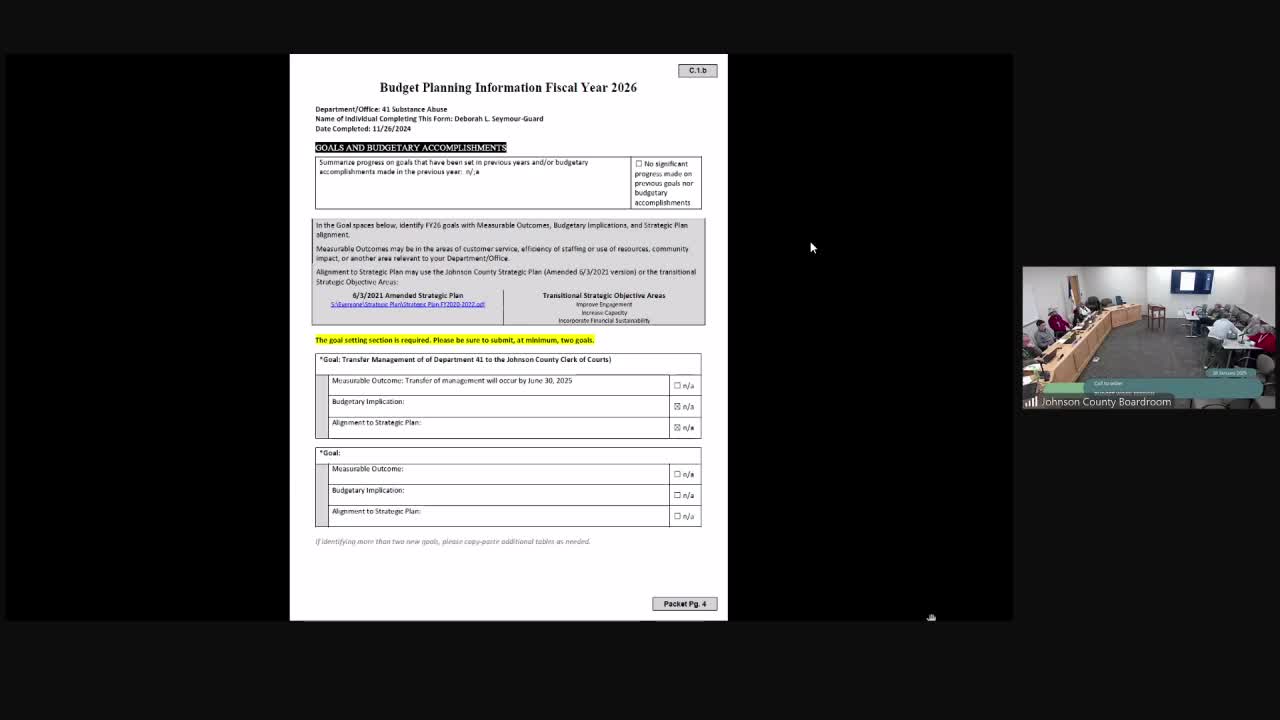
Johnson County supervisors reviewed proposed FY2026 budgets for substance-abuse targeted case management and mental health and disability services (Departments 41, 42 and 43), flagging uncertain state guidance and potential county liabilities if the regional entity winds down on June 30.
Johnson County supervisors on Jan. 28 discussed proposed fiscal year 2026 budgets for the county’s mental health and disability services and substance-use programs, saying key revenue and closing procedures depend on guidance the county has not yet received from the state and the regional managing entity.
County finance and program staff told supervisors Departments 41, 42 and 43 reflect largely routine costs but carry specific uncertainties tied to the East Central Region and the incoming Administrative Services Organization (ASO). The county has budgeted for possible contract payouts, accruals and a fiscal-agent distribution that staff characterize as a “worst case” estimate.
The discussion matters because the region’s planned closure after June 30 could leave counties to reconcile payments, return unused funds or absorb final payroll and unemployment costs. “We still do not have any guidance from [the state] as to how anything is gonna close out,” a county finance staff member said, noting the budget includes line items for final accruals, vacation payouts and a potential distribution back to a fiscal agent.
Staff said Department 41 (commitment expenses and the county-funded judicial referee contract) remains largely unchanged except for a decrease in the judicial-referee line. Department 42 shows a seeming decrease driven by payroll timing (26 pay periods next year instead of 27), though annual salary costs rise when measured on a per-pay-period basis. Department 43 was described as the most uncertain: the budget includes six days of payroll accrual, vacation payouts for three employees who qualified for a quarter-sick-leave payout, and a $150,000 placeholder to cover any required returns to the fiscal agent.
Supervisors pressed staff on several potential liabilities if the region ceases operations. County staff warned unemployment claims for regional employees would fall on counties because the employees are technically county employees. Staff estimated about seven staff members could be affected in the immediate county-administered functions that the region currently performs. A county official also said fiscal-agent services after a regional close could cost roughly $12,000 for about three months, depending on how responsibilities are assigned.
Board members asked about possible state interventions, final audits and whether the ASO would assume responsibilities or reimburse counties. Staff said some reimbursements (for example, the county-funded advocate position) are expected to continue but that the mechanics of reimbursement by the ASO were not yet clear.
Supervisors and staff agreed to continue tracking region-to-county reconciliation issues and to update the board as state guidance becomes available. No formal votes or changes to the proposed budgets were recorded during the session.
The board moved on to other budget items after the discussion.