Get Full Government Meeting Transcripts, Videos, & Alerts Forever!
Get email alerts on the County Budget topic
No spam. Unsubscribe anytime.
Johnson County supervisors advance FY2026 budget with $1.5M conservation bond authority, approve ambulance funding and multiple line items
Summary
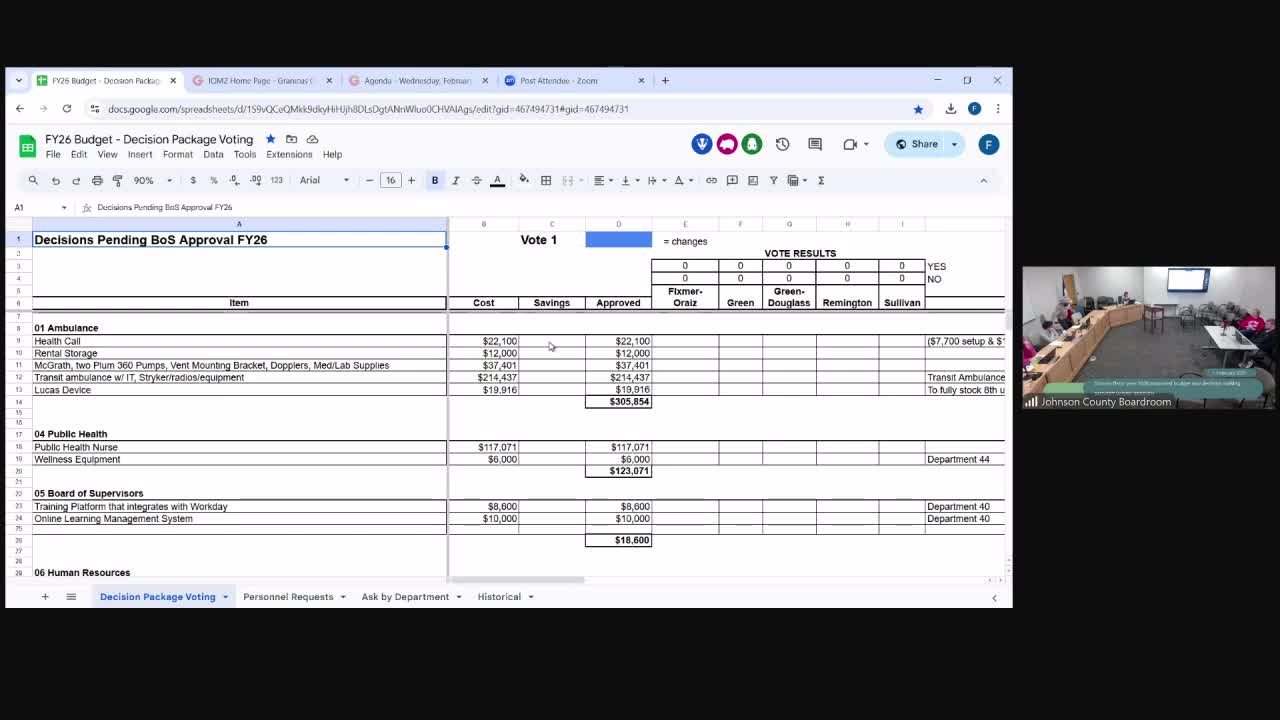
Johnson County's Board of Supervisors on Feb. 5 took preliminary votes on a broad slate of FY2026 budget items, including formal approval of $1.5 million in conservation bond spending authority, a decision to proceed with a transit ambulance program that staff say will be largely revenue-offset, and adjustments to the sheriff's inmate-housing line item.
Johnson County's Board of Supervisors on Feb. 5 took preliminary votes on a broad slate of FY2026 budget items, including formal approval of $1.5 million in conservation bond spending authority, a decision to proceed with a transit ambulance program that staff say will be largely revenue-offset, and adjustments to the sheriff's inmate-housing line item.
The session was a working vote round rather than a final budget adoption; supervisors repeatedly noted the first-round approvals can be amended later in the year. The board also set funding targets for several community grants and departmental capital requests and directed staff to return with more detailed cost and cash-flow information on several large projects.
Why this matters: the votes set spending authority that lets departments continue project planning and contract work going into the formal budget process. The conservation bond authority and the transit-ambulance decisions are the day's largest policy-relevant items because they affect multi-year capital programs (trails, park shelters) and public-safety capacity (transfers/transport units and medical equipment).
Dionne Johnson, identified in the meeting as "the director," told supervisors the county is not yet at the projected operational cadence for a dedicated transfer/transport ambulance but expects volumes to grow: "we are on average 2 to 3 bottles per day," she said, and added that Johnson County will receive central transfers when the University's admissions and transfer center goes live in March. Adam Kirko, identified as a financial analyst, summarized the budget treatment for ambulance revenues, saying, "I believe we captured the majority of it in FY25's budget," including FTEs and vehicle costs consolidated in the ambulance line.
On conservation, Brent Friedoff, director of the Johnson County Conservation Board, walked the supervisors through how existing and new bond proceeds and federal reimbursements flow into project budgets. He told the board the Clear Creek Trail has about $3 million in federal funds and that "we have already taxed for $3,000,000 of the 02/2008 conservation bond" and that the 2024 conservation bond is planned as a $30 million program over 20 years. Friedoff and staff asked the board for budget authority to cash-flow projects while reimbursements arrive.
Facilities Director Dave Frish advised the board on a separate facilities request, cautioning that a proposed window cut in a steel-cross-braced wall would likely be "not much more than a porthole" and could cost more than the $20,000 line item if significant brick cutting and interior work were required.
Board members repeatedly flagged items that need follow-up before final votes, including: verification of ambulance revenue capture and timing, the cash-flow mechanics for reimbursable DOT grants on the Clear Creek Trail, more detailed cost breakdowns for the courthouse renovation package, and whether parts of the sheriff's repair request could be staged or pared back.
Votes at a glance (selected, first-round budget authorizations and outcomes)
- Transit ambulance (transit/transfer vehicle and related FTE funding): passed (Yes: Mandy, Lisa, V, Rob; No: John); outcome: preliminary approval to include funding in FY2026 budget with option to amend later.
- Lucas device (high-cost medical device request listed separately from medical equipment): failed (Yes: Lisa, Mandy; No: Rod, John, Andy).
- Conservation bond authority: $1,500,000 budget authority for projects (to be reimbursed in part by federal DOT grants for Clear Creek Trail); passed (unanimous among those voting in the recorded roll call).
- Jail inmate housing expense (reduction from $960,000 to $800,000 as a compromise): passed (Yes: John, Lisa, Mandy, V, Rod).
- Seed shop expansion (two options considered): three-bay option failed; two-bay option (with alternate for third bay) passed.
- Courthouse renovation phase (Phase 4, $2.3 million): passed on this round (board asked for follow-up detail prior to final appropriation).
- Sheriff's facility repairs (capital request ~$3,355,099): passed for budget authority; board directed staff to return with prioritization and staging options.
- Education and Quality of Life grants (placeholder): set at $200,000 for FY2026 (passed; recorded roll call: Rod voted Nay).
- Greater IC (economic development) service agreement / coordinator position (continue status quo at the budgeted level tied to in-house coordinator): approved (recorded roll calls show majority approval).
- Historic Poor Farm Healing Trail amenities: board reduced the line item from $10,000 to $2,000 and approved that amount.
What supervisors asked staff to return with
Supervisors asked for written/cash-flow clarifications on: whether transit-ambulance revenues and FTEs as budgeted will be sufficient to offset costs; how federal DOT reimbursements will be routed and timed for Clear Creek Trail work; a clearer breakdown of the courthouse renovation package and which pieces (sidewalks, HVAC, sidewalks, holding-cell work) can be deferred without disrupting contractors; and prioritization within the sheriff's repair request so that the board can consider staging rather than one-time full funding.
Key clarifying details recorded in the session
- Ambulance: staff said the county budget currently reflects roughly $912,000 associated with the ambulance program (FTEs, vehicles, and fees). The transit/"Sprinter" vehicle option was described as a lower-cost alternative in the $120,000—$150,000 range, compared with a full ambulance in the $300,000+ range. Staff asked for flexibility to amend later in the year if call volumes rise and revenue offsets materialize.
- Conservation: the Clear Creek Trail has approximately $3,000,000 in federal reimbursements; supervisors and conservation staff discussed treating bond proceeds and reimbursable grants separately for cash-flow purposes. The 2008 bond had $3,000,000 previously taxed and available for projects; the new 2024 conservation bond is a $30 million, 20-year authorization that the board will set an annual tax rate for.
- Jail repairs and inmate housing: supervisors proposed and approved trimming the inmate-housing line from $960,000 to $800,000 as a compromise while keeping funding available for operational contingencies and possible repairs at the existing facility.
- Grants and program funding: the board adjusted several program and grant placeholders and service agreements (Education & Quality of Life grants, Emerging Organizations grants, City Catalyst grants, Greater IC service agreement and the new affordable-housing coalition); amounts were approved at lower levels than some departments requested, with direction to revisit during fall amendment cycles.
What comes next
Supervisors and staff emphasized that this session provided budget authority and direction, not final appropriations. Staff were asked to return updated budget worksheets, state budget forms and more detailed cash-flow and bid information before final votes. The board scheduled its next formal meeting for 9 a.m. the following day and will continue refining FY2026 numbers in subsequent sessions.
Ending: The board recessed the work session after the first round of votes; supervisors stressed the need for follow-up information on large capital and grant-funded projects before final adoption.