Get Full Government Meeting Transcripts, Videos, & Alerts Forever!
Get email alerts on the Community Engagement Jail Study topic
No spam. Unsubscribe anytime.
University of Iowa center proposes survey and focus groups to gauge Johnson County views on sheriff’s office and jail
Summary
University of Iowa researchers proposed a $77,000 mixed-method study — a 400-response mail survey plus six 90‑minute focus groups — to assess public and provider views of the Johnson County Sheriff’s Office and jail; the criminal justice committee agreed to report the proposal to the Board of Supervisors for funding consideration.
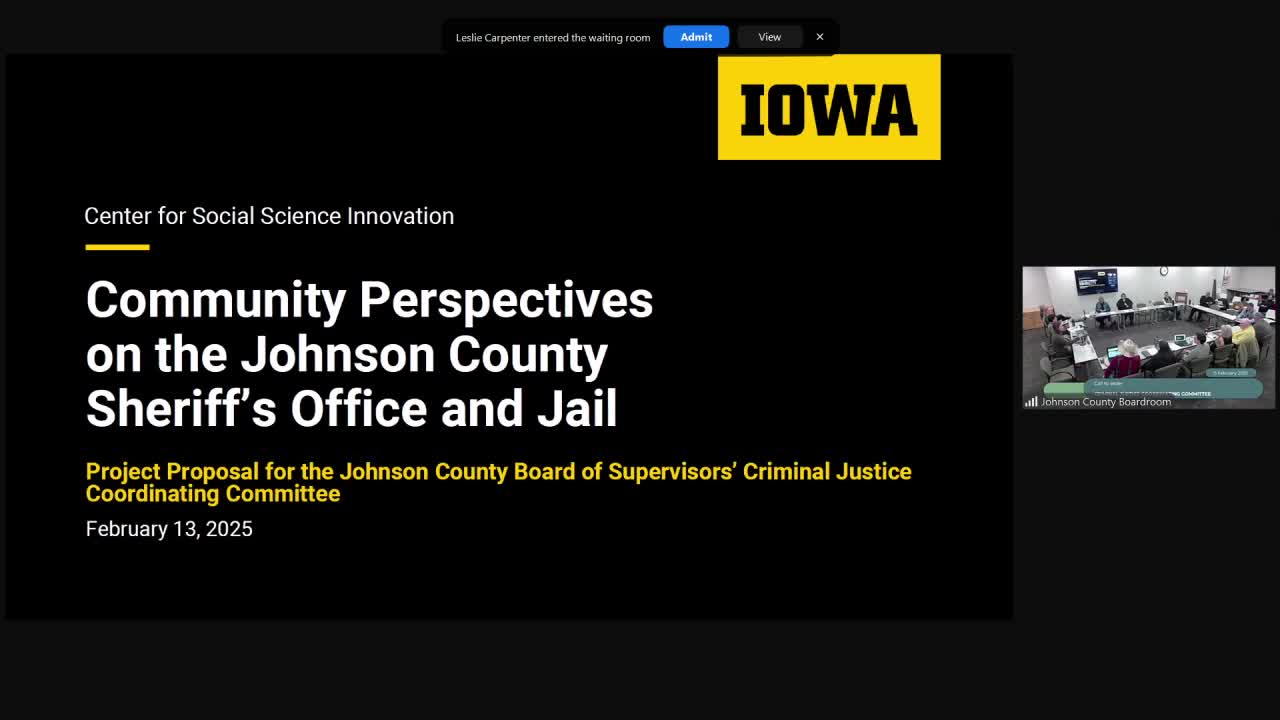
The Johnson County Criminal Justice Coordinating Committee heard a proposal on Thursday, February 2025 from the University of Iowa Center for Social Science Innovation to survey and convene focus groups to measure community and provider perspectives on the Johnson County Sheriff’s Office and jail.
The center proposed a mixed‑method project that would target about 400 completed surveys, stratified by geography and supplemented by phone follow‑up, plus six 90‑minute focus groups (three targeted to people with relevant expertise or experience and three recruited from the survey pool). The center estimated the program cost at approximately $77,000 and presented an accelerated timeline that would require a contract be signed before March to begin survey development in April, report interim results in May–June and close out in July.
“This is simply our recommendation,” Ethan Rogers, associate director for the Center for Social Science Innovation, told the committee. Rogers said the center would collaborate with committee members on question content and sampling and could supply dual‑language (English/Spanish) materials with additional languages added if requested. He described the center’s preferred survey mode as mail with phone follow‑up to boost response rates and said text‑to‑web or phone‑only approaches are possible cost‑saving alternatives with tradeoffs in representativeness.
Rogers described sample design and recruitment: “We are proposing targeting about 400 completed surveys,” a target the center said would yield a roughly 95% confidence level for county‑level estimates if the underlying sample is sufficiently large. The team proposed stratifying the sample by zip code and other available variables and offered weighting to benchmark results to the American Community Survey if the committee requests it.
On focus groups, the center proposed six sessions (about six participants each for community groups and similarly sized targeted groups), moderation and transcription, and thematic analysis to complement survey results. The presenters noted that omitting the survey would require a different, more expensive recruitment strategy for the focus groups.
Committee members discussed objectives, sampling, and timeline. Several members urged more targeted input from system stakeholders — jail staff, mental‑health providers and other subject‑matter experts — alongside community input. One participant suggested running expert focus groups before the public survey so findings could inform question wording; the center said both sequencing options were feasible and described the logistical tradeoffs.
“Just a item on execution here is this committee has no budget authority,” the committee chair said, laying out the next step: if the committee reaches consensus to pursue a version of the proposal, the committee will report the recommendation to the Johnson County Board of Supervisors so the supervisors can decide whether to fund and execute a contract.
Julie Persons, Johnson County auditor, recommended scheduling ballot‑language discussions with an eye toward legislative timing: “I would suggest when you discuss the ballot language in April, you bring it back in May for any changes and then submit it to the office,” she said, and noted county staff do not require final language until mid‑September.
The committee generally expressed support for the mixed‑method approach as a starting point. Multiple members said they favored keeping both surveys and focus groups — with attention to recruiting providers and impacted people — to inform future decisions about facility design, ballot language and public outreach. No formal vote was taken; the committee agreed to report the proposal to the Board of Supervisors for a funding decision and possible contract execution.
The presentation and committee discussion also occurred alongside other agenda items: the sheriff reported that space‑planning work is underway and will continue into the spring and early fall, and the committee discussed planned jail tours of other counties in late March as part of their fact‑gathering.
Next steps recorded in the meeting included: the committee reporting the proposal to the Board of Supervisors for funding consideration; committee members and staff refining the scope, timing and question topics; and University of Iowa staff preparing a contract and a more detailed project timeline if the supervisors authorize work to proceed.