Get Full Government Meeting Transcripts, Videos, & Alerts Forever!
Get email alerts on the Voter Eligibility Identification topic
No spam. Unsubscribe anytime.
Committee advances bill to allow state access to limited‑term ID data, and to make license format more visible
Summary
Representative Wayne Long brought House Bill 1422 to give the Secretary of State access to DFA data on limited‑term driver's licenses and to require limited‑term IDs be printed in a vertical format to aid poll workers in identifying noncitizen IDs.
Representative Wayne Long presented House Bill 1422, which the sponsor described as an effort to let the Secretary of State query DFA data on limited‑term (noncitizen) driver's licenses and to require those limited‑term cards to be more visually distinct — printed in a vertical (portrait) format so poll workers can identify them more easily.
Long told the committee DFA data show tens of thousands of limited‑term licenses are in circulation and that those cards, combined with a Social Security number and a state ID, provide the documents someone would need to register to vote only if they falsely mark themselves a citizen. The bill would authorize the Secretary of State to access DFA data to cross‑check whether holders of limited‑term licenses are registered to vote.
The Secretary of State’s office told the committee it currently lacks access to DFA data and has struggled to find a reliable method to check citizenship for registered voters. The office said federal SAVE data and other sources tried previously were not suitable for Arkansas's needs. Act 441 of 2023 required the Secretary of State to pursue methods to check citizenship, but officials said the state remains constrained without DFA access.
Witnesses for and against the bill differed sharply. Mireya Rythe, executive director of Arkansas United, said her organization has accompanied immigrant residents through naturalization and voter‑registration processes and had not observed noncitizens attempting to register; she warned making IDs visually distinct could deter immigrants from reporting crimes, seeking services, or participating in public life. Marisela Garcia of Arkansas Advocates for Children and Families said data sharing and automatic list checks risk wrongful actions because immigration and work authorization status is fluid and encoded differently on Social Security documents; she also warned of unintended legal consequences for migrants if enforcement followed data matches.
Representative Long said early versions of the bill included license suspension for some findings but that those provisions were removed before the committee hearing. He and the Secretary of State emphasized that the bill’s purpose is to identify potential mismatches so officials can follow up, give affected people notice and an opportunity to explain their status, and remove ineligible voters only after due process.
Committee members asked how the vertical format would be implemented and whether existing limited‑term cardholders would need to obtain new cards before renewal; Long said the change would take effect at renewal and would not immediately require replacements. The Secretary of State said the vertical format matches an existing layout used for under‑21 cards and would be feasible to adopt at renewal, but DFA cautioned in testimony (through opponents) that changing card format could create real‑ID complications and operational costs.
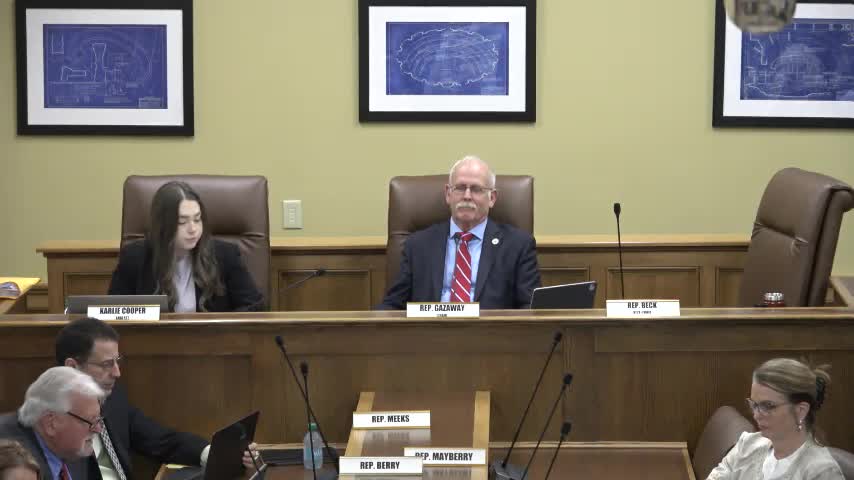
The bill drew many detailed questions about accuracy, due process, the risk of wrongful purges and the broader impacts on immigrant communities. Representative Long closed by saying the measure was designed to be a targeted check, not a punishment, and he moved the measure. After discussion and a roll call, the committee approved HB 1422.