Get Full Government Meeting Transcripts, Videos, & Alerts Forever!
Get email alerts on the Blight Remediation topic
No spam. Unsubscribe anytime.
Reading planning commission hears update on city's housing and blight-remediation strategy
Summary
The Reading Planning Commission received a presentation on the city's 2019 Housing and Blight Strategy and current remediation priorities, including data-driven property inventories, demolition funding, conservatorship, land-banking and a previously set-aside $1 million housing/blight fund.
Reading's Planning Commission heard a detailed presentation March 18 on the city's Housing and Blight Strategy and current blight-remediation priorities, including tools the city and the Redevelopment Authority are using to acquire, secure and rehabilitate problem properties.
Shannon Kalori, a consultant with a housing consulting firm working with the city, told the commission the strategy was developed in 2019 and has been actively implemented since 2020. Kalori said the plan emphasizes a data-driven, systems-based approach and recommended parcel-by-parcel external property condition surveys and a centralized problem-property inventory.
The strategy matters because it shapes which properties the city targets for intervention and which financial and legal tools are used. That determines whether problem buildings are secured and returned to productive use, demolished as hazards, or passed to the Redevelopment Authority for acquisition and redevelopment.
Kalori described several specific practices and tools the city is using or considering: a parcel-level property-condition database implemented using a commercial tool identified in the presentation as Building Blocks; targeted use of Community Development Block Grant (CDBG) funds and other programmed and unprogrammed federal/state resources; foreclosure property registration; presale-inspection policies under consideration; and an active certification-and-eminent-domain pipeline through the Redevelopment Authority.
She said the city previously conducted an external survey during the COVID-19 period, then imported that data into the Building Blocks tool to prioritize interventions by indicators such as vacancy, last inspection date and visible exterior conditions. Kalori also stressed that many owners of deteriorated properties cannot afford repairs and recommended programs to support owner-occupants, including home-repair grants and targeted rehab assistance.
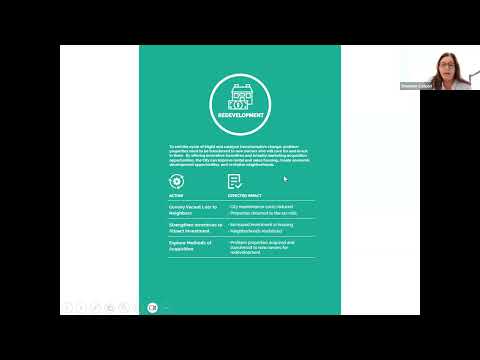
Kalori outlined legal and administrative authorities the city can use for the most difficult properties: filing a blight certification with the county recorder of deeds (a state law adopted around 2019 that allows notice to run with the deed), pursuing blighted-property eminent domain through the Redevelopment Authority, establishing a land bank to acquire properties at judicial sale, and using conservatorship proceedings to secure and rehab vacant properties under a court-approved plan.
She told the commission the city has a dedicated pool of funds and other resources to support demolition and remediation: "The city has set aside $1,000,000 in 2018 for blighted property remediation and a housing fund," Kalori said. She added that the city can also leverage CDBG funds and other grants.
Commission members raised practical concerns: how to address demolition in attached-row contexts where removing one house exposes interior walls; the difficulty of finding and serving absentee owners who use PO boxes; patterns of out-of-state ownership; and limits on the city's ability to compel quick rehabs. Commissioners and participants discussed tactics to improve owner contact (private investigators were suggested), deed restrictions on properties sold by the Redevelopment Authority, and the idea of creating an internal rubric or checklist to decide which legal tool (conservatorship, eminent domain, land bank, demolition, rehabilitation grants) best fits a given property.
Will, a former member of the city's blighted-property review committee, described a past successful use of conservatorship for a property whose owners had died; other speakers pointed to recent Redevelopment Authority activity conveying small parcels to adjacent neighbors and the authority's recent hiring of Dr. Paige Brookmans to strengthen redevelopment work.
Participants also discussed coordination and funding gaps. One commissioner asked whether past CDBG or HOME program funds were being fully used; Kalori and city staff said the administration had recently secured funding and planned new or restored programs (sidewalk-repair programs were cited for possible 2026 funding). The presentation and subsequent discussion repeatedly emphasized that blight work is resource- and time-intensive and that multiple tools must be applied to different property types.
The meeting included two procedural votes: the planning commission approved the meeting agenda at the start of the session and later voted to adjourn; the adjournment vote recorded one opposed member. The session ended with the chair announcing the commission's next regular voting meeting on March 25, 2025, and the next workshop on April 15, 2025.
The presentation and discussion combined technical detail (data tools, legal pathways) with operational concerns (funding timing, contractor capacity, outreach to absentee owners). Commissioners asked the administration to return with implementation checklists and clearer coordination steps so the city can move properties from the certified list to remediation or productive reuse.