Get Full Government Meeting Transcripts, Videos, & Alerts Forever!
Get email alerts on the Energy Rebates Speed Council topic
No spam. Unsubscribe anytime.
JFAC debates Home Energy Rebate funding and a proposed 'Speed Council'; neither federal rebate nor council funding cleared the committee
Summary
Committee members debated awarding the Office of Energy and Mineral Resources $24.5 million in federal Home Energy Rebate funds and a $481,000 general‑fund request for a proposed 'Speed Council.' Multiple substitute motions failed to secure majorities in both chambers, and the items did not receive committee approval.
Committee members debated whether to accept a federal Home Energy Rebates program appropriation and whether to add a governor-backed one‑time $481,000 general‑fund appropriation and 1 full‑time equivalent for a proposed “Speed Council” housed in the Office of Energy and Mineral Resources (OEMR). Neither proposal received the required majorities in both chambers of the joint committee.
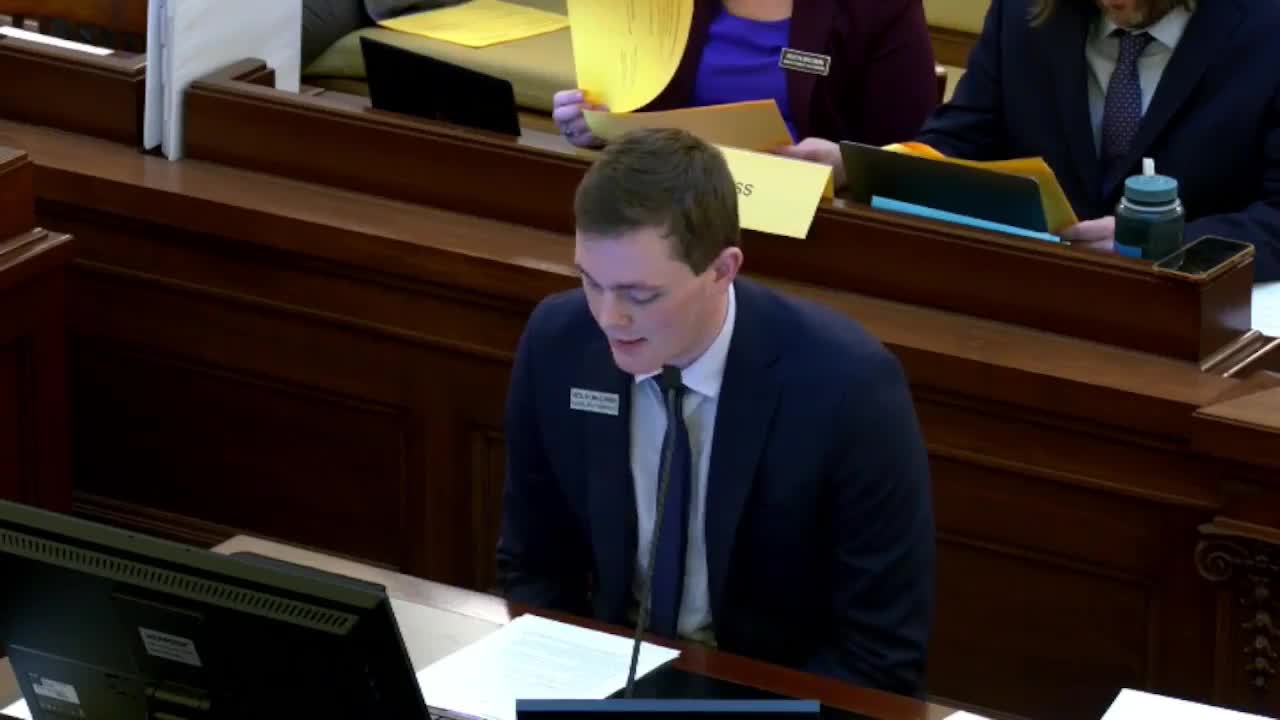
Kellen McGurkin, budget and policy analyst with the Legislative Services Office, summarized the OEMR requests and the federal program: “The home energy rebates program itself was created under the Inflation Reduction Act of 2022 and offers $80,800,000 in federal funding to the state of Idaho to be used through 2031,” McGurkin said. He described OEMR’s request for approximately $24.5 million in federal funds to administer the program, including $20,000,000 intended for direct rebates to households and roughly $4,000,220 for a third‑party implementer and software.
Senator Woodward moved a narrower motion to adopt the governor’s Speed Council proposal — one FTP and $481,000 from the general fund — without the federal rebate appropriation. Other members then offered substitute and amended motions to include the federal rebate funding (24,579,900 in federal funds and 4 FTP). The amended substitute and substitute motions each failed to achieve the required majorities across the two chambers, as recorded in the committee roll calls, and the chair announced those motions failed on the floor and would be referred according to chamber procedure.
Roll-call results recorded during the debate: an amended substitute including the rebates failed with a grand total of 9 yes, 10 no, 1 absent; subsequent motions similarly failed to secure the majority thresholds in both chambers. Committee members who supported the federal rebate emphasized direct homeowner assistance; opponents questioned readiness, implementation costs, and whether Idaho would administer the program.
Staff noted there is no state match required under current federal law and that federal statute provides for reallocation of a state’s share to participating states if a state declines to administer the program. The OEMR request also included an optional Speed Council intended to coordinate permitting and provide a public dashboard for critical infrastructure projects; proponents argued it would streamline large projects, while others suggested using one‑time executive funds or returning to the proposal in a later year.
Because the committee did not adopt the motions, OEMR’s requested federal appropriation and the Speed Council funding did not proceed from committee as approved items.