Get Full Government Meeting Transcripts, Videos, & Alerts Forever!
Get email alerts on the Transportation Gateway topic
No spam. Unsubscribe anytime.
County consultants offer two main Saint Simons gateway designs; board asked to pick preferred alternative to move into schematic design
Summary
Consultant Moffett Nichel presented two primary alternatives for the Saint Simons Island gateway: a three-roundabout option and a continuous-flow/displaced-left (CFI) option. Both improve traffic flow and safety; cost estimates and trade-offs on delays, wetlands impact and constructability were discussed.
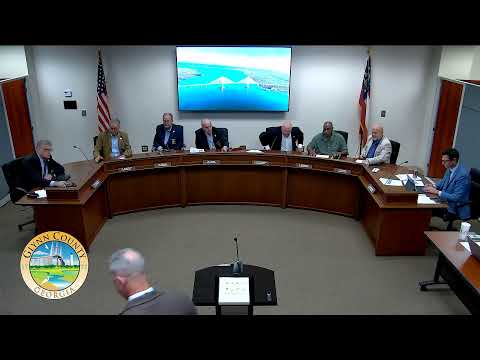
Consultants presented two preferred alternatives for the Saint Simons Island gateway and Demery Road improvements and asked the Glynn County Board of Commissioners to indicate a preferred concept to advance into schematic design.
What was presented: Roland Talbot, director of capital development, introduced consultants from Moffett Nichel (presentation lead identified as Ron [surname unclear in transcript]) who said they had narrowed concepts to a three-roundabout alternative and a continuous-flow/displaced-left (CFI) alternative. The consultants described estimated construction costs that range from about $11–$13 million for the CFI option to $15–$17 million for the three-roundabout option; utility adjustments and right-of-way needs were also discussed.
Key trade-offs: The three-roundabout scheme offers near free-flow movement for vehicles entering the island from the causeway and better speeds for the heaviest inbound flows, but consultants and several commissioners noted it would likely produce periodic queuing and up to about a minute of additional delay for some movements (notably vehicles on Demery Road trying to leave the island during morning peak). The CFI/displaced-left alternative uses a signalized displaced-left configuration to allow overlapping movements; consultants said it requires a somewhat smaller footprint, may be less wetland-impacting, and would generally reduce the long queues on Demery at the cost of signalization, battery or generator backup considerations, and a cycle length (model used roughly a 100–160 second cycle in analysis).
Environmental and right-of-way impacts: Moffett Nichel estimated roughly two acres of additional right-of-way and around three acres of wetland impacts for one of the concepts, and noted careful coordination is required to avoid a heavy transmission line corridor that crosses the study area. The consultants also discussed gateway landscaping opportunities in available median and buffer areas.
Safety and operations: Consultants reviewed crash-severity trade-offs and noted federal and Georgia DOT data showing roundabouts typically reduce crash severity and frequency, but the displaced-left decreases conflict by separating left-turning traffic from through movements. Commissioners asked about storm and power-outage resilience; consultants said roundabouts retain operation without signal power but signals can be equipped with backup batteries or generators and have modest ongoing power and maintenance costs.
Next steps and decision requested: The project team asked the board for a consensus on which alternative to move forward into schematic design. Commissioners discussed impacts on Demery Road, Kings Way traffic shifts, constructability while maintaining traffic, and future 2045 design-year performance. No formal vote was taken at the work session; staff and consultants will return with refined models and cost estimates after the board indicates a preferred direction.
Ending note: Consultants emphasized additional design work is needed, including refined traffic modeling, right-of-way assessments and wetland permitting. The board's selection will guide schematic design and public-engagement steps.