Get Full Government Meeting Transcripts, Videos, & Alerts Forever!
Get email alerts on the Environmental Health Superfund topic
No spam. Unsubscribe anytime.
Emory pilot study finds elevated PCBs and toxaphene in Glynn County residents; county urged to press EPA, DNR and trustees to finish remediation
Summary
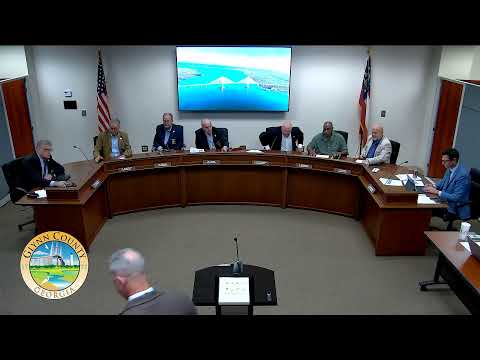
A pilot human exposure study led by Emory University found higher-than-expected levels of certain polychlorinated biphenyls (PCBs) and toxaphene in blood samples from about 100 Glynn County adults, researchers told the Glynn County Board of Commissioners on March 18.
A pilot human exposure study led by Emory University found higher-than-expected levels of certain polychlorinated biphenyls (PCBs) and toxaphene in blood samples from about 100 Glynn County adults, researchers told the Glynn County Board of Commissioners on March 18.
The study ‘‘did not find any evidence that there were elevated exposures’’ to mercury, but ‘‘we did find evidence of elevated exposures for PCBs and for toxaphene,’’ Emory faculty member Dr. Noah Skovranick said, summarizing the team’s results. For three PCB congeners that the researchers linked to the former LCP Chloralkali site, ‘‘the average exposures … were higher than the average level we would expect in the general population of the United States,’’ and almost 40 percent of study participants measured above the U.S. 95th percentile for PCB-206, he said. For toxaphene, roughly 20–25 percent of participants were in the highly exposed category, the team said.
Why it matters: County and local nonprofit leaders said the results strengthen calls to accelerate cleanup plans and to fund further health and environmental study. Alice Keys of the coalition Healthy Coastal Neighborhoods told commissioners the resolution before them urges the U.S. Environmental Protection Agency to finalize remediation plans at two Superfund sites, asks the Georgia Department of Natural Resources (Environmental Protection Division) to complete a corrective action for benzene under a former Panova/DRT site, encourages public and private funding for follow-up health research, and asks trustees to pursue a natural resource damage claim on remediated marshland.
Study scope and limits: Dr. Skovranick repeatedly described the project as a pilot study and said the sample ‘‘was not representative of the full county.’’ Participants were adults who had lived in Glynn County at least 10 years; the handout summaries note the average participant had lived in the county for about four decades. The research team enrolled roughly 100 residents by word-of-mouth recruitment from multiple neighborhoods (including Arco, Blythe Island and St. Simons), Skovranick said, and some of the highly exposed participants lived far from the industrial sites. The team is seeking peer review and additional funding to expand analyses.
Residents’ perspectives: Hal Hart, a lifelong resident who provided his individual test summary to the commissioners, said the study ‘‘has more questions than it does answers’’ and urged commissioners to adopt the resolution and to support further Emory work. Jas Watts of 100 Miles, who said he grew up in Glynn County, told the board the resolution ‘‘would not ban fishing or crabbing’’ and that community action instead is intended to ‘‘help the agencies make sure they’re doing what’s needed to clean up the contamination.’’
Agency and legal context: County staff and speakers clarified the cleanup landscape is complex. The LCP marsh remediation had been finalized by the EPA, the presenters said, covering more than 600 acres of marshland; that milestone starts a three-year window for trustees — NOAA, U.S. Fish and Wildlife Service and Georgia DNR — to file a natural resource damage (NRD) claim to recoup lost public use of those resources. The resolution before the board focuses on urging agencies (EPA and Georgia DNR) to complete outstanding remedy and corrective-action plans, on encouraging funding for continued exposure and seafood research, and on urging trustees to consider NRD filings where appropriate.
Requests to commissioners and next steps: Presenters asked the commission to place a version of the resolution on the board’s Thursday agenda. Commissioners and staff discussed existing seafood advisories and prior wildlife studies (including a 2015 dolphin study in Sapelo Sound that found elevated PCBs) and noted UGA and other partners have produced local seafood guidance and a community cookbook with advisory information. Emory researchers and coalition partners said they need additional funding to expand exposure and seafood sampling.
What the county decided: The board did not vote on the resolution at the March 18 work session; staff indicated a form of the resolution would be placed on the board’s Thursday meeting agenda for formal consideration. The presentation and the request for the resolution were clearly identified as a referral for future board action.
Ending note: Presenters emphasized the pilot status of the research and called for additional, funded study to better understand exposure pathways and community risk. Community groups said the resolution is intended to amplify Glynn County’s voice to the federal and state agencies that control remediation and damage claims.