Get Full Government Meeting Transcripts, Videos, & Alerts Forever!
Get email alerts on the Trestle Creek Plowing topic
No spam. Unsubscribe anytime.
Bonner County workshop considers ending plowing past snowmobile lot unless Forest Service provides turnaround
Summary
County Road & Bridge cited safety and liability concerns for plowing beyond the Snowmobile parking turnaround on Trestle Creek Road and asked staff to work with the U.S. Forest Service on a possible groomer path or dedicated turnaround; residents urged continuation of the 25-year practice and offered local fixes.
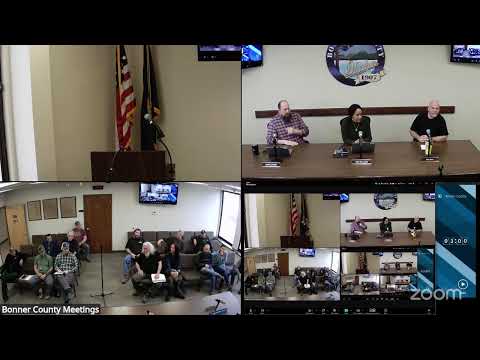
Bonner County officials, road crews and residents debated whether county crews should continue plowing Trestle Creek Road beyond the snowmobile parking turnaround during a workshop that focused on safety, liability and maintenance responsibilities.
Road and Bridge Director Jason Topp told the Bonner County Board of Commissioners that county plows face safety risks where narrow sections and private gates limit where crews can store snow and turn equipment. “It is my opinion that if the Forest Service wants us to continue maintenance above the Snowville turnaround, that they should be providing us with a turnaround,” Topp said, using his title when he spoke to the board.
The issue matters because the county currently performs winter maintenance beyond the end of its usual jurisdiction as part of a cooperative agreement with the U.S. Forest Service. Topp described repeated near misses between plow trucks and snowmobilers, the difficulty of turning 40-foot plow trucks on steep grades, and the lack of legal right-of-way to store snow on private property. Residents who spoke during public comment said county crews have plowed the upper section for about 25 years and argued the existing turnaround and easements are sufficient.
Residents described local fixes and regular cooperation with plow crews. Property owner Eric Soles said he put berms and a gate in place after vandalism and trespass, and that he coordinated with the county to arrange a place for plows to turn. “I did not gate my property until the county went up Trestle Creek Road and created a turnaround,” Soles said. Other residents and longtime users said the interim turnaround installed four years ago has worked and that there have been no known incidents on their section.
U.S. Forest Service representative Kyle Lee told the board the agency currently lacks budget to build a new turnaround this year but said options exist nearby. “If you continued 0.4 more miles up the road, there is already a good turnaround there,” Lee said, referring to a campground site he identified as suitable for a plow turnaround and staging.
During discussion commissioners and staff explored alternatives short of immediate construction: limiting mixed traffic on the narrow section, encouraging a groomer trail adjacent to the road to keep snowmobiles off the plowed travel lane, securing a dedicated turnaround on forest land, or having residents assist with keeping a turnaround clear. Topp and county staff noted design constraints: acceptable turnaround geometry requires roughly a 60-foot radius (about 120 feet across) and current right-of-way widths do not allow that in the existing corridor; plow trucks are about 40 feet long and do not pivot like smaller vehicles.
No formal motion or vote was taken; the board treated the session as a workshop. The board asked Road & Bridge to meet with Forest Service staff and landowners to develop a feasible proposal — including a possible groomer path adjacent to the road or a dedicated turnaround — and return to the board with options for next winter. The board emphasized that the stretch is a Forest Service road under a Schedule A cooperative arrangement and that continuation of county plowing is not an automatic taxpayer obligation.
The discussion also noted possible costs and complications: a Federal Lands Access Program (FLAP) project to widen and reconstruct portions of the road was referenced as a multi‑million dollar undertaking, and staff said terrain and drainage pose engineering challenges for creating additional turnaround area.
The workshop closed with the board directing staff to draft and return with a written proposal that outlines feasible alternatives, estimated costs and any land-rights or easement changes required. No resolution or policy change was adopted at the meeting.