Get Full Government Meeting Transcripts, Videos, & Alerts Forever!
Get email alerts on the Procurement Consulting Services topic
No spam. Unsubscribe anytime.
Commission renews two‑year continuing services list for architects, engineers and planners
Summary
The City Commission approved a two‑year renewal of its continuing consulting services RFQ for engineering, architecture, landscape architecture, surveying and planning services, extending a roster of roughly 27 prequalified firms and adding federal contract language to the agreements.
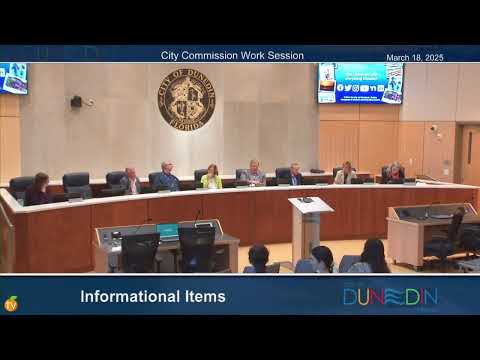
The Dunedin City Commission on March 18 unanimously approved a two‑year renewal and name‑change amendments to the city’s continuing consulting services list for architects, engineers, surveyors and planners.
The action preserves the city’s existing list of roughly 27 prequalified firms that staff may use to issue prompt task orders for design, inspection and peer‑review work. The amendment also adds federal contract provisions to the agreements to allow the city to use those consultants on future federally funded projects, including potential FEMA work after storms.
City staff described the rank of solicitations the city uses and explained why the roster is organized as an RFQ under Florida’s Consultants’ Competitive Negotiation Act (CCNA). Tammy Spearman, the city’s purchasing agent, told the commission that RFQs under Florida Statute 287.055 are awarded based on qualifications rather than price, and that the list is intended to let departments issue task orders quickly without repeating a full selection process for every project.
Finance Director Les Tyler and departmental staff explained typical uses: Clay Watkins, assistant director of utilities and city engineering, said the contracts “allow us to get to a contract and a task order quickly” for everyday utility designs, inspections and specialty engineering. George Kenny, director of community development, said planning‑related peer reviews and traffic‑impact reviews also come from the list.
Commissioners pressed staff on oversight, rotation and how new firms can gain entry. Jorge Quintas (W.C. Manager) said the city will re‑solicit in 2026 (to create a new roster in 2027) and that specialized solicitations can still be issued between major on‑ramps if a specific gap appears. Director of Utilities and Engineering Nan Bennett emphasized the legal rationale: “It is Florida law that you do not select these specific services for engineering, landscape architecture, and these things based on low bid. It is based on qualifications,” she told the commission.
Commissioners also asked about hourly rate schedules, task‑order negotiation and how staff controls costs; Bennett and staff said firms submit rate schedules at contract award and staff negotiates task hours and scope when issuing assignments.
The commission approved the renewal by unanimous voice vote. Staff said the RFQ will remain a practical tool for routine projects while the city continues to solicit for specific, complex projects on an as‑needed basis.
What’s next: staff will plan the formal re‑solicitation cycle that begins in 2026 for a new roster to take effect in 2027, and will bring project‑specific solicitations to the commission when a direct procurement is not appropriate.