Get Full Government Meeting Transcripts, Videos, & Alerts Forever!
Get email alerts on the Town Manager Act Revision topic
No spam. Unsubscribe anytime.
Danvers committee approves wording changes, adopts 20-year review language for Town Manager Act
Summary
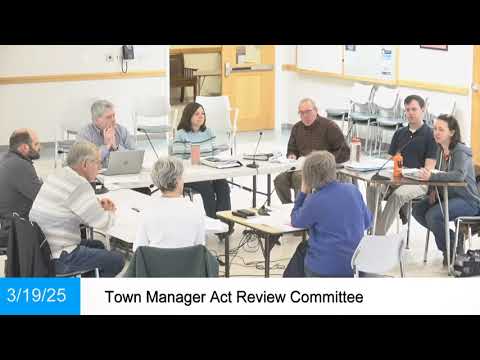
Good evening. This is the meeting for the town of Danvers town meeting, town manager acts review committee. It's Wednesday, March 19 at 6PM, and we're here at the Danvers Senior Center. Thank you all for being here.
Good evening. This is the meeting for the town of Danvers town meeting, town manager acts review committee. It's Wednesday, March 19 at 6PM, and we're here at the Danvers Senior Center. Thank you all for being here, "Sally Shorthill, committee chair, opened the committee’s March 19 meeting by distributing a revised draft of the Town Manager Act and walking members through a short list of editorial and substantive changes.
The committee, appointed after a vote of town meeting, is considering a set of mostly technical edits to the proposed Town Manager Act and a schedule for when the act itself should be reviewed in future years. The panel voted to add the word “representative” before the phrase “town meeting” wherever it appears in the draft, to split a long sentence in section 33 that governs departmental budget submissions, and to insert the same review language used in the revised Town Meeting Act — that the act “shall be reviewed by the Town of Danvers at least once in every 20 years, or sooner as requested by a majority vote of town meeting members at an annual or special representative town meeting.”
Why it matters: the changes tidy language that will appear in any final warrant article and clarify who the act is directed to; the review timetable determines how often the town will re-examine the governance rules that govern how the town manager and town meeting operate. Committee discussion also touched on the scope of town manager authority over departments such as police and fire, the process for appointing the finance committee, and public comments about residency requirements.
Most significant votes and edits
The committee unanimously accepted the minutes of its March 5 meeting. It then approved a motion to add the word “representative” before “town meeting” throughout the draft where that phrasing appears. John Almeda, a committee member, moved the change; the motion carried with committee members voting in the affirmative.
The panel also approved a motion to change the sentence structure in section 33, breaking one long, rambling sentence into two to improve clarity about how departments submit estimates and the budget process. Following discussion, a member moved the split; the motion was seconded and approved.
On the question of review timing for the Town Manager Act, the committee voted to adopt the exact language used in section 14 of the revised Town Meeting Act: the act will be reviewed by the town at least once every 20 years, or sooner by majority vote of town meeting members at an annual or special representative town meeting, and any such review will be conducted in a manner determined by town meeting members. John Almeda moved the motion to use that language for section 36 of the Town Manager Act; Fawn seconded, and the motion passed.
What the committee changed and why
Editorial and technical corrections were presented as a short list: renumbering and relocating the recall-election provision, capitalization and spelling fixes (for example, capitalizing “chief fiscal officer” and correcting “duties”), removal or rewording of a clause in section 14 concerning notice to the select board, and replacing phrasing such as “not less than monthly” with “at least monthly” for town manager reporting to the select board. The committee chair noted these were mostly consistency and clarity edits intended to make the draft easier for town meeting members and town counsel to review.
Members discussed whether the town manager could abolish or consolidate services such as police or fire stations. Committee members and staff emphasized limits: the town manager has authority under the draft to establish or abolish commissions and appoint officers, but civil-service rules, union contracts and operational steps would constrain an immediate closure of a fire station or similar action. A staff member mentioned that Danvers had previously consolidated stations when a new headquarters was built but said significant procedural steps and costs would be involved in any such consolidation.
Appointments and historic provisions
The committee agreed to standardize language across sections that reference town meeting, changing a number of instances that read “town meeting” to read “representative town meeting” for consistency. Members also discussed language about the finance committee’s origin in an older act (1949) and agreed the introductory sentence describing the finance committee appointments should be clarified so the provision would not be read as if the entire finance committee were being re‑appointed upon passage of the new act.
Public input and report-preparation plans
Sally Shorthill read a letter from resident Shannon Chan opposing removal of the residency requirement; Chan was not present. The chair also told the committee she had spoken with former Select Board member Diane Langley, who said she “really liked the way the Town Manager Act worked” and that a professional town manager centralizes operations effectively. The committee agreed to reflect both supporting and dissenting views in its forthcoming report.
The committee discussed outreach and transparency for its final report. Suggestions included making training materials available online for town meeting members, holding an annual or pre-warrant precinct meeting to connect precinct representatives with constituents (proposed timing: late February or early March to align with warrant deadlines), posting redline drafts and DCAT video links, and ensuring the report lists meeting dates and hours spent by committee members. The committee chair said she will circulate a draft report in advance of the April 16 meeting and that the committee expects to submit a final report to the Select Board after its May 14 meeting.
Direct quote highlights
"This act shall be reviewed by the Town of Danvers at least once in every 20 years," John Almeda said when he moved to use the Town Meeting Act formulation for the Town Manager Act review provision.
"I do appreciate your input," Sally Shorthill said after reading the written comment opposing removal of a residency requirement.
What the votes do and do not decide
The committee’s actions on March 19 were procedural and editorial: they do not by themselves change town bylaws or the town charter. The committee is preparing a report and redline language that, if recommended, will be forwarded to the Select Board and then appear as warrant language before a representative town meeting (or be placed on the warrant via citizen petition or other mechanisms allowed by town rules). Committee members and counsel flagged that the town cannot compel future, separately elected bodies to take specific actions; the committee’s changes primarily clarify language and recommend a review timetable.
Next steps
The committee will incorporate the edits discussed on March 19 into a revised draft of the Town Manager Act, prepare a report that documents both majority recommendations and notable dissenting views, and circulate the draft report to members before the April 16 meeting. The committee expects to make a final submission to the Select Board after its May 14 meeting; any warrant language and scheduling for a town meeting vote will follow the town’s standard warrant and finance-committee processes.