Get Full Government Meeting Transcripts, Videos, & Alerts Forever!
Get email alerts on the Nursing Home Workforce Wages topic
No spam. Unsubscribe anytime.
Senate committee hears Nursing Home Workforce Standards Board presentation, debates funding for board'set minimum wages
Summary
Leah Solo, executive director of the Nursing Home Workforce Standards Board, told the Senate Human Services Committee the board spent its first year conducting public forums, reviewing state wage data and adopting employment standards aimed at raising pay for a majority of nursing home workers.
Leah Solo, executive director of the Nursing Home Workforce Standards Board, told the Senate Human Services Committee the board spent its first year conducting public forums, reviewing state wage data and adopting employment standards aimed at raising pay for a majority of nursing home workers.
Solo said the board'created by the 2023 Legislature'held five public forums, received about 260 public comments on proposed rules, and voted on wage standards on May 9, 2024. She said the board adopted two sets of wage standards that meet the statute's "majority benchmark" (raising or matching existing pay for 50% plus one of workers) and that the earliest the wage standards could take effect is Jan. 1, 2026, because they are contingent on legislative appropriation.
The board also adopted other rules that took effect Jan. 1, 2025, including time-and-a-half holiday pay for work on 11 state holidays, certification rules for worker organizations to provide training about worker rights, posting requirements for employers, and a waiver-and-variance process for facilities that say they risk closure or receivership; Solo said no waiver applications had been filed as of the committee hearing.
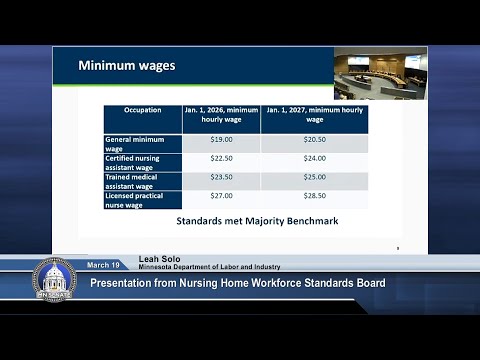
Senators and witnesses debated the rulemaking process and the cost and timing of the wage standards during consideration of Senate File 2480, a bill to appropriate money to cover the Nursing Home Workforce Standards Board minimum wage rule. Senator Joe Pappas, the bill author, said fiscal estimates from the Legislative Budget Office put the cost at roughly $5.6 million under current law and about $15 million under the administration's proposed payment cap. He summarized the board's proposal as an industry-wide minimum wage of $19 an hour in 2026 and $20.50 in 2027, with higher minimums for certified nursing assistants, trained medication aides and licensed practical nurses.
Supporters testified they represent workers and providers who want higher pay. Theresa Beres, a nursing-home laundry worker and SEIU Healthcare Minnesota member, described long staffing runs and an injury she attributed to chronic understaffing and urged funding. Matt Jensen, a maintenance lead and former AFSCME local president, urged support for the bill so nursing homes can meet the standard.
Opponents, including Long Term Care Imperative witnesses, said the cost estimates underestimate the fiscal impact and warned of closures and reduced access without adequate funding. Kyle Berndt, testifying for that group, said his organization's estimate of the mandate costs was substantially higher than the governor's fiscal estimate.
Senators asked about the board's vote composition. Solo told the committee the wage rule passed with six affirmative votes and three abstentions; the abstentions came from employer representatives who said they supported higher wages but had funding concerns. Multiple senators pressed the board's staff and proponents on whether the board should have secured more affirmative buy-in from provider representatives and on whether expedited rulemaking limited public input.
The committee considered two floor amendments to SF 2480 proposed by Senator Ann Rasmussen. The A1 amendment would have required at least one affirmative vote from a provider representative on the nine-member board before a standard could be adopted; A1 failed on a voice vote. The A2 amendment would have removed the board's expedited rulemaking authority and required use of regular rulemaking procedures; A2 also failed on a voice vote. After debate the committee laid Senate File 2480 over for possible inclusion in an omnibus bill.
Why it matters: The Nursing Home Workforce Standards Board adopted wage and holiday-pay rules intended to raise pay for many nursing home employees, but state law ties implementation to legislative funding. Committee testimony highlighted competing fiscal estimates and the risk that unfunded mandates could reduce access to long-term care in rural areas.
Looking ahead: The wage rules cannot take effect until the legislature provides appropriation; the committee laid SF 2480 over for possible omnibus inclusion and signaled further fiscal review is likely.
Actions at a glance: - A1 amendment (requirement that at least one provider representative affirmatively vote for a board standard): moved by Sen. Rasmussen; outcome: failed (amendment not adopted on voice vote). - A2 amendment (remove expedited rulemaking for the board): moved by Sen. Rasmussen; outcome: failed (amendment not adopted on voice vote). - Senate File 2480 (appropriation to fund Nursing Home Workforce Standards Board minimum wage rule): laid over for possible inclusion in an omnibus bill.
Sources: Committee hearing transcript; statements recorded from Leah Solo, Sen. Joe Pappas, Theresa Beres, Matt Jensen, Kyle Berndt, Erin Hubert.