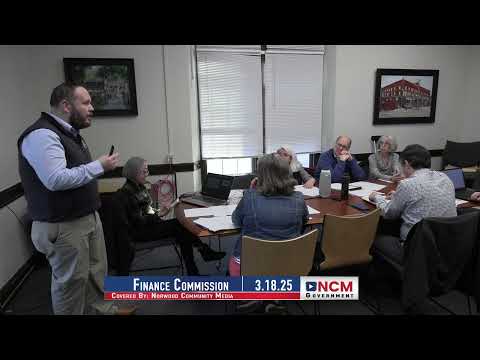
Norwood finance commission hears sharp budget pressures from health insurance, salaries and ambulance strain
Loading...
Summary
At the March 18 Finance Commission meeting, staff presented a general government budget showing rising personnel and insurance costs and reduced road funding; chiefs and staff warned that the hospital closure is stretching ambulances and could raise long-term capital and staffing needs.
The Finance Commission reviewed the Town of Norwood’s general government budget on March 18, hearing that personnel costs and health-insurance increases are the main drivers of a $43.187 million general-government total while road funding and emergency services face new stresses.
Jeff, a town staff member who presented the budget, said, "total general fund budget for, general government, we're coming in at 43,187,000 because everyone knows salaries are always the biggest driver for the budget." He and other staff told the commission that insurance and contractual costs leave little discretionary spending and that the town trimmed operating capital and road construction to balance the draft budget.
Why it matters: The budget frames service levels, capital choices and where the commission may need to apply one-time reserves. Commission members pressed staff on how much flexibility exists in noncontractual lines and whether reserve or free-cash decisions made this spring will leave the town prepared for 2026 when higher insurance bills take effect.
Key facts and council discussion - Budget totals and drivers: Staff reported a general-government total of $43,187,000. The presentation highlighted salaries and health-insurance costs as the largest single drivers. Staff said roughly $46,000 of the year-over-year increase in the general fund is not contractual, leaving little noncontractual leeway. - Health insurance: The town’s Group Insurance Commission (GIC) increase was discussed as roughly 10.5 percent and was described in the presentation as equivalent to about $2 million of additional cost for FY26 in staff estimates; presenters said the final number may move slightly higher after enrollment audits. - Chapter 90 road funding: Staff said the Chapter 90 allocation appears to rise by about $200,000 but that the governor’s proposed supplemental distribution uses a separate formula based mainly on road miles. Presenters said that, under the traditional formula, the town would have seen about $450,000 more—meaning reallocated state funding alters the town’s five-year road program and will reduce the town’s paving plans for the coming year. - Software, IT and recurring costs: Information technology licensing and legacy-system maintenance were flagged as growing, recurring costs. Presenters named Munis (financial software), the town email system (~$100,000 annually as presented), cellphone costs (~$85,000) and multiple smaller software renewals that together push the IT budget up. - Human resources and onboarding: Staff proposed exploring electronic onboarding tied to Munis to centralize hiring and reduce manual processing; the commission was told this would be a one-time implementation cost and might be proposed as a warrant item in May depending on timing and the schools’ integration needs.
Public-safety, ambulance and hospital impacts - Police and fire staffing: Presenters described contractual step and education incentives in both police and fire contracts that produced larger than usual increases this year; the police force was reported at about 65 full-time officers. The commission heard that hiring lateral officers reduces training time but increases near-term salary costs because laterals often start higher on the pay scale. - Ambulance and hospital effects: Fire and EMS leaders told the commission the hospital closure has materially increased ambulance turnaround time and wear on vehicles. Staff described an increase in call volumes and longer transports because ambulances must travel to more distant emergency departments, accelerating vehicle replacement needs and increasing maintenance and fuel costs. - Call volume and capital implications: The fire department reported roughly 7,100 calls last year, about 5,100 of them medical, and staff said the present operating pattern is causing ambulances to reach replacement condition faster. Presenters warned that, without the hospital, the town may require an additional ambulance and more staffing over time; they estimated significant long-term capital needs to maintain extra ambulance capacity.
Budget process, free cash and capital planning - Use of free cash: The commission discussed alternatives for the town’s recent free-cash inflow: placing funds in stabilization accounts, targeted reserves (for special education, compensated absences), or applying them to capital. Staff said some funds already were committed to stabilization and other earmarks; commissioners favored a formal memo showing options and tradeoffs before Town Meeting. - Next steps and timing: Staff (Tony and Jeff) committed to provide a draft memo on free-cash options and a short plan for capital and operating uses before the next commission meeting; commissioners requested the memo within days so they have time to review before additional meetings with facilities and other boards.
Votes at a glance - Approval of minutes, March 13 meeting: Motion to approve moved by Alan (Finance Commission member), seconded by Eric (Finance Commission member); commission voted unanimously to approve the minutes (record: "All in favor? Aye. Unanimous."). - Motion to adjourn: Motion to adjourn moved (mover recorded as Alan earlier during the meeting), seconded by Eric; vote recorded as unanimous.
Ending note: Staff presented a draft operating budget that leans on conservative assumptions for noncontractual spending while flagging that rising insurance and personnel costs leave limited maneuvering room. Commissioners asked staff to return with a compact list of free-cash options and with clearer tallies of FY26 health-insurance projections before the May warrant and Town Meeting.