Get Full Government Meeting Transcripts, Videos, & Alerts Forever!
Get email alerts on the Transportation Blatnik Bridge topic
No spam. Unsubscribe anytime.
State engineers outline Blatnik Bridge rebuild timeline, traffic mitigation and community outreach
Summary
State and contractor-design staff told Superior Common Council on March 18 that the Blatnik Bridge project will enter a formal procurement in November 2025, that design‑build contractors will develop the final bridge design, and that a lengthy closure requiring multiple detours and corridor upgrades is expected.
State and contractor-design staff gave the Superior Common Council a progress update March 18 on the Blatnik Bridge replacement, outlining a November 2025 release of the request for proposals, a June 2026 proposal period and an anticipated contractor mobilization for temporary work in August or September 2026.
The project team described two remaining bridge-type candidates — a tied-arch and a cable-stay design — and said the final selection will balance initial construction costs and long-term maintenance expenses once contractors submit proposals and procurement plans.
“We do know the bridge is gonna be closed for a significant amount of time,” said Beth Cunningham, a project representative from the bridge design team. She and other staff said the project is a design‑build delivery, meaning contractors will complete final designs while they build, which shortens the schedule but leaves some structural choices to bidders.
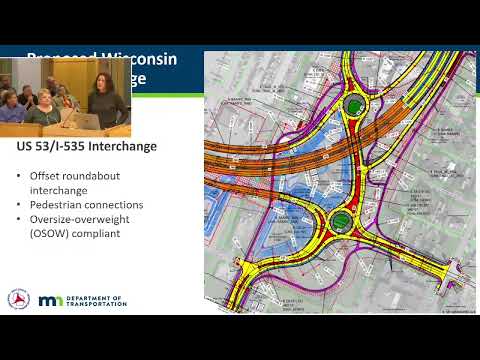
Why this matters: the replacement will require extended closures of the existing structure and reroute regional traffic. The project team is negotiating wetland and Coast Guard permits, adjusting freeway designations on the Wisconsin side and coordinating with the city on sidewalk, lighting and sewer work tied to the interchange redesign.
Traffic mitigation and local work
Project staff outlined corridor-level traffic changes planned before and during the main closure. Stephanie King, a project traffic lead, said contractors will be required to complete a package of local improvements and signal adjustments before the bridge structure is closed.
Planned and proposed measures described to the council include: temporary signals and turn lanes on Winter Street and at Grand and Catland; a left‑turn bay on the Susquehanna ramp under the Bong Bridge; closing some left-turn bays on Belknap (between Banks and Ogden) to increase through-lane capacity; and adding or adjusting signals that will be coordinated and, where appropriate, interconnected with railroad crossing logic so traffic is not trapped on the tracks.
“Winter Street will be signed and set up as a priority alternate east–west corridor,” King said, describing contractor responsibilities before full closure.
Project staff said a package of city road repairs and pre‑works — mill-and-overlay on East Second and other localized concrete repairs — will be completed in 2026 so alternate routes are in better condition when larger detours are used.
Public safety and emergency response planning
Council members pressed the project team on neighborhood cut‑through traffic, speed and emergency response during the closure. Project staff said they have scheduled separate meetings with regional EMS, hospitals and first responders and that a dedicated EMS tabletop is planned “in a week or so” to craft response plans while the bridge is closed.
“We’re going to be working with EMS on a larger regional conversation about what happens during construction,” the project representative said, adding that specific operational plans will emerge after those meetings.
Local concerns and outreach
Several councilors and a downtown business representative asked for more frequent and targeted public outreach. Dave Miller, who identified himself as representing several downtown Superior businesses including Northwest Outlet and Super One, urged the DOT to re-evaluate no‑left‑turn proposals at Belknap and Banks to avoid diverting too much traffic onto Tower Avenue and local streets.
“There's a tremendous amount of traffic that's gonna be flowing through that area,” Miller said during the public comment period and suggested signal adjustments and alternative holding locations to reduce gridlock.
Project staff said they will hold additional public meetings (including an outreach meeting focused on Winter Street in May) and will meet one‑on‑one with downtown businesses in late April to discuss localized adjustments. They also said monthly coordination meetings with city staff will continue through design and construction.
Design, workforce and schedule highlights
- RFP release: November 2025; proposal period November 2025–June 2026. - Contractor mobilization for temporary works: targeted August–September 2026. - Delivery method: design‑build; bidders will score on criteria beyond low bid. - Peak on‑site workforce estimated at about 50 workers during major construction. - Two bridge-type options remain: tied‑arch (lower initial cost, higher long‑term painting/maintenance) and cable‑stay (higher initial cost, lower long‑term painting/maintenance); the final choice will depend on contractor proposals and life‑cycle cost analysis.
Project staff urged residents to consult project web pages, sign up for email updates and use proposed alternate corridors when possible after outreach events begin.
Looking ahead
Council members asked the DOT to return with further details on EMS planning, neighborhood speed mitigation and final signal‑timing strategies as the project moves into procurement and the contractor-driven final-design phase.
The city and state will continue monthly coordination meetings that project staff said will feed contractor specifications and the final phasing plan.