Get Full Government Meeting Transcripts, Videos, & Alerts Forever!
Get email alerts on the Reproductive Health topic
No spam. Unsubscribe anytime.
Committee approves bill on ‘dignity in pregnancy loss’ after heated debate over coroner jurisdiction
Summary
Substitute Senate Bill 1593, addressing dignity in pregnancy loss and the repeal of the crime of concealing birth, was reported out of committee 8–5 after extended debate and several failed amendments seeking to restore or limit coroner and medical examiner jurisdiction.
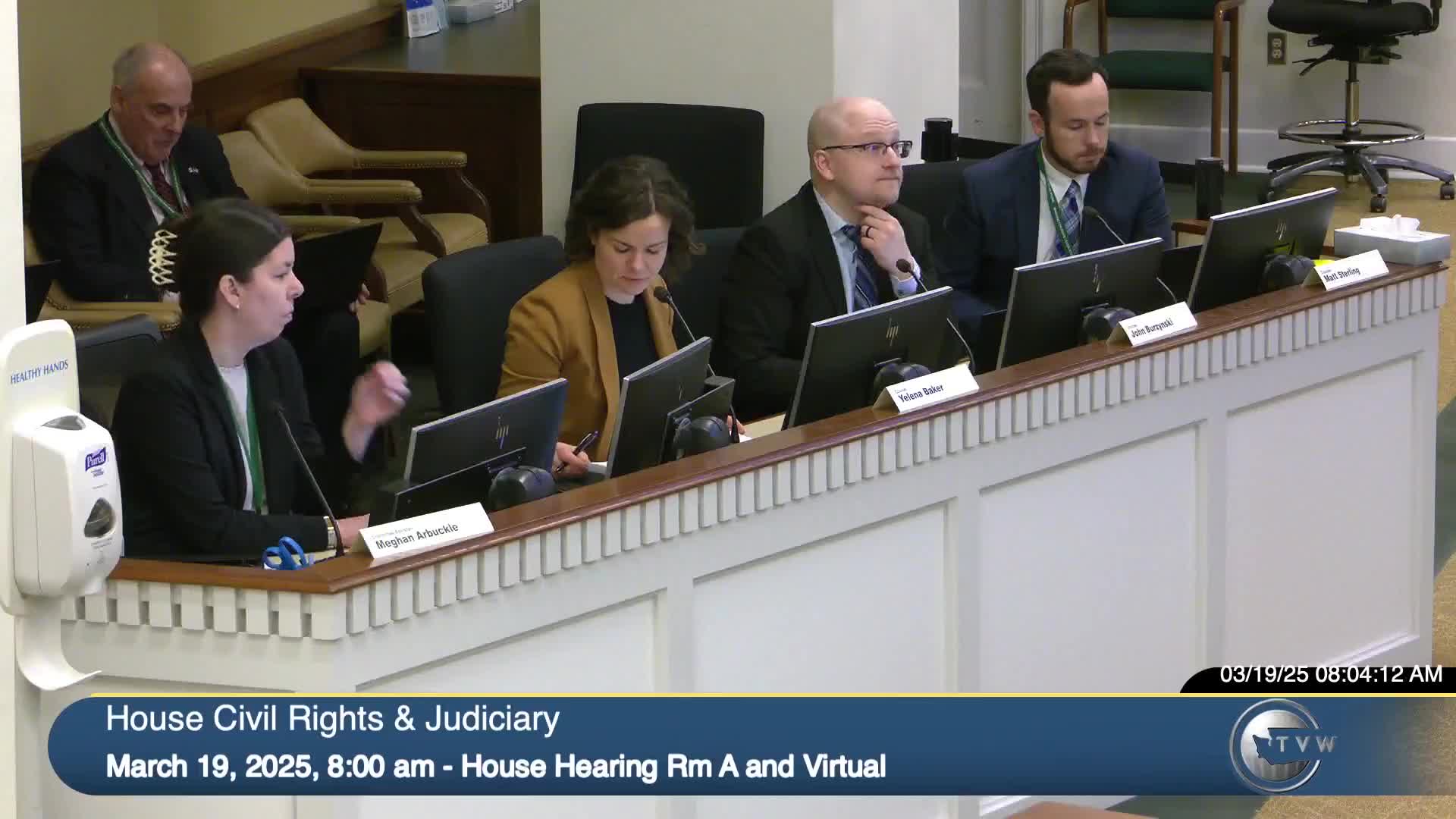
The Civil Rights & Judiciary Committee voted 8–5 on March 19 to report Substitute Senate Bill 1593, titled “dignity in pregnancy loss,” out of committee with a due-pass recommendation after extended debate and multiple unsuccessful amendments.
Committee staff summarized the bill as addressing dignity in cases of stillbirth and pregnancy loss; several members characterized the measure as seeking to repeal an antiquated criminal offense often described in the hearing as the “crime of concealing birth.” Representative Walsh moved several amendments aimed at preserving or clarifying local coroner and medical examiner jurisdiction in certain circumstances. Representative Walsh said the amendments sought “to find a better balance” between public and private interests and described the proposals as attempts to ensure coroners could review cases when there was a reasonable likelihood a fetus would have survived outside the uterus or when there was suspicion that medical treatment was withheld.
Opponents of Walsh’s amendments, including Representative Goodman and others, argued the amendments would reintroduce law-enforcement functions and run counter to the bill’s intent to prevent weaponization of the statute. Goodman said the amendments “run counter to the intent in this bill to repeal the 19 o 9 law about concealing birth” and raised concerns about undefined terms such as “reasonable likelihood” or “reasonable suspicion.” Multiple amendments (Bakke 437, Bakke 438, Bakke 439, AKI 440, and Bakke 441) were moved and each failed on voice or recorded votes.
The committee heard several extended floor statements. Representative Jacobson explained a personal perspective, saying that after a stillbirth her family benefited from a coroner review and she urged preserving avenues for families to understand cause of death. Representative Burnett and Representative Graham voiced concerns about removing local authority to investigate suspicious deaths and warned about hampering death investigations in nonmedical settings.
During amendment votes and final passage, members used the recorded roll call format. The roll call for final passage recorded the following positions (excerpted): Chair Taylor—aye; Representative Farvar—aye; Representative Walsh—nay (do not pass); Representative Abel—nay (do not pass); Representative Burnett—nay (do not pass); Representative Entenmann—aye; Representative Goodman—aye; Representative Graham—nay (do not pass); Representative Jacobson—nay (do not pass); Representative Peterson—aye; Representative Salahuddin—aye; Representative Tai—aye; Representative Wallen—aye. Staff announced a final tally of 8 ayes and 5 nays, and SB 1593 was reported out of committee with a due-pass recommendation.
The transcript shows the most contested issues were (1) whether repealing the offense known in the hearing as “concealing birth” would remove a prosecutorial tool, (2) how to define the circumstances in which a coroner or medical examiner would retain jurisdiction, and (3) concerns that unspecified language such as “reasonable likelihood” or “reasonable suspicion” could invite inconsistent application or law-enforcement involvement. Several members called for narrower language; several amendments sought to permit coroner review only to determine cause of death and expressly barred using autopsy findings as evidence for criminal prosecution. Those narrower amendments also failed.
No committee amendment to the bill was adopted during the hearing. The committee advanced the underlying bill as presented to the committee, reporting it out with a due-pass recommendation.