Get Full Government Meeting Transcripts, Videos, & Alerts Forever!
Get email alerts on the Yakima Basin Integrated Plan topic
No spam. Unsubscribe anytime.
Lawmakers hear mixed reactions to Yakima Basin milestone extension, dispute over interest payment to trust account
Summary
Engrossed Second Substitute Senate Bill 5303 would extend Yakima Basin Integrated Plan water‑supply milestones 10 years and change the state treasurer and cost‑estimate requirements; opponents object to removing an interest payment tied to the Taneum Community Forest loan.
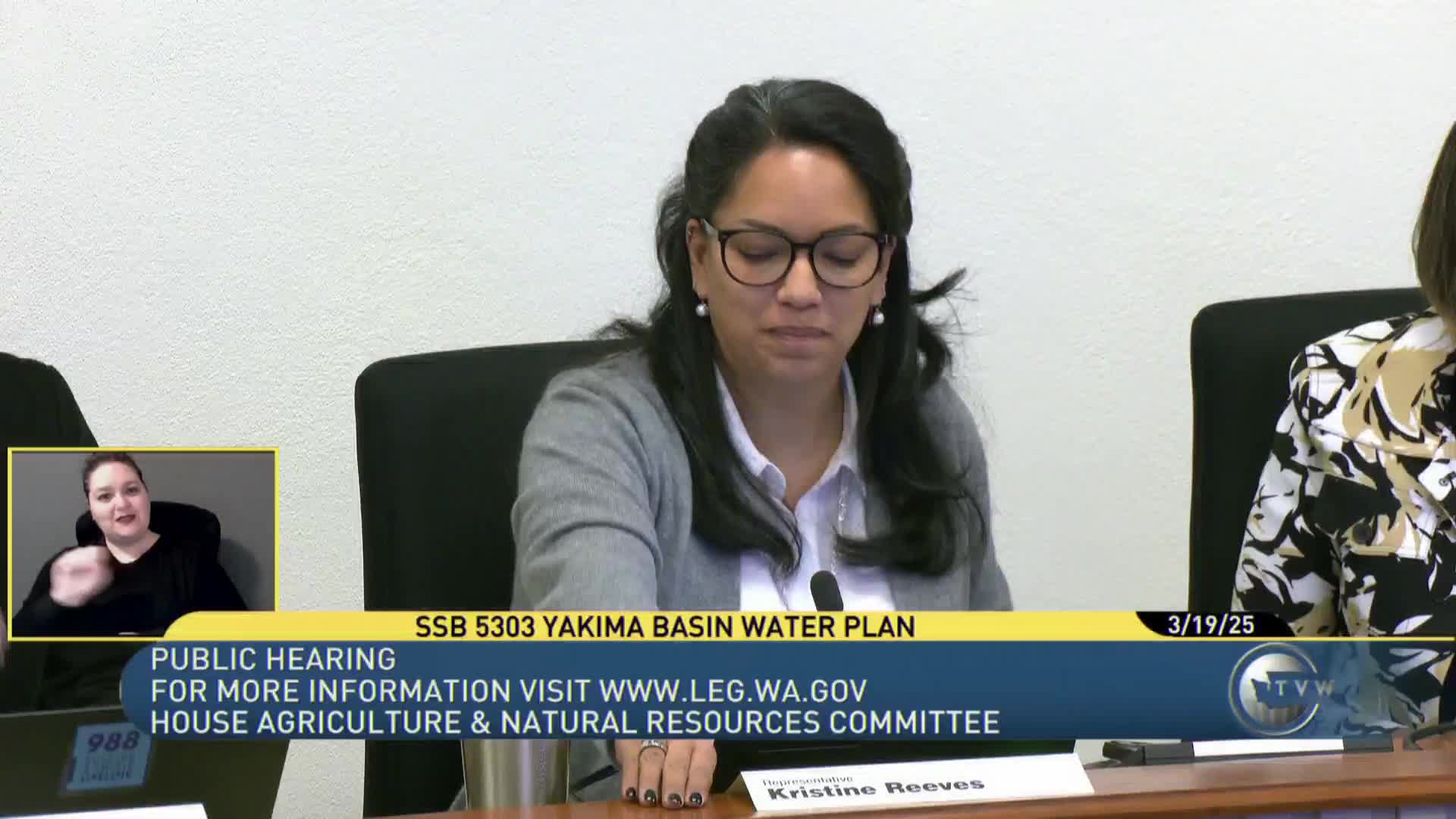
The House Agriculture and Natural Resources Committee on March 19 heard hours of testimony on Engrossed Second Substitute Senate Bill 5303, a bill that would extend milestone deadlines in the Yakima Basin Integrated Plan and change certain financing and reporting requirements.
Lily Smith, committee staff, summarized the proposal as extending the water‑supply permit and funding milestones tied to the Yakima plan by 10 years, ending an interest payment this year on a loan used in the Taneum Community Forest land purchase, and clarifying that the Department of Ecology has lead responsibility for updating cost estimates and financing plans. Smith told members a cost‑benefit analysis requirement for projects above $100 million would also be extended.
Sponsor Sen. Judy Warnick (13th Legislative District) framed the bill as a pragmatic step to keep the collaborative Yakima Basin Integrated Plan moving. She and several panelists said the plan is a long‑running, multi‑party effort among irrigators, the Department of Ecology, tribes and conservation groups that has secured federal authorizations and funding commitments.
Supporters — including Brandon Parsons of American Rivers, Yakima County Commissioner Amanda McKinney, and Urban Eberhardt of Kittitas Reclamation District — emphasized ongoing work on storage projects such as the Cle Elum Pool Raise and the Springwood Ranch proposal and said permitting and feasibility studies require more time. Parsons noted federal cost‑share and said conservation groups and partners have invested in property acquisitions to support storage and habitat goals.
DNR staff and conservation groups sharply contested a floor amendment that would eliminate the state’s ongoing interest payment on the $10 million loan taken from the Real Property Replacement Account to acquire the Taneum property. Duane (Dwayne) Emmons of the Department of Natural Resources said canceling the interest payment raised a trust‑fiduciary issue: “Article XVI requires that a trust asset be fully compensated for the asset in order to be used,” he told the committee, framing ongoing interest as part of DNR’s trust duty. Larry Mattson, director of the Office of Columbia River at Ecology, told members Ecology’s 2022 report showed the current milestone was unlikely to be met by 2025 and that additional time is necessary because storage projects have proven costly and complex.
Opponents, including conservation groups and local citizens, called the change a “poison pill” that ties the community‑forest designation for the Taneum property to completion of the Yakima milestones and risks the common‑school trust fund’s compensation. Rick McGuire of the Alpine Lakes Protection Society and Chris Maycutt of Friends of Bumping Lake urged repeal of the statutory provision that would convert the land if milestones are not met, and cited prior independent benefit‑cost work that found some proposed storage projects have low benefit‑cost ratios.
Committee members pressed agency staff on details including the source and accounting of the interest payments; DNR answered that the legislature has funded the interest payments in the operating budget and that the loan remains interest‑only to date. Members asked whether federal partners remain committed; witnesses said the project retains federal authorizations and congressional appropriations lines and that federal agencies continue to support the plan, though federal funding availability remains uncertain.
No formal committee action or vote was taken on SB 5303 at the March 19 hearing. Committee members asked for follow‑up materials on the loan accounting and federal budget commitments and signaled additional review of the amendment that cancels the interest payment to the Taneum purchase loan.