Get Full Government Meeting Transcripts, Videos, & Alerts Forever!
Get email alerts on the Claims Bill topic
No spam. Unsubscribe anytime.
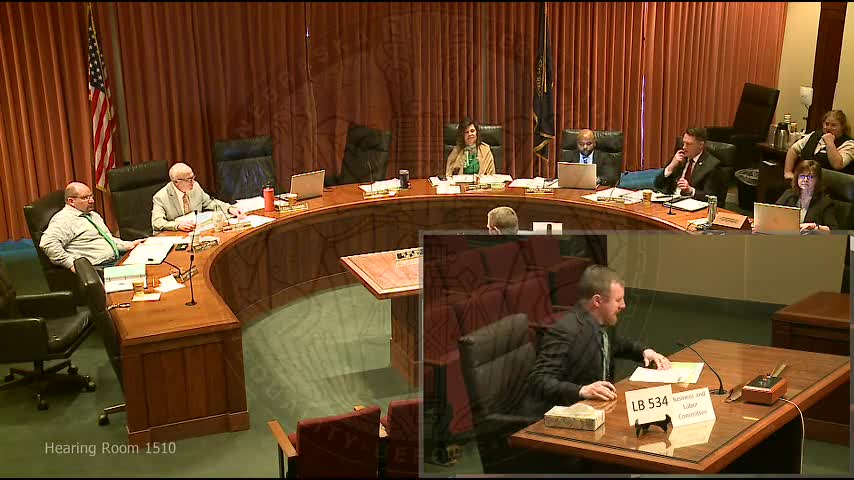
Business and Labor Committee hears annual claims bill asking Legislature to approve state settlements and write‑offs
Summary
LB534 (claims bill) compiles settlements and agency write‑offs requiring legislative appropriation or review, including tort settlements, workers' compensation settlements and agency debt write‑offs; the Department of Administrative Services and Attorney General outlined claims, and agencies explained uncollectible debt categories.
The Business and Labor Committee heard LB534, the Legislature’s annual claims bill, which requests legislative review and appropriation for several settlements and agency debt write‑offs arising from tort, workers' compensation and miscellaneous claims against the state.
Thomas Helget, legal counsel to the committee, and Sarah Skinner, interim state risk manager, explained the claims process: tort and miscellaneous claims follow administrative filing and agency investigation, and settlements above statutory thresholds require state‑level review and, where necessary, legislative appropriation. The bill aggregates claims that exceed the statutory review threshold and includes multiple categories: indemnification settlements (employment discrimination and federal civil suits), workers' compensation settlements already approved by the Workers' Compensation Court, automobile‑related tort settlements to be paid from the State Insurance Fund, and a set of agency debt write‑offs (debts agencies have pursued but determined uncollectible).
Attorney General staff summarized the higher‑value settlements in LB534. Examples included three indemnification settlements for employee‑related claims (total settlements cited as $135,000; $212,500; and $235,000 with portions previously paid and the remaining amounts submitted for appropriation). Several workers' compensation settlements were listed with totals and amounts previously paid; examples included settlements with total amounts of $375,000, $275,000 and $315,000 with remaining balances submitted for legislative review. Tort claims arising from automobile accidents were aggregated; one high‑value motor vehicle tort settlement involving a Nebraska state patrol trooper was reported as $1,000,000 (the state expected $400,000 reimbursement from the state's excess automobile insurance carrier, reducing net state cost to $600,000 after reimbursement). A vehicular‑pursuit claim was settled for $428,000 with $53,500 previously paid and the remaining amount submitted for review.
A number of state agencies requested statutory authority to write off uncollectible debts. Department of Health and Human Services requested write‑off of approximately $1.424 million in debts across multiple programs (largely due to statute‑of‑limitations expirations, bankruptcies and debtors who are deceased or out of business). Department of Motor Vehicles requested write‑off for international registration plan fees totaling $14,296.88 for accounts tied to carriers that ceased operations. Department of Transportation requested write‑off of approximately $120,741.50 for damage claims to state property deemed uncollectible after collection attempts. The Department of Labor sought write‑off of approximately $90,339.82 in unemployment overpayments discharged in bankruptcy; Nebraska Public Employees Retirement Systems sought write‑off of $49,591.34 for retirement overpayments to deceased members or incorrect refunds that could not be collected.
Nebraska Press Advertising Service explained a $348,654.28 claim to cover constitutionally required publication costs for six ballot measures in the prior election cycle; the service compiled tear sheets and affidavits from 141 legal newspapers and delivered the proof of publication to the Secretary of State.
Committee members asked about timing and reimbursement: the Attorney General stated many settlements require legislative approval before final disbursement; the $1,000,000 tort payment included expected reimbursement from an excess carrier after the state paid the settlement. Members asked about statutes of limitation and why older claims (including 1983 civil‑rights claims) appear; counsel answered that limitation periods vary by claim type and some older claims still reach settlement.
No committee vote was held; the hearing compiled the claims for further committee and floor consideration. The chair noted additional claims would be submitted by the statutory sixtieth day (April 11) and the committee anticipated an amendment and a supplemental hearing to include any later settlements.