Get Full Government Meeting Transcripts, Videos, & Alerts Forever!
Get email alerts on the Paid Family Medical Leave topic
No spam. Unsubscribe anytime.
Senator Cavanaugh introduces voluntary paid family and medical leave plan for Nebraska
Summary
Sen. Cavanaugh introduced LB189 to create a voluntary Paid Family and Medical Leave program administered by the Department of Labor. The bill would let employees opt in via payroll contributions, allow employers to opt in voluntarily, seed start‑up costs from the health care cash fund and provide partial wage replacement for qualifying events.
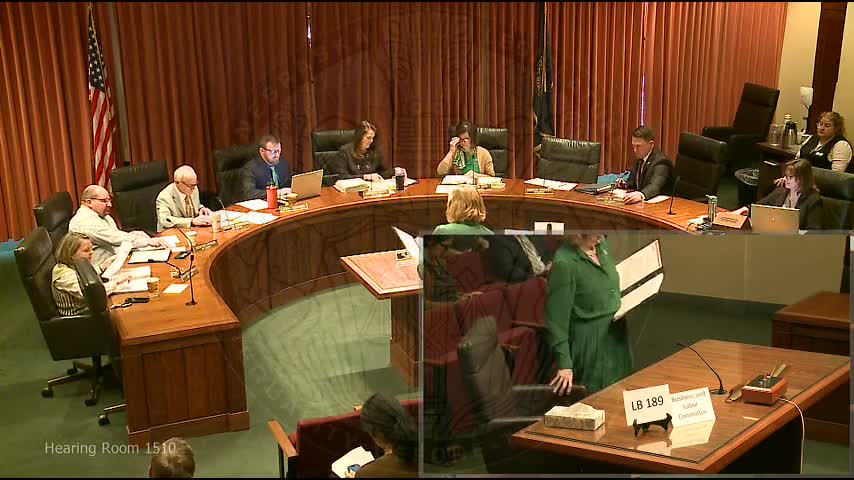
Senator Mikaela Cavanaugh introduced LB189 to the Business and Labor Committee, proposing a statewide paid family and medical leave program administered by the Nebraska Department of Labor.
The bill would create a voluntary insurance‑style program funded primarily through employee payroll contributions, with employers allowed (but not required) to contribute. Participating workers could receive partial wage replacement for qualifying events such as their own serious illness, caring for a family member, birth or placement of a child, and certain military exigencies. Cavanaugh told the committee the program would be “100% voluntary” for employers and employees and modeled administratively on state unemployment insurance systems.
The proposal includes a one‑week waiting period and would allow up to 12 weeks of leave for full‑time or intermittent qualifying events. Benefits are calculated as a percentage of a worker’s average weekly wage compared with the state average weekly wage: wages at or below the state average (cited by the introducer as $671) would be reimbursed at roughly 90%; wages above that threshold would receive a smaller percentage (discussed as approximately 50% in committee exchange). Cavanaugh said erroneously paid benefits could be reclaimed or offset from future payments and that a covered individual who presents false statements would be disqualified for one year.
Administration and costs: the Department of Labor would administer the program and the Commissioner of Labor would promulgate rules, forms and complaint processes. The bill proposes a one‑time transfer of $5.5 million from the health care cash fund to seed the paid leave fund; that cash advance would be repaid by the fund if and when reserves permit. The department’s fiscal assumptions included an estimate that 10% of the covered workforce would apply for benefits in the early years (approximately 99,706 applicants and 84,750 approved under that assumption), producing estimated annual benefit payments of about $385 million and requiring an initial operations staffing level the department estimated at 32 FTEs. Cavanaugh and committee members discussed that the Department of Labor’s cost and staffing estimates assume the fund will be self‑sustaining once premiums are collected.
Supporters who testified said the bill would reduce economic hardship for families and improve workforce retention. Justin Hubley of the Nebraska Association of Public Employees (AFSCME Local 61) said state employees frequently contact the union about family leave struggles and endorsed the state‑run approach as one that would serve employees who have not banked paid time off. Anahi Salazar of Voices for Children emphasized child and maternal health benefits, and Erin Feichtinger of Women’s Fund of Omaha highlighted evidence linking paid leave to improved employment retention and lower reliance on public assistance. Ken Smith of Nebraska Appleseed and other proponents stressed that most Nebraska workers currently lack paid family leave and that the payroll‑deduction financing model is commonly used in other states.
Committee questions focused on eligibility and scope. Members pressed whether the bill copies federal FMLA eligibility rules (12 months’ employment and 1,250 hours in the prior 12 months) and whether the federal employer‑size threshold (50 employees in a 75‑mile radius) would affect participation; Cavanaugh said she intended to align definitions with the federal law but acknowledged the bill could be clarified by amendment. Senators also asked why employers would voluntarily contribute if employees could draw benefits funded by employee contributions; proponents replied employers view paid leave as a recruitment and retention tool and some Nebraska employers already offer paid leave voluntarily.
Several senators asked about program risk if claims exceeded fund reserves. Cavanaugh said the proposal follows a FIFO claims payment model and that, if the fund were exhausted, there would be no automatic additional state general fund obligation; the startup loan is intended to bridge early costs and be repaid by the fund. Committee members asked for a list of other states with paid‑leave laws and distinctions between mandatory programs and this voluntary design; the committee was told a number of states and D.C. have enacted paid leave programs (later enumerated by a witness as California, Colorado, Connecticut, Delaware, Maine, Maryland, Massachusetts, Minnesota, New Jersey, New York, Oregon, Rhode Island, Washington and D.C.).
The hearing record included 29 proponents, 12 opponents and one neutral position filed online for LB189, according to the introducer’s statement to the committee. No formal committee vote on LB189 occurred at the hearing; the bill advanced to a public hearing and question period.
Why it matters: supporters told the committee the bill would help workers avoid choosing between wages and caregiving at times of serious health or family need, reduce turnover costs for employers, and improve child and maternal health outcomes. Opponents and skeptical senators raised questions about employer incentives under a voluntary model, the scope of state exposure if claims rise quickly, and whether the bill should instead require or allow different eligibility rules than federal FMLA.
The committee did not adopt amendments during the hearing. The bill remains under committee consideration for future amendment and potential subsequent fiscal analysis.