Get AI Briefings, Transcripts & Alerts on Local & National Government Meetings — Forever.
Committee hears competing views on brine minerals, lithium extraction and property rights; bill left pending
Loading...
Summary
Senate Bill 17 63 would declare ownership rules for minerals recovered from brine (including lithium) and aims to provide legal certainty to encourage investment; committee testimony showed strong disagreement among property-rights advocates, mineral owners and industry representatives, and the bill was left pending.
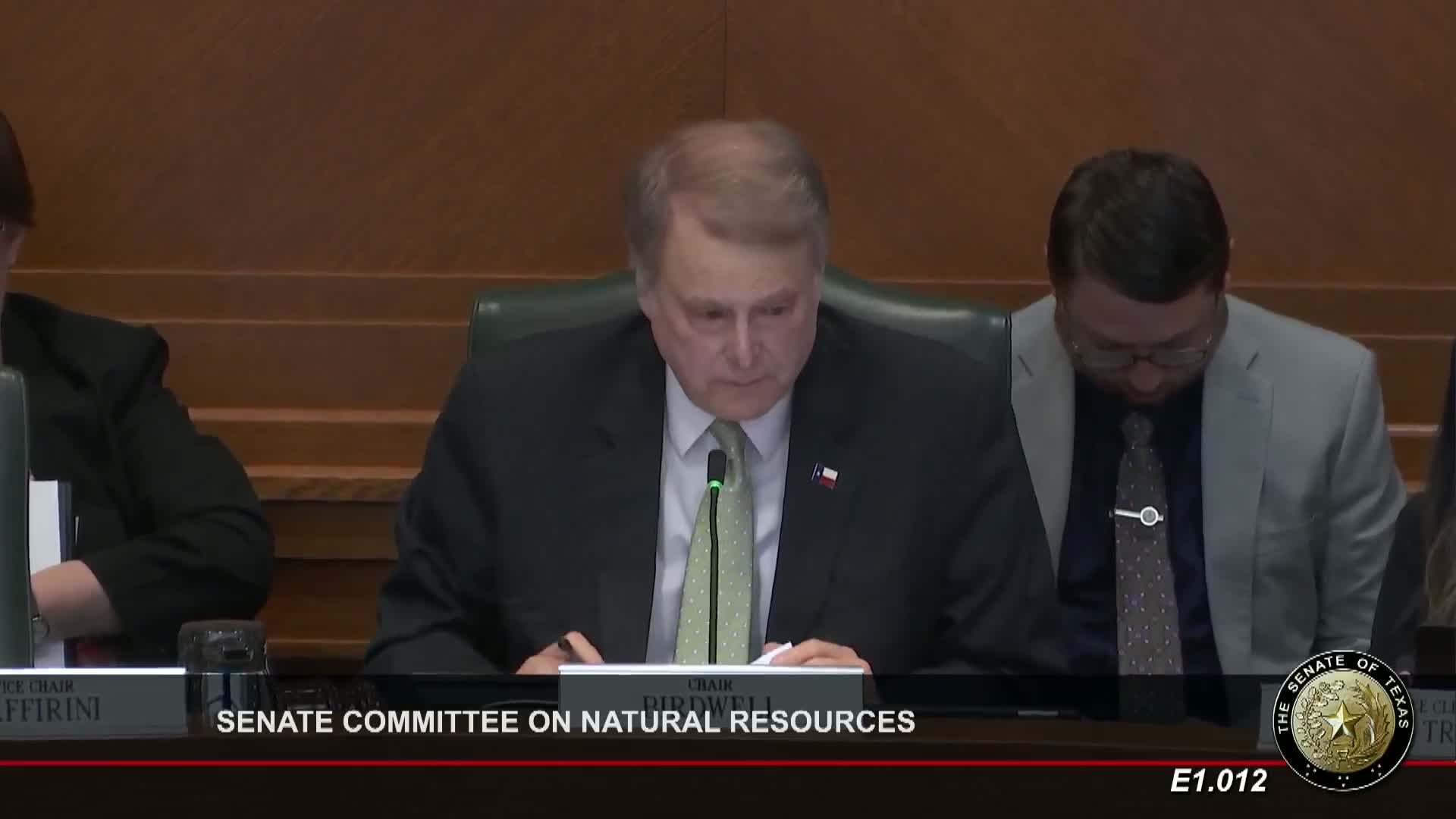
Senate Bill 17 63, presented by Sen. Hughes, would address ownership and regulatory clarity for minerals contained in brine (saline subsurface fluids) such as lithium and bromine. Committee testimony revealed sharply divided views among landowners, ranching interests, mineral-rights organizations and industry lawyers. The committee left the bill pending to allow time for stakeholders and to await potential guidance from ongoing litigation.
Hughes said the bill aims to provide legal assurance to stakeholders so that investment and production decisions can proceed: "The intent of this bill is that all the stakeholders have the necessary legal assurances so they can move forward." He highlighted the strategic and economic importance of lithium and other minerals found in the Smackover formation.
Opponents told the committee the proposal risks undermining established groundwater ownership and surface-owner rights. Arthur Ruhl of the Texas and Southwestern Cattle Raisers Association testified the bill "conflicts with the legal rule in Texas that the land owner owns the groundwater," and cited Texas Water Code Section 36.002 as codifying that rule. The Texas Land and Mineral Owners Association (Jennifer Owen) urged the committee to pause the bill, noting that the Texas Supreme Court was hearing the Cactus Water case addressing ownership of produced water; she said passing statute now could add confusion and lead to litigation.
Supporters said the draft offers clarity that would unlock investment. James Carroll, a board-certified oil and gas attorney, said the bill focuses on ownership of the minerals found "in solution" and that clarifying ownership would help companies and landowners negotiate leases: "There is a for clarity on who owns these minerals that are in solution. It's not so much about the the water itself ... It is about the minerals themselves where they exist that are trying to be extracted." He and other supporters described the brine occurrence as deep (the transcript referenced depths around 9,700 feet) and saline (testimony described brine salinities up to roughly 30-40% versus about 3% for ocean water), arguing these fluids are distinct from typical groundwater and historically were treated as minerals in other jurisdictions.
Multiple witnesses raised drafting, constitutional and takings concerns, the potential for overlapping claims and the risk of litigation. The committee heard also from landowner Paul Hale, who described mixed surface/mineral ownership on his properties and warned about surface impacts from repeated extraction operations. Charles Maley of the South Texans Property Rights Association urged deference to private property rights and urged the committee to wait. The committee left the bill pending while stakeholders await the Texas Supreme Court's ruling in the Cactus Water case and continue to refine statutory language.
Clarifying details heard in committee: witnesses discussed differences between produced water and independently targeted brine units, the role of the Railroad Commission's recent brine-mining regulations, and that the bill as drafted excluded "groundwater, fluid oil and gas waste, and produced water" from the definition of brine but raised concerns that other clauses could be read to include groundwater or produced water. Supporters argued that treating minerals extracted from deep brine as part of the mineral estate would allow established oil-and-gas leasing and royalty frameworks to apply.