Get Full Government Meeting Transcripts, Videos, & Alerts Forever!
Get email alerts on the Probate Estates topic
No spam. Unsubscribe anytime.
Bill would require qualified delivery of original wills and other probate clarifications; probate practitioners back measure
Summary
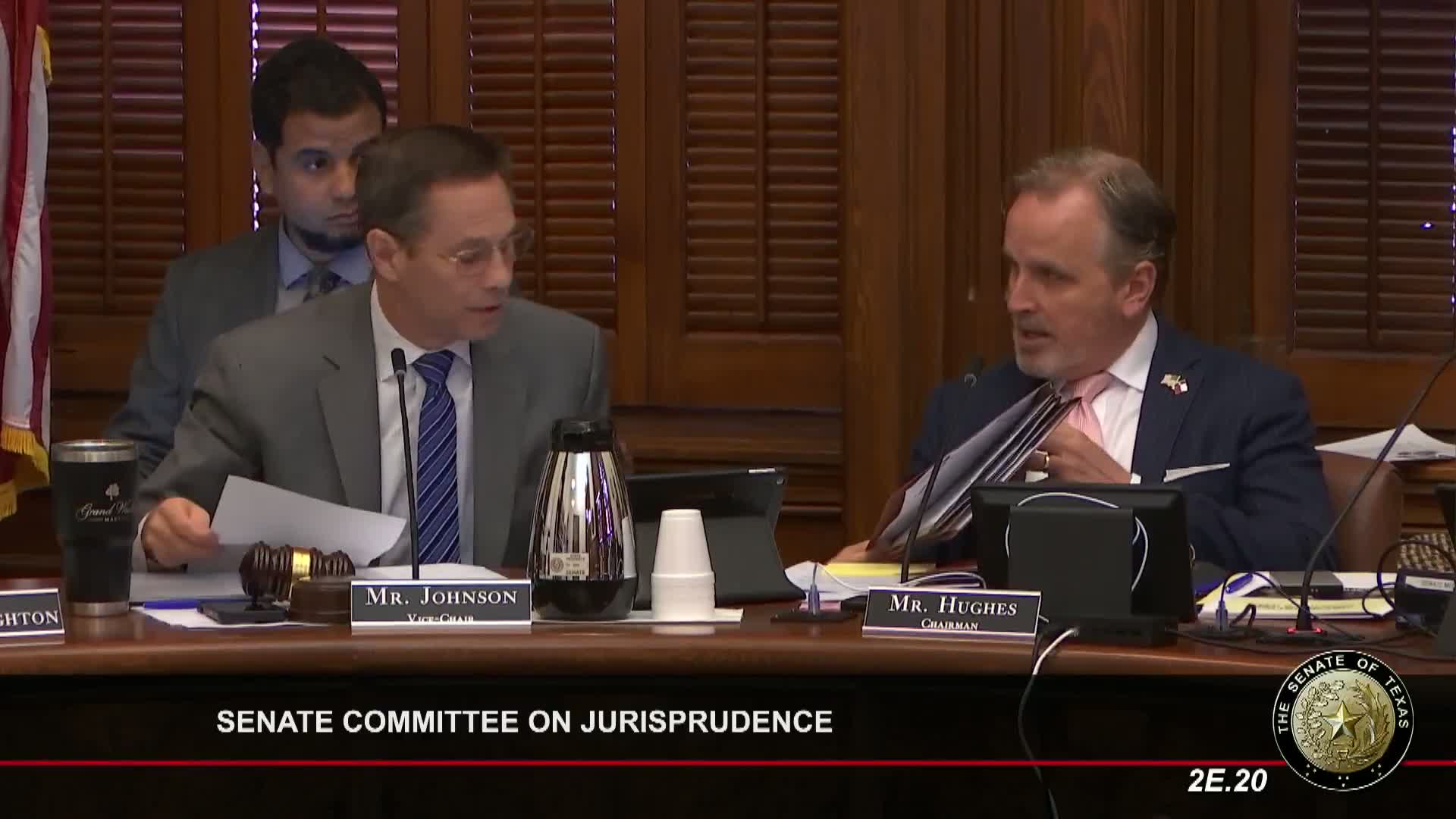
Senate Bill 1448 would require that original wills be transferred by a qualified delivery method in court-to-court transfers and makes other clarifying changes to the Estates Code. The Texas Real Estate and Probate Institute testified in support and the committee left the bill pending.
Senate Bill 1448, introduced by Senator Hughes, would amend probate procedures to require that original wills be transferred using the Estates Code’s definition of a “qualified delivery method” when a probate file moves between courts and make other clarifying edits to recent probate reforms.
Senator Hughes told the committee the 2023 legislation that authorized electronic transfer of probate documents inadvertently omitted provisions guaranteeing transfer of original paper wills. SB 1448 would require the physical transfer of the original will by a qualified delivery method and require courts to deliver electronic copies of orders in statutory probate courts, which were omitted from last session’s list, according to the bill author and witnesses.
Meredith MacIver, an estate-planning and probate attorney with the Texas Real Estate and Probate Institute (TREP), testified in support. MacIver told the committee SB 1448 clarifies several points from the 2023 session: transferring original wills by qualified delivery (with transfer costs paid by the requesting party), treating certain paper copies of wills the same as originals when originals cannot be produced in court, and adding statutory probate courts to courts required to provide electronic delivery of orders. She said the bill also cleans up residual references to community debts and clarifies procedural items such as proof of service and deadlines for notifying heirs about temporary administrators.
Committee members asked no substantive questions; public testimony closed and the bill remains pending.