Get Full Government Meeting Transcripts, Videos, & Alerts Forever!
Get email alerts on the Facility Segregation Restrooms topic
No spam. Unsubscribe anytime.
Committee advances bill to require sex-segregated facilities in certain institutions; transgender witness urges rejection
Summary
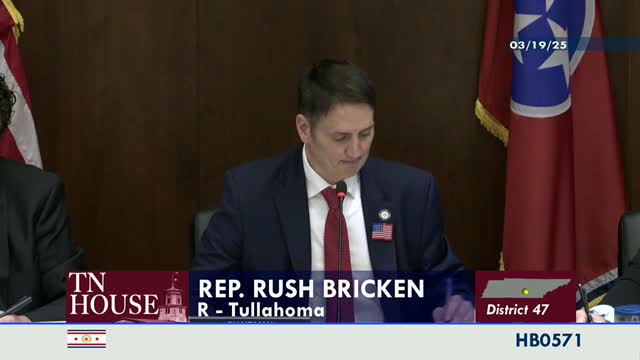
The Civil Justice Subcommittee voted 6-1 to advance House Bill 571, as amended (drafting code 4451), which would require sex-segregated changing areas, showering facilities and restrooms in specified facilities.
The Civil Justice Subcommittee added amendment 4451 and voted 6-1 to send House Bill 571 to the full judiciary committee.
Representative Bolson, carrying the House measure for Senator Janice Bolling, told the committee HB 571 "requires, facilities, in 4 different categories to segregate changing areas, showering facilities, restrooms by [biological sex]." The four categories specified in committee discussion were domestic violence centers, public schools, correctional institutions and juvenile detention facilities. The bill includes exceptions for emergencies and family circumstances.
Elliot Certain, who identified as a transgender Tennessean, testified in opposition. "This bill is not about safety. It is about exclusion," Certain said, urging the committee to reject the measure. He argued the bill would "singl[e] out transgender and non-binary individuals for discrimination" and increase policing of how people look and present. Certain cited national statistics and academic sources: he told the committee that transgender people face higher rates of intimate-partner and violent victimization, and said, "Transgender people experienced 86.2 victimizations per a thousand people, whereas cisgender people experienced 21.7 victimizations per a thousand people," referencing figures from the Williams Institute that he cited in testimony.
Members debated the intent and scope of the bill and heard public testimony before moving the previous question and advancing the bill. The clerk recorded six ayes and one no on the voice-to-record vote; HB 571 now goes to full judiciary as amended.
The committee discussion focused on privacy and safety in facilities serving women and girls and on whether the bill's biological-sex segregation approach would create harms, particularly for transgender people and cisgender women who do not conform to traditional appearance norms.