Get Full Government Meeting Transcripts, Videos, & Alerts Forever!
Get email alerts on the Substance Use Treatment topic
No spam. Unsubscribe anytime.
Panel approves bill letting qualified midlevel prescribers give buprenorphine in correctional settings under limits
Summary
House Bill 1239 would permit nurse practitioners and physician assistants employed by or contracting with correctional facilities to prescribe buprenorphine for opioid use disorder under defined supervision and dosing limits; committee advanced the bill 7-0.
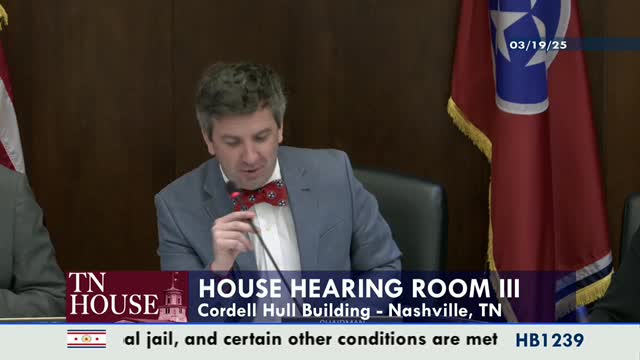
House Bill 1239, introduced by Representative Hilton Haynes, would allow certain midlevel practitioners working for state correctional facilities or county and municipal jails to prescribe buprenorphine products for treatment of opioid use disorder to patients treated through the facility, subject to supervision, chart‑review and dosing limits. The subcommittee voted 7-0 to advance the bill to the full Health Committee.
Haynes told the committee the bill "creates an exception for mid level providers to be able to prescribe buprenorphine products for the treatment of opioid use disorder in correctional facilities." The legislation requires the prescribers to be employed by or contracted with the correctional facility, to be supervised by or collaborate with a physician who reviews 100% of patient charts for those prescribed buprenorphine, and caps physician oversight to a maximum of five licensed nurse practitioners or physician assistants.
Other requirements included in committee testimony: the prescribers must adopt clinical protocols for initiating or continuing medication‑assisted treatment for incarcerated persons and persons being released; providers cannot have had limitations or conditions on their license in the prior three years; prescriptions may not exceed a 16‑milligram daily buprenorphine equivalent; prescribers must hold an active DEA registration. The sponsor said an amendment removed a requirement that the prescriber enter data into the controlled substance monitoring database (CSMD), noting that correctional prescribers may lack access and pharmacies already submit dispensing data.
The clerk recorded 7 ayes, 0 nays; the chair declared the bill "moves on to health full."