Get Full Government Meeting Transcripts, Videos, & Alerts Forever!
Get email alerts on the Department Of Health Budget topic
No spam. Unsubscribe anytime.
Tennessee Department of Health requests new funding for dental pipeline, cancer screening and rural grants
Summary
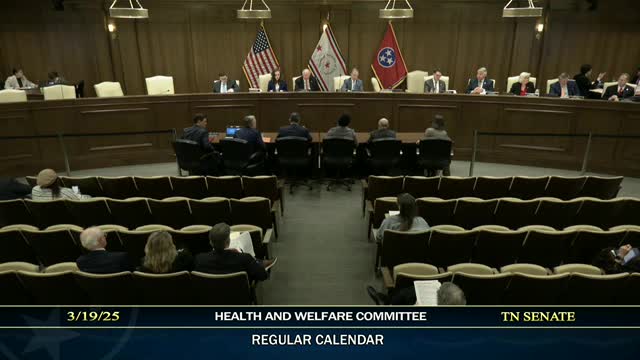
Commissioner Ralph Alvarado presented the Tennessee Department of Health budget and a package of 11 cost increases to the Senate Health and Welfare Committee, seeking new nonrecurring and recurring funds for dental training, expanded cancer screening, syphilis testing automation, nursing-facility grants and other rural health programs.
Commissioner Ralph Alvarado presented the Tennessee Department of Health budget and a package of 11 cost increases to the Senate Health and Welfare Committee, saying the proposals aim to expand dental training and access, add lung and colorectal cancer screening for eligible patients, and support rural health grants.
"We have, a total of 11, cost increases for the upcoming budget year," Alvarado told the committee as he opened the department presentation. He called the dental pilot and other rural investments "working" initiatives and described measurable expansion in dental education and services.
Alvarado outlined the largest requests first. The department seeks $24,200,000 in nonrecurring state funds for the fourth year of a Healthy Smiles dental pilot designed to expand dental class sizes and clinical rotations into rural and underserved areas. A separate nonrecurring request of $33,375,000 would continue a Lincoln Memorial University (LMU) educational dental safety-net grant that has grown LMU's class to 80 students and funds rotations and operational costs.
Other notable requests include $2,200,000 in recurring funds to add lung and colorectal screening reimbursements for eligible patients (the department estimates this would reach roughly 7,000 Tennesseans annually), $2,600,000 in nonrecurring funds tied to the JUUL settlement for youth vaping prevention, and $500,000 to automate syphilis testing as the department handles an annual increase in tests (64,500 in FY22 and 72,300 in FY23).
Alvarado also described a request to use $50,000,000 in TennCare shared savings to fund competitive nursing-facility grants aimed at workforce development, infrastructure, and capacity improvements for rural facilities. He said the nursing-facility program will be run through a competitive process similar to the earlier ARPA-funded Healthcare Resiliency Program (HRP) and noted prior rounds drew far more applications than available dollars.
The department proposed continuing several rural health initiatives funded from shared savings: a center of excellence (COE) to provide technical assistance to rural communities, planning and implementation grants tied to the COE, an eConsult specialty-care platform and incentives, and rural health training programs (rotations, fellowships, residencies) to increase provider retention in underserved areas. A separate $83,000 request, funded from board fees, supports pharmacy board licensure of ambulatory surgical treatment centers under Public Chapter 714.
Committee members pressed the department on program mechanics. Senator Reeves asked whether the $50 million nursing-facility grants would be distributed competitively; department staff said the program has typically used a competitive grant rubric and that applications historically undersubscribed available awards in some rounds. Reeves asked whether an association applying on behalf of multiple facilities would jeopardize federal match; staff and Senator Watson agreed that such a structure likely would not qualify for federal match.
Committee members also raised questions about weight-loss drugs (GLP-1 class), and Deputy Commissioner John Webb and Chief Medical Officer Tim Jones discussed clinical uses, side effects and the barrier posed by cost and insurance coverage.
Alvarado emphasized the wide scope of services the department provides, noting Tennessee is the only state that operates primary care services directly in local health departments and listing immunizations, WIC, STD/HIV programs, environmental health, maternal-child health, emergency preparedness, and the state lab among its duties.
The committee approved the Department of Health budget by roll call (9 ayes). The budget will move to the next step in the legislative calendar.