Get Full Government Meeting Transcripts, Videos, & Alerts Forever!
Get email alerts on the Professional Conduct topic
No spam. Unsubscribe anytime.
Committee advances bill allowing private peer‑assistance for self‑reporting physicians
Summary
House Bill 1203 would let physicians who self-report substance abuse be evaluated in executive session and assigned to peer assistance programs; the subcommittee approved the bill 7-0 to advance to full committee.
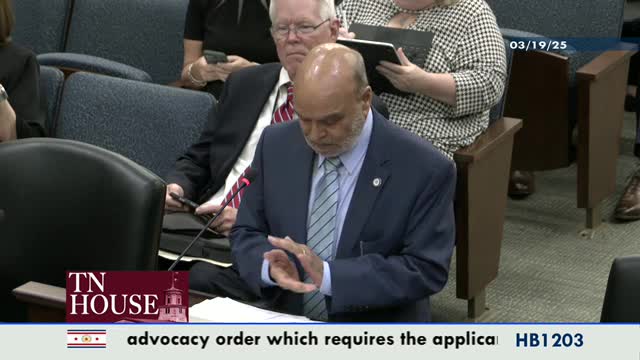
House Bill 1203, carried by Chairman Kumar, would provide a pathway for physicians who self‑report substance use issues to be interviewed in a private executive session by the licensing board and, in lieu of immediate disciplinary action, assigned to a peer assistance program that monitors clinical competence and ethics. If the physician complies with monitoring and program requirements, they may continue to practice under their license; failure to comply may trigger disciplinary action and conversion of previously private records to public records and reporting to the National Practitioner Data Bank.
Kumar described the bill as addressing "a physician who is self reporting about substance abuse" and emphasized an approach that favors remediation when no patient harm has occurred. He said the board "may choose to assign them to a peer assistance program in which they will be closely monitored as to their competence, their ethics, and the professional work that they do. And if they agree to do that, they can continue to practice under the license issued by the board." He added that failure to comply would allow disciplinary processes to proceed and records to become public.
Dr. Reeves Johnson of the Tennessee Medical Foundation appeared with the sponsor and was acknowledged to answer questions. Representative McKenzie praised the bill as a compassionate approach to clinicians experiencing personal crises, noting that recovery is a long‑term process and that allowing monitored return to practice avoids a permanent "scarlet letter." Representative Mitchell thanked Dr. Johnson for his participation and information provided to the committee.
The committee recorded 7 ayes, 0 nays; the chair declared the bill "moves on to health full."